Why We Write
For many people, one of the primary functions of the poem is to reaffirm a sense of wholeness, to restore. It’s a way of seeing the bigger picture, or at least to gain some semblance of objectivity about our experience. Is this why I write poetry? To say that I do it as a form of self-care seems true enough, but that would be to isolate it from its other parts. Poet and essayist Reginald Shepard cited a variety of reasons for his writing habit from the observation that, “I write because I would like to live forever” to the call to “never forget beauty, however strange or difficult.” (Orpheus in the Bronx, by Reginald Shepard, University of Michigan Press, 2007). In her poem, “Why I Write Poetry,” Leah Kindler offers that one of her reasons is “Because I could say my friend’s exes live in a swamp in my heart/ and no one would ask what it means” (from Respect the Mic: Celebrating 20 Years of Poetry from a Chicagoland High School, Penguin, 2022). In the coming weeks I’ll be looking at some of the reasons we read and write poetry and how it can serve as what Robert Duncan called an x-ray of the psyche.
One Bright Pearl
A new poem, “One Bright Pearl,” will appear in an upcoming issue of Braided Way Magazine. It was inspired by an observation of 9th century Zen master Xuansha Shibei, “In all the ten directions, the whole world is one bright pearl.” A publication of the non-profit Spiritual Quest Foundation, Braided Way aims “to cultivate and nurture people to become open and accepting of different spiritual perspectives and practices…” www.braidedway.org
Exploring Suisun Marsh
and Grizzly Island
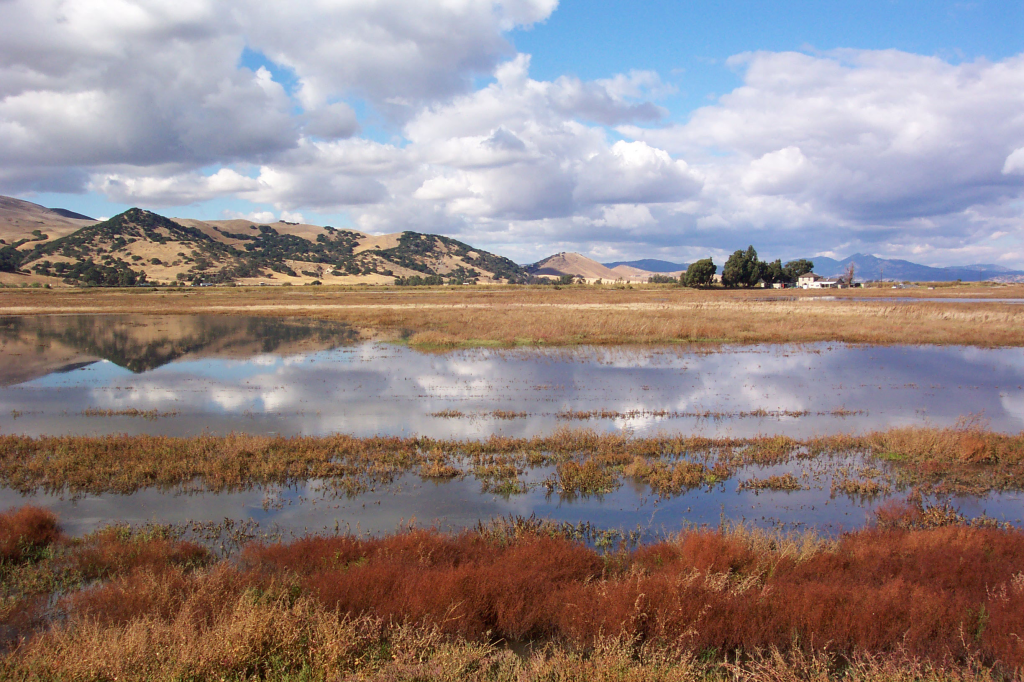
Ground broke last June, 2023, on the new Pacific Flyway Center located on Suisun Marsh, about 6 miles from the City of Fairfield in Northern California. Originally home to the Suisunes, the site is a sanctuary for over 200 species of birds including snowy egrets, quail, pelicans, and hawks, and serves a stopover for thousands of waterfowl as they migrate annually from Alaska to Patagonia. Phase One of the project, scheduled to open in 2027, was funded by a $5 million donation and consists of restoration work and a “marsh walk” that will meander through 15 new habitat ponds. Phase Two will see the construction of an interpretive center consisting of three buildings. Meanwhile, visitors can take advantage of 75 miles of existing roads and paths while the nearby Grizzly Island Trail offers educational signage, benches, and an overlook area. Summer temperatures often hover in the 90’s here but can reach the triple digits. Late fall days are generally cool, with foggy mornings and breezy afternoons.
“A wonderful bird is the pelican.
His bill will hold more than his bellican.”
– Dixon Lanier Merritt, 1910

Nature and Health
In the new book All in Her Head: How Gender Bias Harms Women’s Mental Health (Greystone Books, 2024), author Misty Pratt writes that quality time spent in nature is vital for health. Dr. Melissa Lem, a family physician based in Vancouver agrees. Lem studied evidence showing the benefits of nature-time on mental health and physical conditions such as diabetes, blood pressure, and stress hormone levels, and began making changes in her own busy schedule. Now, she’s part of a growing movement by doctors and health care professionals who recommend time in nature to their patients. “I think it’s important for nature to become routine advice during a health care visit — diet, exercise, sleep, and nature time,” Lem says. She calls these the “four central pillars of health.” See The Fourth Pillar of Health: Nature Time – YES Magazine Solutions Journalism (yesmagazine.org).
 Jerome Gagnon Blog