Recent Publications
Refuge for Cranes, the title poem from the 2023 Wildhouse publication, appeared in the fall issue of Avocet, a Journal of Nature Poetry.
One Bright Pearl appeared in Braided Way (online) September 6, 2024.
darting ahead (haiku) appeared in Under the Basho, Fall/Winter, 2024
Deep Imagery
In the poem “A Blessing,” by James Wright, the language suggests a kind of magic is afoot as “Twilight bounds softly forth on the grass…” and two Indian ponies “come gladly out of the willows…” I don’t often reread this poem, but when I do, it’s always with a certain amount of anticipation. The music is low-keyed, the rhyme subtle, and by the time the last line arrives I’m completely under its spell. Critic James Seay, writing in the Georgia Review, commented on Wright’s work that, “I cannot recall experiencing anything like that keen sense of discovery which I felt in reading The Branch Will Not Break…” and…“what makes Wright’s poetry special…” is that “he has the gift of using language in a way that the human spirit is awakened and alerted to its own possibilities.”

The opening of another one of his celebrated poems, “The Jewel,” is also memorable: “There is this cave/ In the air behind my body/ That nobody is going to touch:/ A cloister, a silence/ Closing around a blossom of fire.” Known for the striking “deep images” of his work, this “blossom of fire” was no doubt hard won. “Poetry can keep life itself alive,” he has written. “You can endure almost anything as long as you can sing about it.” Winner of the Yale Younger Poet’s Prize, the Ohio- born poet (1927-1980) attended Kenyon College and the University of Washington where he studied with Theodore Roethke. Above the River: The Complete Poems was published posthumously in 1990 and won the Pulitzer Prize.
Connecting With Mystery
Poet Ada Limon observed in an interview recently that, “The connection between poetry and nature is that they both give us a moment to recognize what we’re going through. They give us space. They give us breath. They return us to ourselves” (Outsider, August 1, 2024). As part of her signature project as U.S. Poet Laureate, Limon has conceived of a coast-to-coast exhibit of poems engraved on picnic tables in seven national parks, including Mount Rainer in Washington State where visitors can ponder A.R. Ammons’ poem, “Uppermost.” On the east coast, Mary Oliver’s poem “Can You Imagine?” is engraved on a table located in Beech Forest, near Provincetown, Massachusetts. Limon invites everyone, poet or not, to share their responses to the poems and the landscape around them with the hashtag #youareherepoetry. “Poetry is a place that holds so much mystery…” “So often we stand in a forest and think, Oh there are no words, and that’s enough,” she said.
Opening of the River
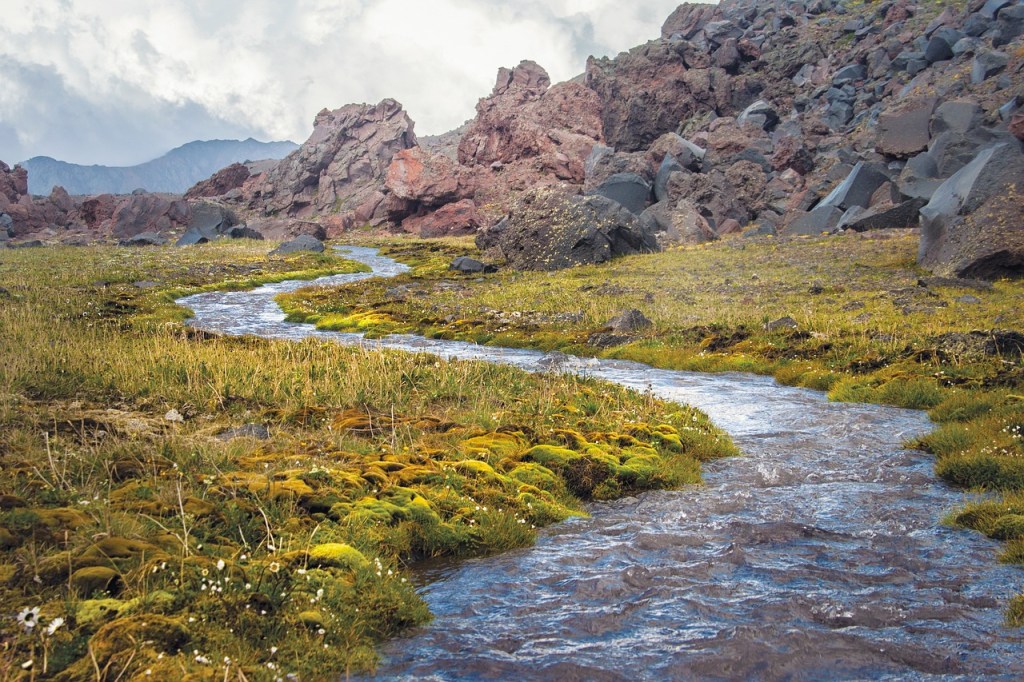
An historic project to remove four outdated hydroelectric dams along the Klamath River was completed late this summer, allowing it to flow freely in its original channel for the first time in over a century. It’s hoped that restoration of the river, which runs for 257 miles from Central Oregon to Northern California’s Lost Coast, will enable endangered chinook and coho salmon to return to their original spawning grounds. According to water rights specialist Brad Parrish, it’s vital to reconnect “the features on the landscape that allow water throughout the basin to function naturally…” (“A Geography of Hope,” Earth Island Journal, August 8, 2024).
In Case You Missed It
In the article “Building Another Kind of Peace: How Poetry Can Help Calm Our Tumultuous Spirits” LitHub, September 4, 2024), teacher and writer Megan Pinto describes poetry as both a mindful and literary practice.
Contests
The Steve Kowit Poetry Prize offers $1,000 and publication in the San Diego Poetry Annual for a single poem. Judged by Ellen Bass, the deadline is October 15th.
The North American Review will award $1,000 and publication for a single poem. All entries will be considered for publication. Deadline is November 1st.
Mad Creek Books, of Ohio State University Press, will award $2,500 and publication for a poetry collection of at least 48 pages. Judged by Marcus Jackson, the deadline is October 9th.
“Wild” Exhibit
A year-long exhibit entitled “Wild” opened in June, 2024, at the U.K.’s Manchester Museum showcasing projects from around the world that have revived natural landscapes and saved wildlife from extinction. Curated by David Gelsthorpe, it includes films, photographs, text, and objects that tell the story of “some of the ways people are rewilding landscapes…” and “gives glimpses of how nature can thrive when given the opportunity,” Gelsthorpe has written in The Conversation (www.theconversation.com, June 4, 2024).
About Craft
I was up early looking at a poem I’d written the day before, instant coffee beside me at the laptop. I knew it wasn’t right and I wondered if I could fix it with a bit of cutting, some revising. Maybe get a whole new poem out of it. No such luck. This was one of those poems that needed more than revising and a few quick fixes. I saved what was left of it and moved it to another file, with some regret. But also with an appreciation for the process. I confess I love poems that write themselves, but most of them require attention, and really, that’s the whole point of poetry, isn’t it? Looking closely at our view of the world and self through the lens of language. This is how poetry saves us, I think. It teaches us to look deeply and with patience, and in doing so we open to uncertainty, to the messiness of the process, to disappointment, to loss. Here, I find a hint of the objectivity I could use more of, an appreciation for poetry and life as creative movement, as change.
Spotting the Redstart
As birder Dominik Mosur wandered around Pine Lake Park in San Francisco one day recently, he heard what sounded like the tick of a warbler. Peering through the foliage, he caught a glimpse of the red belly and black feathers of a slate-throated redstart. Commonly found in the southern hemisphere, from Mexico to Bolivia, this was the first such sighting in California, according to an article in SF Gate (“Mysterious bird never seen in California draws crowds to San Francisco park,” Amanda Bartlett, Aug. 6, 2024). Birders and biologists have offered various reasons the redstart might have ventured so far north, including global warming, monsoons in Northern Mexico that may have disoriented it, and the instinct to seek out new territory.
Into the Clear Blue Sky
July 22, 2024 was the hottest day on record on earth, according to NASA, caused in part by human activity and the proliferation of greenhouse gasses. Climate Scientist Rob Jackson’s new book, Into the Clear Blue Sky: The Path to Restoring Our Atmosphere (Scribner, 2024) presents an attainable vision for the future, pointing out that while cutting harmful emissions is essential, we also need to reduce carbon dioxide and methane to pre-industrial levels by such means as “direct-air capture” and “enhanced weathering.” Chair of the Global Carbon Project and a Senior Fellow at Stanford’s Woods Institute for the Environment, Jackson believes that this goal can be accomplished in a lifetime with the help of nature and technology, and it’s our moral duty to attempt to do so. Publisher’s Weekly calls Into the Clear Blue Sky “an exceptional inquiry into the fight against global warming.” Kirkus sees it as “A useful handbook for reducing one’s carbon footprint and encouraging neighbors and communities to do the same.” (Jackson is also a well-published poet, with poems in the Atlanta Review, Cold Mountain Review, LitHub, and elsewhere.)
 Jerome Gagnon Blog