Writing the Spring Haiku
I started writing a few spring haiku recently and found that satisfying but still lacking in something I couldn’t easily identify. Maybe it has something to do with doubt or fear, or maybe with sorrow at the state of the world — all emotions we don’t ordinarily associate with spring. But there they are, lurking in the violets. So I’ll go back to those first drafts again and take another look.
Haiku are surprisingly flexible and big enough to frame particulars of anxiety and suffering alongside images of beauty and renewal. Shiki, who lived with TB as an adult and died at the age of thirty-four, was adept at contrasting such images. He wrote the following while serving as a journalist during the first Sino-Japanese war:
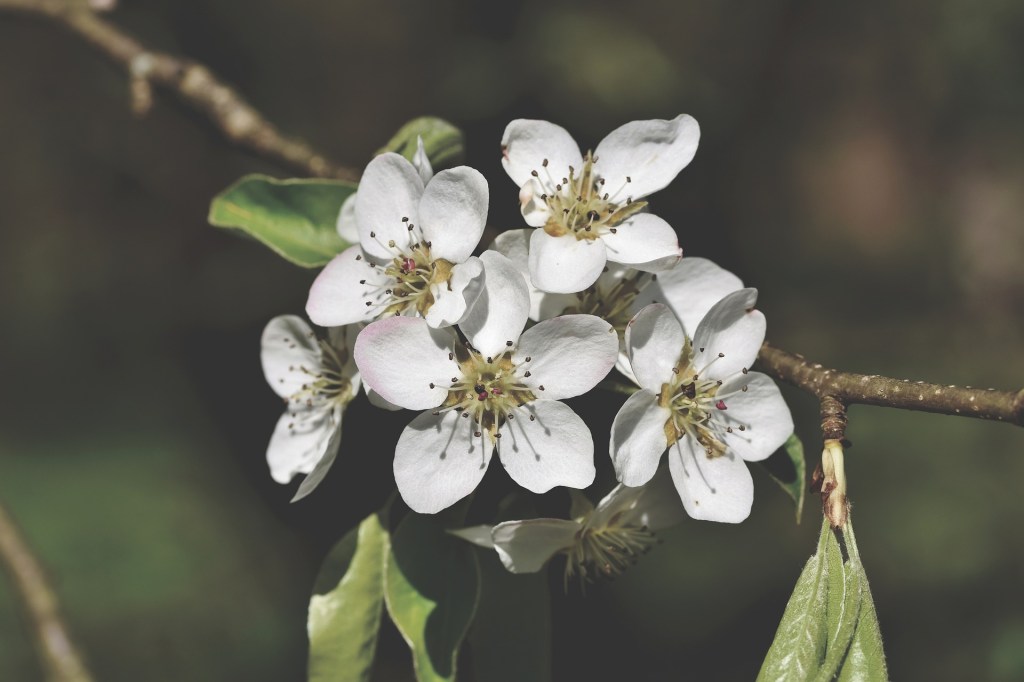
where the battle was,
beside the shell of a house,
a pear tree blossoms
(tr. jg)
Here’s another one he wrote while confined to bed:
watching peonies
and munching a green apple —
I’ll die soon enough
(tr. jg)
Shiki’s work is crisp, not to say stark. Here’s one of his unconventional takes on spring that embodies renewal, a hint of impermanence, and something more. It’s a reminder to me of the power of minimalism:
spring walk —
a long trail of footprints
on the empty beach
(tr. jg)
Appealing to sight and sound, this last one pairs an image of industrialization with a traditional spring subject:
the roar of a train
startles cherry blossoms
in the moonlight
(tr. jg)
Finding Your Kigo
Veteran haikuists know that traditional haiku generally contain an appropriate season word or kigo; these can be found in a Japanese Saijiki (kigo dictionary).There are kigo that relate to the sky and other elements, the landscape, human affairs, animals, plants, and insects, to name a few categories. (The Yukki Eeikei Haiku Society, www.yths.org, has a good one.) Finding the right kigo can ground a haiku temporally as well as deepen its resonance.
New Poems
“Crow in a Persimmon Tree” and “One Morning” appeared in the December issue of Kosmos Journal. Founded in 2000, Kosmos publishes “interdisciplinary educational content to foster global well-being…”
 Jerome Gagnon Blog