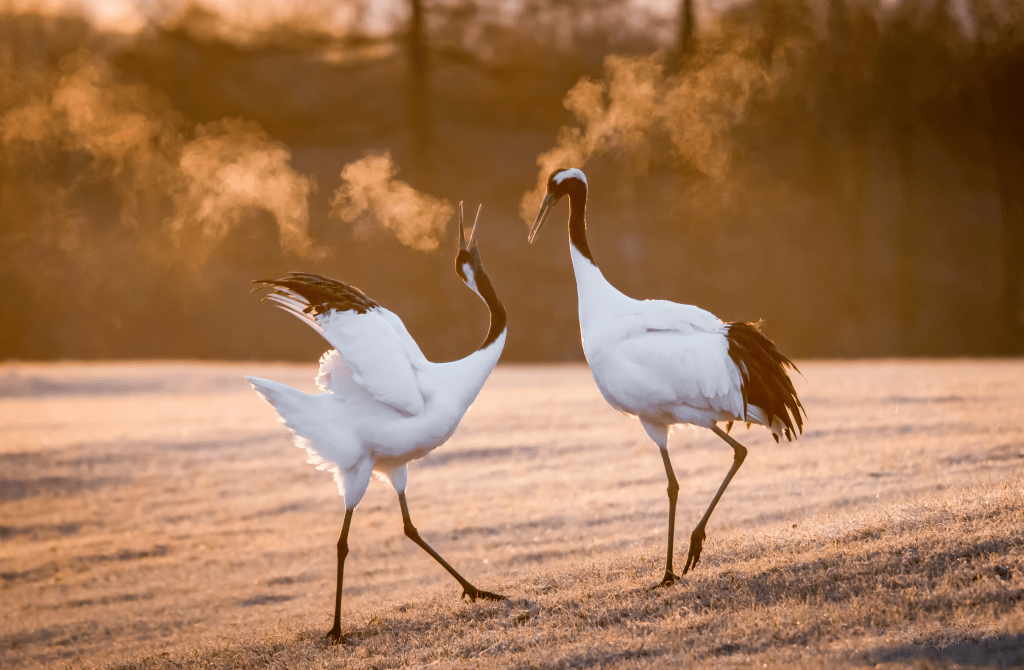
Sandhill Cranes Return to Lodi

Each year in the fall, Sandhill Cranes begin their migration from the northern to southern hemisphere in search of warmer temperatures, food supplies, and nesting sites. West of the Rockies, they journey from western Siberia and Alaska to the Central Valley of California and farther south to Mexico. East of the Rockies, they make their way from Canada, pausing in the Great Lakes region, and down to Arizona, the Gulf, and along the Rio Grande.

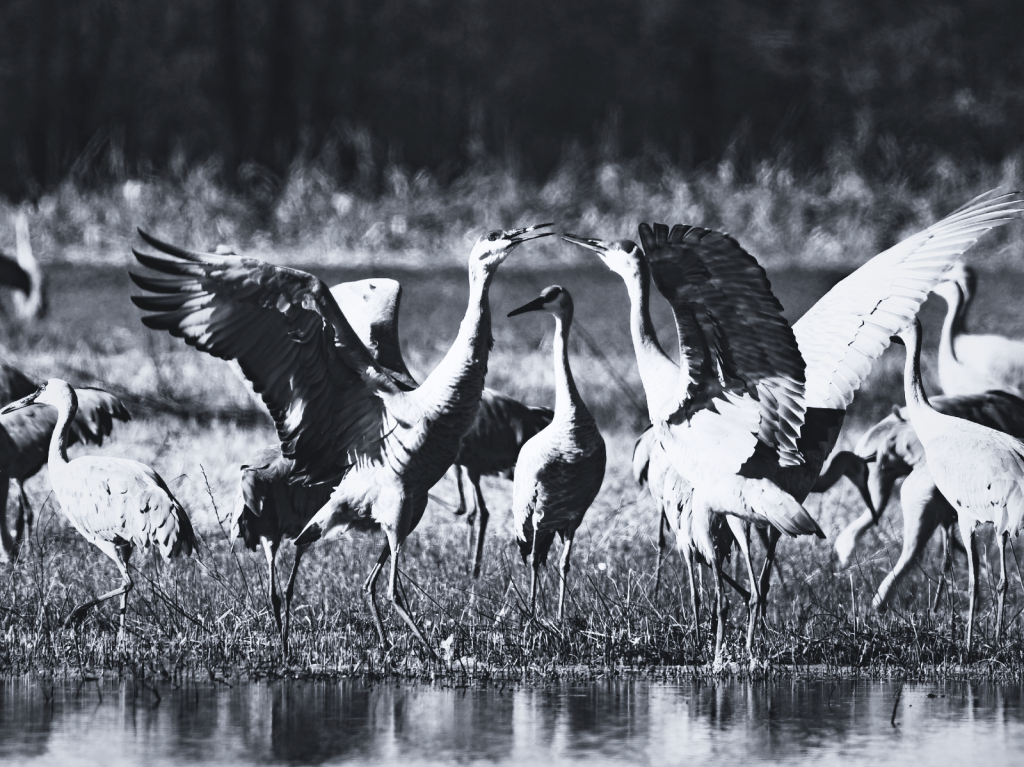
Here in California, they can now be found near Lodi where they feed in harvested rice and corn fields, roosting in flooded fields. From late September to February, they can be seen at the Consumnes River Preserve, the Rancho Seco Recreational Area, and the Woodbridge Ecological Reserve, which hosts guided tours. Believed to date to 2.5 million years ago, Greater Sandhill Cranes have a wingspan of up to eight feet and stand approximately four feet tall. Known for their impressive courtship rituals and loud, trumpet-like calls, their populations declined dramatically by the 1940s due to hunting and loss of habitat, but since then breeding pairs in California have increased to over four hundred and fifty.

Climate Action Poem Prize

The 2024 Treehouse Climate Action Poem Prize, sponsored by the American Academy of Poets, is now accepting submissions through November 15th for previously unpublished work. Established in 2019, the contest aims to increase awareness of climate change and the vulnerability of the environment. For more information, visit https://www.poets.org. The first place winner will receive $1,000, second place will receive $750, and third place will receive $500. This year’s judges are poet Elizabeth Bradfield and climate scientist Kate Marvel, Ph.D.
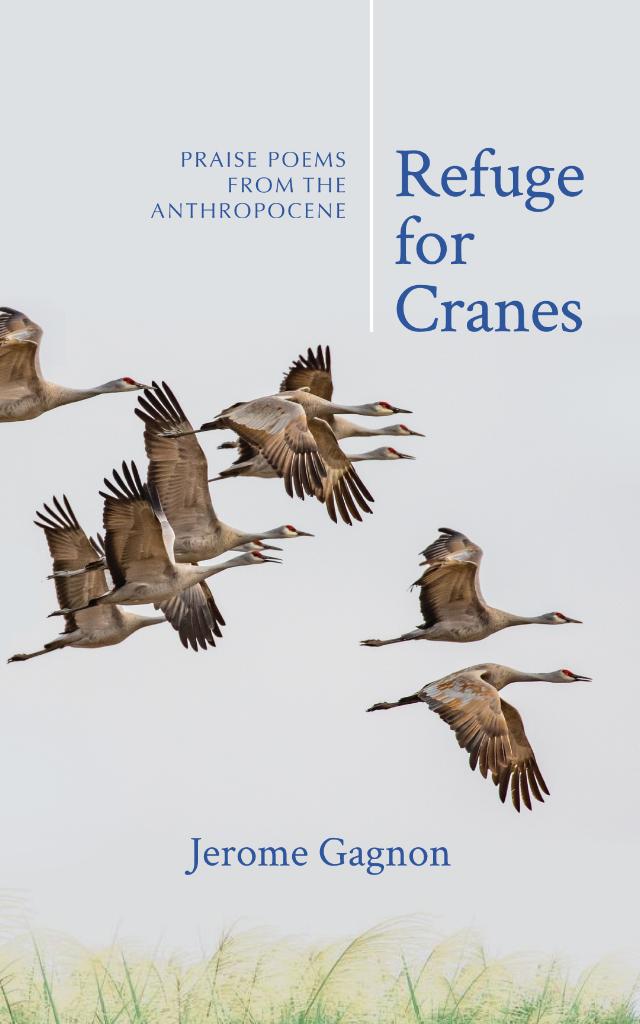
Click here to order.

“Refuge for Cranes plunges us wholly into the natural world through a series of poems that are equal parts celebratory, revelatory, and prophetic…” “Like the cranes that give the book its title, birds rumored to be immortal and wise, the poet bravely writes the truth he sees, “scratching our message into this passing world.” – Angela Alaimo O’Donnell, author of Andalusian  Hours and Holy Land

 “These touching poems remind us of the beauty and value of nature now threatened worldwide by our carelessness. Cranes are appropriate carriers of that message as conveyed in Jerome’s work…” – George Archibald, co-founder International Crane Foundation

“The poet’s “Love of Earthly Things” expressed in this rich collection, is a refuge for the reader. If you enter these pages, be prepared to open yourself wider to the world, like a flower to the sun.” – Phyllis Cole-Dai, author and co-editor of Poetry of Presence, I & II
New Poem

A new poem, “Pear Tree with Sparrows,” appears in the fall issue of The Banyan Review (www.thebanyanreview.org).

Reconnecting to Nature with Haiku

“The wisdom of the ancestors is shining

 on the hundred tips of the grasses.”

                           – Ling Shao

Haiku have a way of appearing out of the blue, but you may want to try a “haiku walk” in your neighborhood or in a local park as a kind of experiential writing prompt, or just to refresh your senses to what’s going on around you — to nature as it is, minus the usual preoccupations. In Japan, these walks are known as ginkoo (goo – singing, praising, poem-making; koo – walking). You may want to take a notebook and pen along so that you can jot down a few key words about your experiences. These may serve as the basis of one or more haiku later. If that’s not possible, list some of the memorable sites you’ve visited in nature. What was the outstanding thing, experience, or feeling about your visit to each of them? (Think in terms of sensory experiences, such as sights, sounds, or scents.) Compose a haiku using your notes as a jumping off point. Although the traditional format of haiku calls for a pattern of five syllables in the first line, seven in the second, and five in the third, you may want to vary that pattern somewhat. Do incorporate a seasonal reference and leave off the pronoun “I” if possible.

Restoring Chinook Salmon

Northern California Chinook salmon, which once numbered in the millions, are threatened with extinction due to the construction of dams and the subsequent loss of spawning grounds. Although the situation is dire, there’s some good news to report. A new agreement between the Winnemem Wintu Tribe, the State Department of Fish and Wildlife, and the National Oceanic and Atmospheric Administration aims to restore endangered Chinook Salmon to the McCloud River near Redding, just below Shasta Dam. Plans call for developing a “swimway” to allow fish to swim around the dam, and for using eggs from New Zealand Chinook that were introduced to that country in the last century. There are no guarantees, of course, but this could make a big difference in years to come.

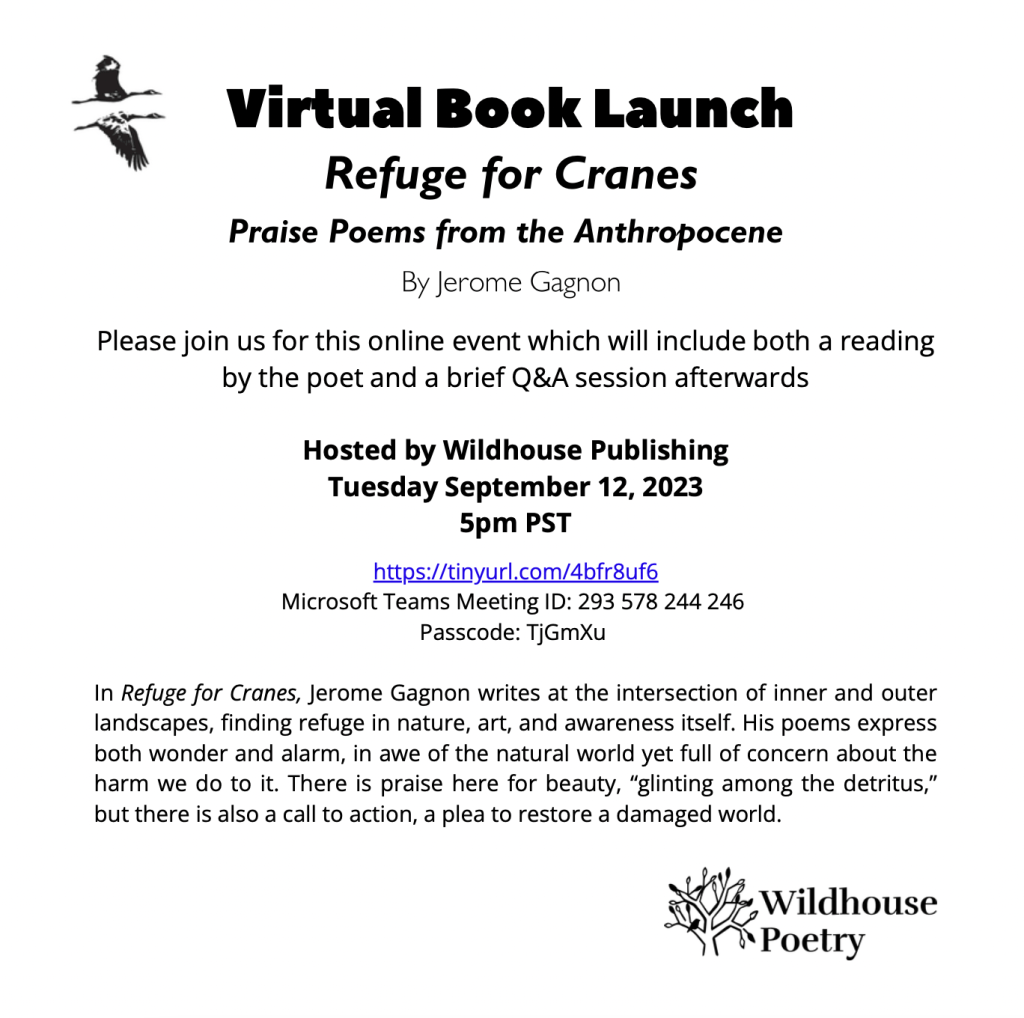
Book Launch September 12th

Refuge for Cranes will be available to order soon and looks wonderful (okay I may be biased). Thanks to Editor Mark S. Burrows for sheparding it through the editorial process, and to everyone at Wildhouse Publishing who helped to make this collection a reality. Thanks, also, to Design and Production Editor Melody Stanford Martin, who designed the beautiful cover with a photo of Sandhill Cranes in flight, and to Publicity Manager Molly Silverstein, who produced an awesome book trailer.

A virtual launch will take place via Zoom on September 12th at 8pm EST and at 5pm, PST. I’ll be reading a selection of poems from the book and answering questions afterward. I hope you can join me for this live online event but, if not, you can find a recording of it on the Wildhouse website shortly afterwards. Here’s the link to the Zoom launch:

Out of the Fog Podcast

An interview with podcaster Karen Hager will be released on September 12th (www.https://karenhager.com). I’ll be reading a few selections from Refuge for Cranes and we’ll talk about how the collection came together, how poetry can serve as an X-ray of the psyche, and ways to re-enchant ourselves with nature. Karen lived for many years in San Francisco where she began her popular series “Out of the Fog” while studying at Church Divinity School of the Pacific. She now makes her home in southeastern Michigan where she serves as an intuitive guide and teacher.

Contests

The Philip Levine Prize for Poetry, sponsored by California State University Fresno, is now open for submissions. The winner receives publication of a full-length manuscript (48-80 pages), an award of $1,000, and twenty-five author copies. Until September 30th. http://fresnostate.edu/levineprize

The New Women’s Voices Chapbook Contest, sponsored by Finishing Line Press, is open for submissions until September 15th. Winner receives a $1500 prize plus publication. http://finishinglinepress.com

One Page Poetry will award a prize of $2,000 and publication for a single poem. Until September 30th. http://onepagepoetry.com

Dzanc books will award a prize of $2,500 and publication for short story collection (minimum 40,000 words). By September 30th. http://dzancbooks.org

Refuge for Cranes due in early September

Refuge for Cranes: Praise Poems from the Anthropocene will be available from Wildhouse Publications early September. The poems range in topic from climate fires and the demise of bees to the “transparency of grace” and the “soul’s deep-down unfathoming.” There’s praise here for beauty “glinting among the detritus,” but there’s also a call to action, to restore a damaged world. Poet and author Angela Alaimo O’Donnell has written of the collection that “Refuge for Cranes plunges us wholly into the natural world through a series of poems that are equal parts celebratory, revelatory, and prophetic…Like the cranes that give the book its title, birds rumored to be immortal and wise, the poet bravely writes the truth he sees, “scratching our message to this passing world.”  

Selections from Refuge for Cranes: “Earthbytes”

This poem was a conscious attempt to express the need for active involvement in the environmental crisis, without being “preachy.” I really wanted to write a poem that encourages commitment to conservation and mindful living. This isn’t necessarily that poem, but it’s a start. It began with a fragment of a line from several years ago, “like the bulb that from darkness emits the bloom,” and evolved from there. Yes, the current crisis is dire but I believe we can make a difference. It won’t be easy, but what’s the alternative?

Earthbytes

Perform your natural magic

like the bulb that emits the bloom.

Be in harmony with the brown bear,

the moon, and the music of reeds.

Restore the oceans and rivers,

the kelp forests, marshes and bays.

Repair the hives of bees

and the resting places of monarchs.

Embrace the other, brother and sister.

See no one and nothing as the enemy.

Notice this place as if for the first time

as if it was your own skin, your own bones —

draw strength here, and return it.

                  –  jg

Dear Friends,

I’m taking a break from the blog this month, returning in August. Meanwhile, here’s a link to Phyllis Cole Dai’s website, where an interview appeared on her newsletter, The Raft, on May 28th. 

The image below features a quote from a poem in my forthcoming collection “Refuge for Cranes.”

Enjoy the summer, and stay safe. See you soon!

Best,

Jerry

To hear a selection of poems from the book read by Lisa De Lay, visit lisadelay.com.

Summer Writers’ Conferences

The Mendocino Coast Writers’ Conference in Mendocino, California offers “craft seminars, panels, one-on-one-consultations, and open mics.” Registration is now open for the 2023 conference to be held from August 3 – 5. It features keynote speaker Ariel Gore, founding editor of Hip Mama and author of the memoir, Atlas of the Human Heart. www.https://mcwc.org

The Santa Barbara Writers’ Conference in Southern California will be held this year from June 18 – 23 at the beachside Mar Monte Hotel. Celebrating its 50th year, the conference features 30-plus speakers, agents, panels, seminars, and workshops. It can accommodate full or partial week attendees. www.https://sbwriters.com

The Jackson Hole Writers’ Conference in Jackson Hole, Wyoming, will be held from June 22 -24 at the Jackson Hole Center for the Arts. Featuring a wide range of speakers and craft classes, including a fiction class by Dave Eggers, it offers both day and evening events, as well as individual manuscript critiques. www.https://jhwriters.org

Books Noted

A Field Guide to Nature Meditation

In A Field Guide to Nature Meditation: 52 Mindfulness Practices for Joy, Wisdom, and Wonder, author Mark Coleman describes how to develop a “nature-based meditation practice (Awake in the Wild, 2022) A psychotherapist and senior teacher of mindfulness meditation at Spirit Rock in Marin County, California, he also conducts wilderness retreats around the world. “Nature teaches us simplicity and contentment,” he says, “because in its presence we realize we need very little to be happy.” For all seasons and landscapes, for sitting still or for moving, these 52 meditations are designed to deepen awareness and support a sense of well-being. https://www.markcoleman.org

Climate Champions

Journalist and author of Girl Warriors, Rachel Sarah showcases the lives and work of influential women “on the frontlines of science” in Climate Champions: 15 Women Fighting for Your Future (Chicago Review Press, 2023, 12 years and up). Aiming to create a sustainable future for planet earth, the subjects profiled here “do not shy away from showing how racial and social injustices lie at the root of so many climate-related issues.”  

Environmental News

Bats at Risk

White nose syndrome has killed millions of bats in North America since it was first discovered in a cave in upstate New York in 2006, according to a recent article by Wilson Ring (www.https://physorg.com). Of the 154 species found across the United States, Mexico, and Canada, 81 of them are “at risk for white nose infection, climate change, and habitat loss,” the North American Bat Alliance reported last month. The fungus is identifiable by white spots on their noses, which can disturb their hibernation and prompt them to leave shelter in search of food in frigid, deadly temperatures. Yet studies suggest that certain bat populations have evolved “an efficient DNA repair mechanism,” according to virologist Dr. Arinjay Banerjee of McMaster University (PBS News Hour, December 2020), and these bats can “provide hints for possible future medical treatment strategies.”

Bats in Poetry

“…And bats with baby faces in the violet light/Whistled and beat their wings/And crawled head downward down a blackened wall…”

– from The Waste Land, by T.S. Eliot

Many poets have written about bats, including D.H. Lawrence, Emily Dickinson, T. S. Eliot, Alfred Lord Tennyson, and Anne Sexton. My favorite is by D. H. Lawrence. Known mainly as a novelist (Sons and Lovers, Women in Love), he had a keen eye for observation that served him well as a poet, too. Titled, simply, “Bat” (from Birds, Beasts, and Flowers, 1923), it’s full of unexpected rhyme and images, alarm and, finally, humor. https://www.poetryfoundation.org

Green Zendo Haiku

Recent Haiku

Night Train, a sampling of my haiku, was recently selected by Buttonhook Press (an imprint of OPEN: Journal of Arts & Letters) and is set to be released in a free, PDF format. These twenty-five haiku celebrate night and the wonder of the passing moment. I’ll post more information here as the publication date nears.

silver morning: cattails, April, 2023

peeling posters: hedgerow: a journal of small poems, #142

Flowers of Emptiness

Avrom Altman began his Buddhist studies in 1969, sitting zazen at Tassajara Zen Center with Shunryu Suzuki Roshi. A Licensed Professional Counselor and Certified Hokomi Therapist, he’s also Professor Emeritus at Pacifica Graduate Institute. The haiku in his new book, Flowers of Emptiness, sketch a life lived with “an astonished heart.” Dennis Patrick Slattery, Ph.D, has written, “I loved reading them and delighted further in rereading them…Let them resonate within you.” Flowers of Emptiness: Imaginal Haiku (Sungold Editions, 2023)

Opportunities                                                                

bottle rockets press is now accepting haiku, senryu, and other small poem submissions (up to 10 samples) until May 15th. Submissions by snail mail only. Please see the site for more details. https://www.bottlerocketspress.com

Presence Haiku Journal, out of Britain, is accepting haiku, tanka, senryu, and related material for both print and online publication from April 15th to May 31st. For details, visit https://www.haikupresence.org

The Heron’s Nest, a quarterly online journal, is offering cash prizes for winning entries in the Peggy Willis Lyle Haiku Awards, open now until June 1st. Judging is blind and there is no entry fee. For details visit https://www.theheronsnest.com

Karumi

The quality of karumi, or lightness, can be found in Basho’s haiku as early as 1667. He was twenty-three years old when he wrote the following:*

cherry blossoms

in the breeze — breaking out

in laughter 

Haruo Shirane, Chair of East Asian Languages and Cultures at Columbia University, has described karumi as “a focus on everyday subject matter, on the use of ordinary language, and on a relaxed rhythmical, seemingly artless expression.” Here the traditional topic of cherry blossoms takes on an unusually welcome aspect. Rather than contrasting the beauty of the flowers with sadness at their brevity, for instance, Basho depicts the exuberance of the moment. Is it the blossoms that have broken out in laughter or the poet? Or both? In this case, ambiguity adds to the impact of the lines.

Much haiku is celebratory in nature. An exclamatory haiku such as the one above is a good example of this. Another approach, common to the Basho school of haiku, presents two juxtaposed images, offering up a view that embraces them both. Below, a view of the garden, written near the end of Basho’s life, evokes a minimalist yet wholistic response: 

morning dew —

muddy melons

on the ground

Here there’s no trace of poetic conceit, just the pristine scene as Basho found it. In that sense, karumi may be considered not only in its literal sense as “not heavy or dark” but as possessed of a light artistic touch, allowing the reader to bring to the scene what he or she will. Even on his deathbed, Basho found an unexpected lightness:

flies everywhere —

how lucky they are to meet up

with a sick man

In the 20th century, Nakagawa Soen was a lifelong practitioner of haiku. As a literature student at Tokyo Imperial University, he wrote his thesis on Basho and later became a Zen monk and teacher. This haiku, written in 1946, presents two images pointing to the connection of ordinary things:

small plums

and dewdrops —

alive together

Although penetrating, there’s nothing heavy about these lines. Instead there’s a clarity and freshness, and a sense of happiness at the simple pleasures. We, too, are alive together with the plums and the dewdrops. How wonderful! These are the primary characteristics of karumi.

*all versions by jg

New Book Cover

The cover design for Refuge for Cranes is complete and I think it’s a standout. Designed by Melody Stanford Martin of Wildhouse Publications, it features a photograph of Sandhill Cranes in flight by Chris Briggs that evokes the majesty of these amazing birds (pls. see Books section). My thanks to both Melody and Chris for their beautiful work. I’ll post more information about publication when it’s available.

Susan Fenimore Cooper, “America’s First Recognized Female Nature Writer”

When Rural Hours, a natural history diary by Susan Fenimore Cooperwas first published in 1850, it was done so anonymously “by a lady,” the custom for women writers of the Victorian era. Favorably reviewed, it went into nine editions in Cooper’s lifetime, according to Michelle T. Harris, writing in Audubon Magazine (Jan. 8, 2021). One of the first to warn of the dangers of deforestation, Cooper also lamented the loss of wild Passenger Pigeons (extinct by 1900) and the shrinking populations of other birds. The daughter of popular novelist James Fenimore Cooper, she lived in Cooperstown, New York, where she founded an orphanage and wrote for magazines, including The Atlantic Monthly and Harper’s. Rural Hours was reissued in 1998 by University of Georgia Press.

Sandhill Cranes Return to Platte River

This month thousands of Sandhill Cranes will touch down in the Platte River Valley in central Nebraska, feeding primarily on corn kernels and insects, before moving on to their nesting grounds in Canada, Alaska, and Siberia. Visitors often hear the low, chortling sound of the prehistoric birds before they see them, observes columnist Rick Windham of the Platte River Telegraph. Known as a “rally bugle,” that call “is a sound that moves the spirit,” he says. The Iain Nicolson Rowe Audubon Center in Gibbon, Nebraska, offers guided tours of this annual event. Bird lovers can also observe the cranes in their natural habitat in “virtual tours.” For more information, go to https://www.row.audubon.org/events/.

An Ethics of Wild Mind

Author, poet, and translator David Hinton speaks about his latest book in a recent interview in Emergence Magazine. Drawing on Eastern philosophy, Ch’an, and “an ethics tempered by love,” he discusses the need for a deep relationship between humans and earth. https://www.emergengencemagazine.org

Writing Opportunities

The Annual Permafrost Book Prize in Poetry is open to all writers (including non-U.S. citizens) until March 15th. Winner receives $1000, 50 copies, and publication by the University of Alaska Press.

Passager Journal is now accepting poetry entries for their annual contest issue through April 15th.  An independent press located in Baltimore, MD, it was founded in 1990 for writers over the age of fifty. https://www.passagerbooks.com

The Robert Phillips Poetry Chapbook Prize is open until March 31st. Winner receives $500 and publication by the Texas Review Press.

Writing the New Year Haiku

Originally celebrated on the first day of spring per the lunar calendar, the New Year is considered a season in itself in Japan and New Year haiku often depict elements such as blossoms and songbirds. Here’s one by Buson*:

plum blossoms

whether I go north or south —

pink everywhere

This one by Issa may refer to the Buddhist idea of the “dharma ending age”:* 

New Year’s Day —

petals drifting down

in this fallen world

In another year, date unknown, his spirits were up:*

clear blue sky

this New Year’s Day —

glad to be alive

In this haiku from 1689, Basho offers a glimpse of a spring thaw:*

warmth of the sun

on a glistening field — 

New Year’s Day

This last one by Basho, written toward the end of his life, acknowledges a depth of feeling in which beginnings co-exist with endings*:

New Year’s Day

but everything feels like

autumn to me

*versions by jg

Writing Prompt

Writing a New Year’s haiku offers an opportunity to welcome a fresh outlook. This prompt joins mindfulness with images from nature. To begin, make a list of five positive feelings, thoughts, or intentions. Then list several of your recent observations from the natural world. Select one entry from each list and fashion them into a haiku. Here’s an example I wrote recently:

imagining peace,

an end to war — birdsong

from the chimney top

This isn’t the traditional way to write haiku — it’s generally more intuitive, even “accidental” — but I think it’s a good way to widen the lens of attention. You may get one or more effective haiku out of this process; if not, set them aside and try looking at them another day with a fresh eye. Sooner or later, a pearl will show up.

New Collection Slated for 2023

I’m very happy to report that my new collection, Refuge for Cranes: Praise Poems from the Anthropocene, will be the first volume of a poetry series by Wildhouse Publications. Slated for mid-2023, it explores the intersection between inner and outer landscapes, finding refuge in nature, art, and awareness itself. Poems range in topic from climate fires and the demise of bees, to the “transparency of grace” and “the soul’s deep-down unfathoming.” These poems were a way to address my fears about the environment, even as I continue to find beauty all around. Someone used the term eco-grief to describe the psychological effect of the crisis we’re living through — the sorrow at seeing habitats destroyed and species gone forever, and that was part of my impetus. But as the subtitle indicates, they’re also poems of praise. My thanks to everyone at Wildhouse Publications for welcoming this project and for bringing poetry to the forefront during these challenging times. (I’ll post details about ordering, etc., as soon as they’re available.)

Sandhill Crane Conservation

In 1937, conservationist Aldo Leopold warned in his essay, “Marshland Elegy,” that upper Midwest Sandhill Cranes were in danger of extinction. But with the support of farmers, wetland restoration, and changed hunting practices, their  population rose from just 25 breeding pairs in Wisconsin to over 15, 000 today, while the eastern population is around 90,000 (“A Conservation Success Story,” October 26, 2022, www.https://wpr.org). Yet cranes still remain at risk throughout the world, with 10 out of 15 species endangered, including Greater and Lesser Sandhill Cranes of California’s Central Valley. The International Crane Foundation “works worldwide to conserve cranes and the ecosystems, watersheds and flyways on which they depend,” according to their mission statement. To learn more and how you can help visit www.https://savingcranes.org.

Writing Opportunities

Wildhouse Poetry, a new imprint of Wildhouse Publications (WHP), is sponsoring a chapbook contest to launch their new poetry series. Offering publication and $500 to the winner, the contest will be judged by Jane Hirshfield. Based in Boston, Massachusetts, WHP “exists to bring transformative spiritual insights to people for whom traditional resources may not fit,” according to their homepage. The non-profit indie press is also considering full-length poetry, fiction, and non-fiction manuscripts through Submittable (https://www.wildhousepublishing.com/WiPo).

Happy New Year!

(Coming up: Writing the New Year Haiku)