
Category Uncategorized
News
Sent off the final galleys of “Spell of the Ordinary” to Finishing Line Press on January 11th. It looks good and I’m glad to have it under wraps. Well, almost. Word is that it’s being sent directly to the printer but will be delayed a few weeks. My guess is that it will be out sometime in February. I’m told that any questions or concerns about orders can be addressed to missingbookorders@finishinglinepress.com (please include the title, author name, purchase date, and your name and shipping address). My apologies to those of you who were kind enough to order. I’ll keep you posted on progress as I hear more.
My thanks to David Dragone, Editor of Crosswinds, for selecting “White Poppies” for their spring issue, to Richard Smyth, Editor of Albatross, for selecting “Looking out at the Stream” for an upcoming issue, and to Lynn Parr, Editor of Curlew (Wales, U.K.) for selecting “Pulling Weeds” for their June issue.
Appreciated Editor Jonathan Heinenen’s introductory note to the Fall 2017 issue of Crazyhorse (out of the College of Charleston in South Carolina). Commenting on the “fevered tempo” of bad news recently, he asks, “…how much making art matters when so much seems so grim.” His conclusion bears repeating: “Art isn’t some frivolous reflection or aimless escape. It’s a way for us to understand each other, to imagine experiences we would never have first hand, and empathize with someone other than ourselves. It’s something we need. It’s the light that shines so brilliantly and helps us make sense of the world we inhabit. It’s truth.” This is a remarkable issue with standout work by Gary Soto, Wendy Chen, Wesley Rothman, Emily Skaja, and others. I look forward to reading more.
News

“Scene from an Untended Garden,” “Christmas in the Yard,” and “December Mushrooms” appeared December 1st in Dodging the Rain (IE).
https://dodgingtherain.wordpress.com
“It’s impossible to consider the landscape of the last 50 years of American poetry without Kinnell,” Craig Teicher writes in the Los Angeles Times of Galway Kinnell’s posthumous “Collected Poems” (Houghton Mifflin Harcourt, 2017). Citing the well-known, “After Making Love We Hear Footsteps” and “Blackberry Eating,” Teicher says that, at their best, Kinnell’s poems evoke intimacy with nature, self, and other, yet he wonders if younger readers will accept such “secular spiritualisms” as the line, “everything flowers, from within, of self-blessing.” My guess is that many will, especially when such a line is read in context. Citing “When the Towers Fell” (regarding 9/11), Teicher suggests that we need more poems like this one “which ache to understand others’ suffering.”
Many of the selected poems in Mary Oliver’s “Devotions,” (Penguin Press, 2017) will be familiar to followers of her work. What I like about this volume is that the voice in the newer poems is informal, even conversational. “Do Stones Feel?” (from Felicity, 2015), for instance, has a lightheartedness to it, and yet it has depth, too. Like the koan, “Does a dog have Buddha nature or not?,” it invites the reader to go beyond the limitations of opposites and enter a world of delight. As Oliver writes in “Three Things to Remember”: “As long as you’re dancing, you can/ break the rules/ Sometimes breaking the rules is just extending the rules./ Sometimes there are no rules.”
Wishing you all the joys of the season, and a happy and healthy new year!
News
The latest issue from Poet Lore arrived and it was well worth the wait. Have been dipping in and out of “The Poetics of Liquid,” by Terrance Hayes, “Mysterious Me, a Brief Meditation on Personae,” by Leah Souffrant, and “Making it Real in the Time of Trump,” by Annie Kantar. These thoughtful essays explore the personal and public aspects of writing poetry, of living in an uncertain world. Not to be missed, Robert Schreur’s “Leaving Baltimore” and Barb Reynolds’ “March 10, 2016.” Grateful that my poem, “Pieces, Some Blue,” was included here.
Dodging the Rain is an innovative “blogazine” out of Galway, Ireland with quality writing and some amazing visuals. If you haven’t seen it yet, visit https://dodgingtherain.wordpress.com. “November Turning” appeared November 1st.
The Creative Writing Department at San Francisco State University recently established the Kay Boyle Poetry of Witness Award. A longtime writing professor at SFSU (and two-time O. Henry Award winner), Boyle was active for many years in Amnesty, while much of her fiction and poetry focused on the need for political awareness. Available to students of SFSU, the award offers a prize of $500. For writing contests open to the general public, see https://pw.org.
Each of the twenty-two poems in Ted Kooser’s final volume, “At Home” (The Comstock Writers Group, 2017), demonstrates his finely-honed powers of observation. “That Kooser often sees things we do not would be delight enough, but more amazing is exactly what he sees. Nothing escapes him; everything is illuminated,” says the Library Journal. Selections reflect the Nebraska farm life he knew and loved — a squirrel’s nest, a meteor shower, a barn door, a bat, a croquet ball, an owl, a milk jug — and each reveals the universal in the particular. Describing the cracks around an aged croquet ball as “rings on a planet,” he suggests, “…perhaps it is a planet, and not even one of the lesser ones, but something worth our full attention…” Kooser’s poetry offers nothing less.
News
After The Book Shop closed its doors for good, former manager Renee’ Rettig raised $70,000 through Indiegogo to open a new store across the street. Dubbed Books on B, the independently owned store in Hayward, California, is a light-filled space that’s a testament to Rettig’s dedication and the generosity of booklovers. You can read more at www.sfgate.com.
Pleased to hear that my new poem, “Pilgrimage,” was selected by editor Mark S. Burrows for the journal, ARTS. Along with Jon M. Sweeney, Burrows is co-translator of “Meister Eckhart’s Book of the Heart, Meditations for a Restless Soul” (Hampton Roads, 2017). These are short, sometimes ecstatic meditations that speak directly to the heart.
Photographer Fred Lyon’s visual essay, “San Francisco Noir” (Princeton Architectural Press) was released earlier this month and it’s a joy to take in. But just as evocative as the after dark images of The City, lit by neon and shrouded in fog, are Lyon’s photos of San Francisco by day — an old man playing a harmonica on the sidewalk, rickety backstairs, and wash hanging out to dry.
Reading Lawrence Ferlinghetti’s, “San Francisco Poems” (City Lights Foundation), I came across “They Were Putting Up a Statue (of St. Francis),” which originally appeared in “Coney Island of the Mind.” It was recorded on Fantasy records back in the day and can now be heard on You Tube. Still rocks.
Poet Aline Soules (Meditation on Woman) writes about her recent visit to Seamus Heaney’s Home Place, a small museum in Ulster devoted to the Irish poet’s life and work, and provides links to podcasts and videos. If you haven’t heard Heaney’s poems, pour yourself a cup of tea (or something stronger) and settle in. https://alinesoules.com
Words of Witness: Remembering Kay Boyle (1902 – 1992)
Although it was a few years ago, it feels like yesterday when I ran into Kay Boyle’s former secretary, David Ryan, while working at a bookstore on the edge of the Tenderloin in San Francisco. It was a happy reunion. He channeled her in a spot on impersonation that got me laughing and thinking back.
As a student at San Francisco State University, I was lucky enough to spend time with some amazing writing teachers. Kay was the most memorable of them. She was — for me, at least — larger than life, even though she was quite thin and in her early seventies when I met her. Having lived as an expatriate in Europe in the 1920s and 30s with the likes of James Joyce and Ernest Hemingway, she had stories to tell. When I expressed my admiration for the poet Hart Crane, she said, “Oh, yes, Hart,” and told me a story about one of his little-known escapades.
I remember a class I attended at her Victorian house on Frederick Street in the Haight Ashbury District. On the hall table was a surreal looking “tree of hands” that Jean Cocteau had bought for her at the Paris flea market. “It’s for holding calling cards,” she explained. But for me it was pure magic, evoking daydreams of Scott and Zelda Fitzgerald, Gertrude Stein and Alice B. Toklas. I got a sense of her mindset early on, though, when she responded to a student who complained that he didn’t have enough time to work on a story. “Andre Malraux found time to write, even when he was working with the French Resistance and helping Jewish children escape from the Nazis,” she said crisply. “If you’re serious about writing, you’ll find time.”
Boyle’s growth from an idealistic young writer to a savvy witness of political realities can be seen in her early novel, “Death of a Man,” which exposed the threat of fascism to a largely unsuspecting world. It can also be seen in her long story “The White Horses of Vienna” (winner of the O. Henry Award), which depicts the need for artists to engage in the political and social conditions around them. It’s a theme that shaped much of her poetry over the years, too. Her poem, “A Testament to My Students,” supports student demands for a Black Studies program and other reforms in the 1960s; “Dedicated to Terre Des Hommes” laments thwarted efforts to transport wounded Vietnamese children to European hospitals ” (Doubleday & Company, 1970).
A critic once faulted Boyle for a tendency toward romanticism, to which she responded with atypical indifference, “This may very well be true.” At its core, though, her work reminds us that people need to speak out, to stand against injustice in every era. The message couldn’t be timelier. The opening lines from “A Poem for the Teesto Dine’ of Arizona,” below, suggest that the source of Boyle’s commitment wasn’t simply anger, although that was part of it, but respect for others and a deep reverence for life. The complete poem can be found in “This is Not a Letter and Other Poems” (Sun & Moon Press, Los Angeles, 1985).
“The Mountain is old. They say she is a female mountain.
The women who know her are not young, yet they call her
The Mother. She stands tall against the sky, fragrant with herbs,
embellished by shrubs…”
“…She is The Mother who stands in silence
when the land is fettered and barbed with wire, when it is parched
to dust by the drought of uniformed men…”
– Kay Boyle
Two of my favorite books are Boyle’s memoir, “Being Geniuses Together, 1920 – 1930,” written with alternating chapters by Robert McAlmon, and her collection of short stories, “Nothing Ever Breaks Except the Heart.” Both evoke the world of pre- and post-war Europe through the voice of an insightful narrator who was ahead of her time.
Coming Soon
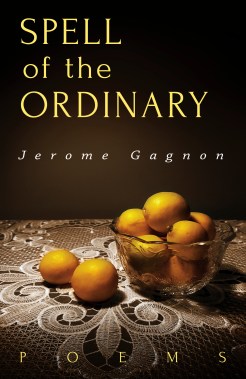 “In this stunning collection, Jerome Gagnon exalts evidence of the ‘enduring mutable.’ Spell of the Ordinary is a contemplative song that modulates between Gregorian chant and blues hymn. Here you will find beauty in discord and discard, loveliness in the moment and in the minute…”
– Lana Hechtman Ayers, author of The Dead Boy Sings in Heaven
News
Happy to announce that my chapbook, “Spell of the Ordinary,” is scheduled to be published by Finishing Line Press and will be available to order. (Please click here to order.) Thank you to Tony Sanchez for designing such an eye-catching cover and to everyone who shared their thoughtful comments about my work. Thanks also to the editors of those journals where several of the poems first appeared — their notes were always encouraging. Last, my gratitude to Director Leah Maines, Senior Editor Christen Kinkaid, and the dedicated staff at Finishing Line Press for their work in bringing out this volume and so many others.
Reed Magazine’s 150th issue is out and it’s a beauty. Over three hundred pages of engaging poetry, fiction, nonfiction, art, and profiles. Honored that they selected “Some Ways Into Joy” to appear in the Anniversary edition. A celebration/reading will take place on the evening of September 22 in the Rotunda of San Jose City Hall.
Editor Daniel J. Rice selected “Crow Makes a Scene,” for the new anthology from Riverfeet Press, “Awake in the World.” Love the cover (image by Creative Pear Graphic) — it reminds me of my old Boy Scout manual. Chris Dombrowski, author of “Body of Water,” says, “Leave room in your dry-bag, boat box, rucksack, even fishing vest, for this rich collection of voices.” Among my favorites, poetry by Matt Hohner and Gwen McNeir.
Editor Judy Bolz selected “Pieces, Some Blue” for the latest issue of Poet Lore (“America’s oldest poetry journal”). Due shortly.
Writing “Spell of the Ordinary”
The poems in this collection are about paying attention to ordinary things and the activities going on around me. A barometer hanging on a wall, a bowl of lemons, an aphid on my arm. Looking for the connections they sometimes evoke. Usually they were prompted by a recognition or memory that I’d seen something in a new way. Sometimes a line would come to me and I just went with it, not knowing where it would go. Sometimes I found myself confronting loss (“Cranking the Wheel”), sometimes a sense of gratitude (“Gifts”). Sometimes, what I would call paradox or mystery (“Spotting Turkeys,” “Crow Makes a Scene”).
Although most of the poems required polishing, they generally came as a single piece, or slice of life. (Happy day!) I didn’t add or take away much. Sometimes I got stuck. “Crow,” for instance was all about pronoun usage. Should I refer to the crow as he or she? Or should I address the whole experience as “You?” I think I finally got it right and was pleased that editor Daniel Rice of Riverfeet Press selected it for the recent anthology, “Awake in the World.”
Lately, I’ve found myself more invested in the idea of shaping a poem. I’ve let go of the idea of expecting them to arrive in any sort of finished form. The process of polishing is a time for making associations, and possibly for finding some kind of personal meaning, as much as it’s an opportunity to experiment with form. For me, the moments of “Spell of the Ordinary” were openings to go below the surface but also to appreciate that surface, to savor the penumbra around a pear, or the light off frost.
Writing Poems of Praise

Mary Oliver’s poem, “Prayer,” (from “Thirst,” 2006) speaks volumes about praise-making and poem-making. Yes, we love the blue iris, though possibly not before it’s sent up its skinny stalks and roused our attention, before the unfurling. But what about the weeds that grow around it, the wild artichoke, and the skunk grass? Glittering glass in the alleyway?
Paying attention, she suggests, is the way to go. Looking closely at what’s there. The grimy couch somebody set out on the sidewalk. A fallen gate. The way fog slips down from Twin Peaks to the city below.
Form arises out of function, and a poem, if it’s going to have any life at all, will shape itself, tell us which way it wants to go. “Patch a few words together,” Oliver says, and don’t make them grandiose, as if you’re standing on a soapbox. Consider a whisper as opposed to a shout.
Via Negativa

It’s not easy to talk about my own poetry because it generally comes from a place of not knowing. I don’t think I’ve ever started a poem knowing where it would end up. And although it’s true that poetry can sometimes lead to discovery, it can also lead to uncertainty, and that’s okay, too. Uncertainty can be a door into wider awareness of the mystery that surrounds us. Keats dubbed this state “negative capability,” the willingness to be in “uncertainties, mysteries, doubts, without any irritable reaching after fact and reason.”
It’s a condition that reminds me of the theological term, Via Negativa, which suggests that God can never be fully known or described because the mind is unable to grasp infinitude. So God is best approached by reflecting on what He is not. That’s the way the thinking goes. St. Thomas said that “to know that we do not know Him,” is the ultimate in human knowledge. And if we look at the poetry of some of the early Christian mystics such as Hildegard of Bingen, we can find some moving examples of the Via Negativa at play. When she writes, “The mystery of God hugs you in its all-encompassing arms,” uncertainty appears as a loving connection, a hug that can contain our fears and our losses, as well as our joys.
For me, Rilke is one of the most compelling travelers on the Via Negativa, and I think it’s because his poems reveal an intimate relationship with a personal God who encompasses knowing and not-knowing, light and dark. “You, darkness that I come from,” he writes, “I love you more than any of the fires.”
Here’s one more example of the Via Negativa by the Sufi poet, Rumi (1207 – 1273):
“God, whose love and joy
are present everywhere
can’t come to visit you
unless you aren’t there.”
(trans. Stephen Mitchell)
I really like that one. It’s not so much a description of mystery, really, as it is a reminder of the importance of getting out of our own way.
 Jerome Gagnon Blog