New Poems

New poems are scheduled to appear in theSanta Clara Review, a publication of Santa Clara University, and the upcoming anthology, A New Season: Poems from a World in Flux. Edited by Vallejo co-Poets Laureate Jacalyn Eyvonne and Kathleen Herrmann, the anthology will highlight San Francisco Bay Area voices but “welcomes poets from all regions…” Due around the end of January.

Revision

In the last year or two, especially, I’ve come to enjoy the process of revision. There’s a certain perspective gained in seeing how a poem develops from point A to point B, and beyond. Of course, it helps if you’re not attached too much to the status quo. Case in point, I recently observed as one troublesome word changed from “rising” to “meandering” to “wilding” to “rewilding.” Of course that last change was what it should have been all along. Sometimes you just have to sit down in the chair at your computer or your writing pad and put in the time.

Those Winter Sundays

Born and raised in Detroit, Robert Hayden (1913-1980) “was the first Black American to be appointed as consultant in poetry to the Library of Congress (later, U.S. poet laureate),” according to poets.org. One of his most memorable poems, “Those Winter Sundays,” evokes a “tumultuous” childhood but it also speaks of love’s austere presence. It appeared in A Ballad of Remembrance, Paul Bremen, 1962, and can also be found at www.poets.org.

Contests and Submissions

Ninth Letter, a print journal from the University of Illinois, Urbana-Champaign, is currently accepting both experimental and traditional forms of prose and poetry. www.ninthletter.com

Publication in Booth Magazine and $1,000 will be awarded to the winner of the Susan Neville Poetry Prize. Submit up to three unpublished poems stories through December 31, 2025. www.booth.submittable.com

Ecotheo Collective accepts all forms of literary and visual expression for their print and website issues. They seek work that reflects “questions of ecology and spirituality from within and outside all religious traditions.” Publishes four times a year. www.ecotheo.org

Wishing you peace and joy now and in the New Year!

Stanley Kunitz: The Collected Poems

Born in 1905, Pulitzer Prize winning poet Stanley Kunitz lived to be 100 years old. His later poems, beginning with The Testing Tree in 1971, were less philosophical and more personal than his early efforts. Some of my favorites from this period include “My Mother’s Pears,” “Halley’s Comet,” “Snakes of September,” and “Days of Foreboding,” but there are many more; in “The Unquiet Ones” he addresses the deaths of his parents and in “The Round,” expresses his love of gardening, poetry, and life. Kunitz wasn’t averse to confronting the shadow side of the personality or the dark side of history — his father committed suicide before he was born and he commented that the Holocaust was “the basic subtext of much of his work.” Twenty-five years after its publication, The Collected Poems remains relevant in today’s polycrisis for its penetrating gaze at beauty, love, and loss. “What do we know beyond the rapture and the dread?” he asked. (The Collected Poems, Stanley Kunitz, W.W. Norton & Co., 2000)

Rewilding the River Basin

Thousands of native wildflower seeds, hand collected and planted by Yurok tribe members and volunteers, are thriving along the Klamath River after a spectacular show of color this spring. Over 2,200 acres, submerged for decades by four recently removed dams, are part of an ongoing restoration project along the river basin. Some of the flowers that can be found there are California poppies, lupine, buttercups, tiger lilies, asters, larkspur, and orchids. www.oregonstater.org, www.oregonstate.edu

Opportunities

Blessing the Boats Selections, sponsored by BOA Editions, is offering a $1500 prize and publication for a full-length collection of poetry by a woman of color who lives in the US. Named after Lucille Clifton’s award-winning collection, the series will be judged this year by Evie Shockley. Manuscripts must be at least 65 pages in length. (There’s no entry fee.) www.boaeditions.org

Stony Brook Southhampton is sponsoring a short fiction prize for undergraduates. The winner will receive a prize of $1,000, a scholarship to the Southampton Writer’s conference, and possible publication in the Southhampton Review. The contest is open to undergrads in the US and Canada. (There’s no entry fee.) www.stonybrook.edu

Palette Poetry, an online journal, is open for submissions year round for its Featured Poet category. Payment is $50-150 per poem. Aiming for diversity, they welcome “new and emerging” poets. (There’s no fee for this category.) www.palettepoetry.com

Assembling a Poetry Collection

For tips on assembling a poetry collection, see “Putting a Full-Length Collection Together,” June 6, 2021 and July 26, 2021, on this blog.

Living the Questions

I’ve been dipping in and out of You Are the Future: Living the Questions with Rainer Maria Rilke (Monkfish, 2024).Written by translator and scholar Mark S. Burrows and best-selling author Stephanie Dowrick, it reaches into the heart of Rilke’s poetry, stressing the value of living “the deep questions of our day.” The Austrian poet’s work was inspired by his mystical leanings and a need to come to terms with the suffering wreaked by WWI. “I am the stillness between two notes/that don’t easily harmonize,” Rilke wrote, and as Burrows observes, he “sensed that polarities are always with us, and within us — light and dark; good and bad; right and wrong — and that our work was that of integrating them.”

The poet’s yearning for wholeness is common to many people and it’s not likely to be fulfilled by outer means such as self-help fixes. It is, instead, “a call to open ourselves to what is real,” “to enter deeply into the soulful depths of your own life,” Burrows says. This isn’t so much about transcendence as it is a process of transformation, says Dowrick, a former psychotherapist, who cites this passage from Rilke’s Letters to a Young Poet: “Don’t search now for the answers; they can’t be given to you because you couldn’t yet live them. And what matters is to live everything. Live the questions now. Perhaps on some future day you’ll find yourself, slowly and imperceptibly, living into the answer…” Rich with insight and references, this is a book to savor. Not only is it a good resource for understanding Rilke’s writing and the context of his life, it also shows how poetry, in general, can nurture “soul work.”

April is National Poetry Month

Launched in 1996 by The Academy of American Poets, National Poetry Month celebrates poetry with a series of special in-person and virtual events. This year, “Mindful Poetry Moments” offers “a chance to pause and reflect on poetry’s ability to encounter ourselves, the world, and the mystery of each other,” according to the AAP website. On Wednesday, April 9th, from 3-4pm EST, participants will gather virtually to write and share their experiences based on Mary Oliver’s “Wild Geese.” For a full description with a link to register for this free event, and for a complete schedule, visit www.poets.org.

Power Lines

The Poetry Foundation honors the 25th anniversary of the Midwest anthology Power Lines this month with a series of readings, exhibitions, and performances. Dubbed “POWER LINES: Lineage as a Source of Collective Power,” the series focuses on “an energetic current connecting us to the past, fueling us toward the futures of our imaginations.” For a complete schedule visit www.poetryfoundation.org.

Contemplating Kinship

“Contemplating Kinship,” a free multi-media event sponsored by The Poet’s Corner of Maine, will take place on Zoom April 13th at 4:00 pm, EST. Exploring our connections with each other, nature, and the world, the event will feature writers Claire Milliken, Jane Pirone, Mikhu Paul, and David Baker. To register and to learn about other programs and opportunities sponsored by The Poet’s Corner, visit www.thepoetscornermaine.org.

Sandhill Cranes Return to Lodi

Each year in the fall, Sandhill Cranes begin their migration from the northern to southern hemisphere in search of warmer temperatures, food supplies, and nesting sites. West of the Rockies, they journey from western Siberia and Alaska to the Central Valley of California and farther south to Mexico. East of the Rockies, they make their way from Canada, pausing in the Great Lakes region, and down to Arizona, the Gulf, and along the Rio Grande.

Here in California, they can now be found near Lodi where they feed in harvested rice and corn fields, roosting in flooded fields. From late September to February, they can be seen at the Consumnes River Preserve, the Rancho Seco Recreational Area, and the Woodbridge Ecological Reserve, which hosts guided tours. Believed to date to 2.5 million years ago, Greater Sandhill Cranes have a wingspan of up to eight feet and stand approximately four feet tall. Known for their impressive courtship rituals and loud, trumpet-like calls, their populations declined dramatically by the 1940s due to hunting and loss of habitat, but since then breeding pairs in California have increased to over four hundred and fifty.

Climate Action Poem Prize

The 2024 Treehouse Climate Action Poem Prize, sponsored by the American Academy of Poets, is now accepting submissions through November 15th for previously unpublished work. Established in 2019, the contest aims to increase awareness of climate change and the vulnerability of the environment. For more information, visit https://www.poets.org. The first place winner will receive $1,000, second place will receive $750, and third place will receive $500. This year’s judges are poet Elizabeth Bradfield and climate scientist Kate Marvel, Ph.D.

Click here to order.

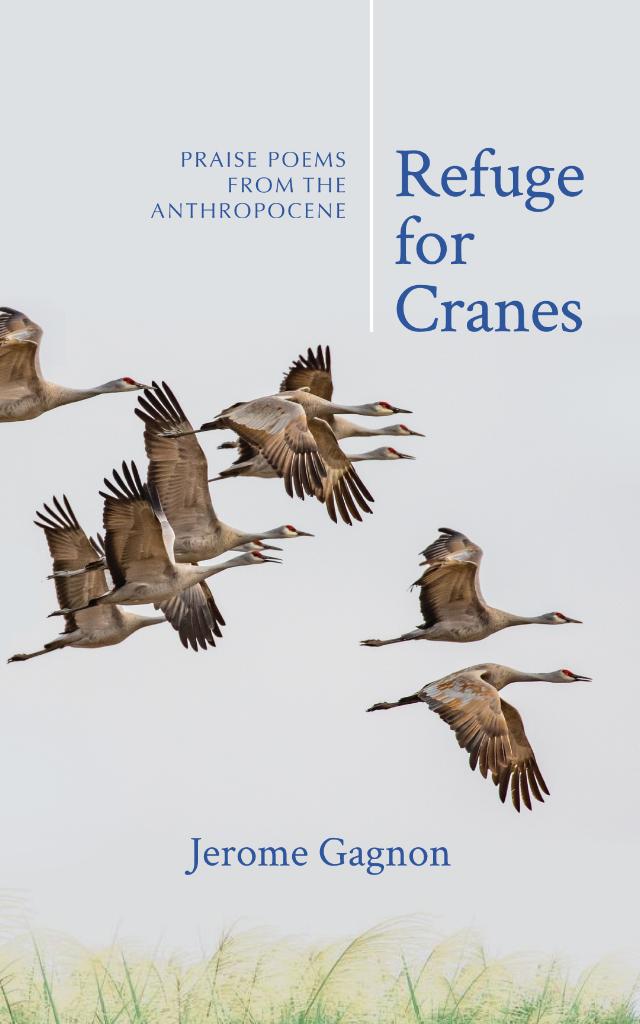
“Refuge for Cranes plunges us wholly into the natural world through a series of poems that are equal parts celebratory, revelatory, and prophetic…” “Like the cranes that give the book its title, birds rumored to be immortal and wise, the poet bravely writes the truth he sees, “scratching our message into this passing world.” – Angela Alaimo O’Donnell, author of Andalusian  Hours and Holy Land

 “These touching poems remind us of the beauty and value of nature now threatened worldwide by our carelessness. Cranes are appropriate carriers of that message as conveyed in Jerome’s work…” – George Archibald, co-founder International Crane Foundation

“The poet’s “Love of Earthly Things” expressed in this rich collection, is a refuge for the reader. If you enter these pages, be prepared to open yourself wider to the world, like a flower to the sun.” – Phyllis Cole-Dai, author and co-editor of Poetry of Presence, I & II

A Place for Joy

The poet Carl Phillips said in an interview recently that, “A place must be made, still, for joy.” That’s probably always been the case but these days the need to cultivate positive feelings and attitudes may seem more critical. May we all find a time and place for joy, now, and in the days to come.

Pushcart Nomination

“Encomium for a Garden” (Spiritus, Fall 2022), was recently nominated for a Pushcart Prize. This is one of those serendipitous poems that practically wrote itself. I may have changed a word or two and then changed it/them back, again. This is my favorite kind of poem to write, one that flows easily from pen to paper. My thanks to the editor, Mark Burrows, for forwarding it.

Winter Workshops

Cassie Premo Steel, author of Earth Joy Writing: Creating Harmony thorough Journaling and Nature, will lead an online writing workshop, Release the Dark, Receive the Light, sponsored by Ashland Creek Press, on January 2, at 11:a.m. www.https://ashlandcreekpress.com

Robin Farr, poet and co-editor of River Heron Review, will lead a four-session online workshop, Poetry Boost: From Title to Publication on Thursday nights from November 10 to December 8. www.https://riverheronreview.com

Writing Opportunities

Emergence Magazine

An online magazine with an annual print edition, Emergence publishes essays, op-eds, films, and audio stories about the “timeless connections between ecology, culture, and spirituality,” according to their homepage. Focusing on “long-form content that is both thought-provoking and evergreen,” they also offer a weekly podcast with interviews, narrated essays, fiction, and more. www.https://emergencemagazine.org

Passager Journal and Books

Dedicated to the work of writers over the age of 50, Passager Journal publishes a twice-yearly print edition and now features a weekly podcast, too. Passager Books focuses on poetry collections, short fiction, and anthologies by writers who’ve been published in the journal and offers the Morgenthau Prize for a first book of poetry by a writer age 70 or older. www.https://passagerbooks.com

The Cincinnati Review is seeking poetry, fiction, nonfiction, and translations through December. (Submissions close once they meet their cap.) A print magazine out of the University of Cincinnati, it pays $30 per page for poetry. www.https://cincinnatireview.com

KAIROS Literary Magazine

Founded in 2016, this online magazine is looking for poetry, creative nonfiction, and op-ed pieces. Published tri-annually, submissions are accepted on a rolling basis. www.https://kairoslit.com
Prairie Schooner is a print quarterly published by the University of Nebraska-Lincoln. They’re seeking essays, interviews, reviews, short stories, and poetry now until May 1st. The Raz-Shumaker Book Prize opens January 15th. www.https://prairieschooner.unl.edu

In Praise of the Natural World

Attention is the beginning of devotion.

– Mary Oliver

Praise seemed to come instinctively to Mary Oliver. One of the most popular late twentieth-century poets, Oliver’s attention was often focused on the woods, ponds, and beaches that she explored in forays around her home in Provincetown, Massachusetts. In Upstream (2016), a collection of essays on nature and literature, she notes that early on she “did not think of language as the means to self-description…” but as a way “to notice, to contemplate, to praise…” One of my favorite poems, from New and Selected Poems Volume One (winner of the National Book Award) is “Little Owl Who Lives in the Orchard.” It captures me from the first line and doesn’t let go until the last line. I could say the same for most of Oliver’s poems, but this one feels as if I’m right there in the orchard listening to a youngish owl “flutter down the little aluminum ladder of his scream.”  

If “attention is the beginning of devotion,” as she wrote, then wonder may be the beginning of praise — for the fox “so quiet — he moves like a red rain,”  for the hawk with “one exquisite foot” attached to a twig, even for “The cracked bones/of the owl’s most recent feast…” For Oliver, attention most often means being in the presence of, whether it’s the owl in the orchard, a hermit crab on the beach, a hummingbird in a trumpet vine, or egrets at the edge of a pond. This attention to wildlife and the environment alerts her to possibility — the possibility of danger, of beauty, of death, of life, or simply of nothing “but the cold creek moving/over the old pebbles…”

Unlike the narrative “I” of Whitman, who she considered a childhood “friend,” Oliver’s “I” enjoys a relative position in the background. From this vantage point, she offers observations rich with detail, color, and music. She’s not afraid to use a well-placed exclamation point occasionally, or just as often, a question mark. “Are you listening, death?” she asks in “The Rabbit.” These kinds of questions don’t always come with answers, of course, but reflect a sense of mystery that permeates her work, a respect for not knowing and for silence.

She had her darker moments, some of them probably attributable to childhood trauma. In “A Visitor,” she struggles to come to grips with her estrangement from her father, a subject she discussed frankly in her later years. In one of her most well-known poems, “Wild Geese,” she writes, “Tell me about despair, yours, and I will tell you mine./Meanwhile the world goes on.” If there’s a secret to her appeal, I think it’s that she comes to the poem with an inclusive love for the world in all its imperfections — that and a willingness to embrace it again and again.

Writing Prompt: Gratitude

For this prompt, make a list of ten things you’re grateful for. They might be ordinary items around you — just-picked tomatoes, a set of salt and pepper shakers, or a glass of water, for instance, or they might be something more personal such as a family member, pet, or a prized possession. After completing your list, select the most promising subject and write continuously about that for at least five minutes, or more. When you’ve run out of steam, take a look at what you’ve come up with. Is there a poem there, or more than one poem? After fine-tuning your work, let it sit for several days. Then go back and have a second look. If it’s redundant, remove the deadwood. If it feels incomplete, you may want to weave in some additional details, or consider posing a question and answering it.

Writing Opportunities

Poetry Northwest is accepting poetry submissions from October 1st to November 30th. https://www.poetrynw.org

The Colorado Prize for Poetry is open for submissions of full-length manuscripts (48-100 pages) from October 1st to January 14th. https://www.coloradoreview.colostate.edu

News

Books Noted

Kindest Regards, New and Selected Poems, by Ted Kooser (Copper Canyon Press, 2021), contains four decades of poetry in addition to recent work. The Pulitzer Prize winner, who hails from Nebraska and served as Poet Laureate to the Library of Congress from 2004 to 2006, is known for his short, imagistic poems that focus on everyday events and objects. Reflecting the landscape of Midwestern towns and farms (he lives on acreage in Garland, Nebraska), his poetry expresses universal experiences and the need for meaningful connection. He has said of his work that, “I want to show people how interesting the ordinary world can be if you pay attention.”

As the 23rd U.S. Poet Laureate, Joy Harjo gathered the poetry of Native peoples past and present in the 222-page An Anthology of First People’s Words: Living Nations, Living Words (W.W. Norton, 2021). Poets such as Natalie Diaz, Sherwin Bitsui, Ray Young Bear, and Santos Perez address themes of displacement, visibility, struggle, resistance, and other subjects here. The anthology demonstrates “that heritage is a living thing,” Harjo writes in the introduction, “and there can be no heritage without land and the relationships that outline our kinship.” A member of the Muscogee (Creek) Nation, she is the author of several poetry volumes and a memoir, “Crazy Brave.” 

Poet and teacher John Brehm’s The Dharma of Poetry: How Poems Can Deepen Your Spiritual Practice and Open You to Joy (Wisdom Publications, 2021) is geared toward poets and poetry lovers who practice meditation, but it’s a rich resource for readers and writers of any persuasion. Brehm presents poetry as a “powerful way to disrupt the habitual momentum of the mind, its automatic reactions and obsessive self-concerns.” His analysis of poems such as James Wright’s “A Blessing” and Ryokan’s “First Days of Spring” point out how these poems offer the reader an opportunity to pause while “full of imaginative engagement,” and invite us to enter “the timeless experience the poem describes.” The book also contains writing prompts and suggested meditations.

In Memoriam

Three of San Francisco’s former poet laureates died in 2021 — Lawrence Ferlinghetti (at age 101), Janice Mirikitani, and Jack Hirschman. In addition to their innovative literary output, each made a vital contribution to the city’s cultural life — Ferlinghetti as co-founder of City Lights Bookstore and publisher of the Beat poets, Mirikitani as ambassador of love (with her husband the Rev. Cecil Williams) and Hirschman as an outspoken writer who reminded us of the importance of politically relevant poetry. Other outstanding American poets who passed recently are: bell hooks, Stephen Dunn, Thomas Kinsella, Jean Breeze, and Robert Bly. May they all rest in peace.

Open Submissions

Split Rock Review, an independent online publication, is accepting submissions for Issue #18, including poetry, creative nonfiction, fiction, hybrid, photography, and art with an emphasis on place and the environment. Until Jan. 31st. www.rockreiew.org

The Emerson Review, out of Emerson College, is now open for submissions until February 1st for the spring issue, due to be published in April. Seeking poetry, fiction, nonfiction, photography and art. Selected pieces are nominated for a Pushcart Prize. www.emersonreview.submittable.com

Beloit Poetry Journal, a print publication, is open for poetry submissions in various forms and styles. Send up to five unpublished poems or one long poem by January 31st.  www.bpj.org

Putting a Full-length Collection Together: Part 1

Getting Started

There are a lot of articles out there about how to put a full-length collection of poems together and some of them are of the “ten easy steps” variety. But the truth is, it’s more complicated than that. The process calls on intuition, trial and error, and a good deal of rewriting and editing. A full-length collection can take three years or more of reworking and polishing before it’s ready to be published. Teaming with an experienced editor may speed up the process, but the time it takes to turn a manuscript into a book is valuable, even precious, to a poet’s growth. Why rush it?

Like writing a poem, assembling a collection of poetry is a non-linear process that invites deep immersion. Through close observation you begin to recognize the shape and purpose of the work. You note its weak points and its strengths. You go over it multiple times with various lenses, looking for connections and commonalities. You sink into the mystery of it, not looking for answers necessarily, but alert to questions.

In her article, “How Do You Pick and Arrange the Poems for a Poetry Collection?” poet and blogger Christina M. Ward, author of the collection “organic,” stresses the importance of cohesiveness (www.https:medium.com): “When I say plan a theme, I don’t mean that each poem needs to be about one topic, but the book as a whole needs to have a definable “purpose” or “theme” or “feel,” she says, suggesting that poets think of this as the “vision” of the book. It helps if a book is about something but not every collection needs a specific theme to be cohesive.

Selecting, Sectioning, and Sequencing

Once you’ve identified your vision for the book, you’re ready to begin selecting the poems that are most aligned with that vision. In assembling my second collection, I began by separating poems into two stacks, those that worked or had the potential to work, and those that clearly didn’t. At that point I had about thirty-five poems and knew I needed more. Searching what I laughingly call “my files” — a couple of drawers full of loose papers and others in manila folders — I found a few more possibilities, bringing the total to fifty-one, just enough for a full-length collection. I wasn’t exactly off and running, but there was a glimmer of a hope that I might find a book in there someplace. 

One way to jump-start your collection is to divide the manuscript into sections. This will let you zone in on specific areas and can make it feel more manageable. It also offers visual breaks, along with an opportunity to add section titles and related inscriptions that can help to transition the reader from one thematic focus, or mood, to the next. But like everything else in the process, these details are apt to change. For me, those changes are a sign that I’m beginning to hone in on the finer details. At some point, sections and inscriptions may appear superfluous or even interrupt the flow — if so, it’s okay to let them go. They will have served their purpose like scaffolding on a building site. 

One of the most challenging tasks in putting a collection together is sequencing. Phoebe Stuckes, a former Foyle Young Poet and author of Platinum Blonde (www.https:poetryarchive.org), compares the process to stand-up comedy, in which you “tell your second best joke at the start of your stand-up set and your best joke at the end.”  She suggests printing out your manuscript so you can physically try out various sequences until you find the right one. I’d compare this stage to putting an album of songs together; you want some ballads and some up tempo numbers, some highs and lows, some short numbers and some longer ones. These variations will add texture and interest. Avoiding repetition is key. If you have two poems that are both on the same topic and use much the same vocabulary, you’ll need to rework one or drop it. Feel free to experiment. Playing with different formats such as prose poems and concrete poems can reap unexpected benefits, not only in the way the poems look on the page, but in how they “mean,” and can open the work up in unexpected directions. If you decide later that an experimental poem doesn’t make the grade, you can always pull it.   

Having an accurate table of contents early on is an advantage if you decide to submit the manuscript on the spur of the moment or if you want to share it with a trusted reader for their input. Yes, it’s going to change a lot over the course of the project, but the benefit is that you can scan it from time to time to get a sense of how the “narrative line” is evolving (more on this later). It’s also a good place to enter any notes about what you think might be missing. Do you want a title poem? If so, where do you think it ought to go? Scanning the table of contents will help you decide. Granted, it can be tedious to update page numbers as you shift sections or shuffle poems around, but I’ve found that it’s worth it. This is the uninspiring part of the work, the busy work you might call it, that nevertheless helps to bring a sense of structure to the chaos. (Next time: Looking at structural models and selecting a title.) 

News

Books Noted

The Art and Craft of Poetry

In case anybody hasn’t heard, April was National Poetry Month, but any time is a good time to enjoy poetry in its various forms. Here are a few recent offerings:

Three Simple Lines: A Writers Pilgrimage into the Heart and Homeland of Haiku, by Natalie Goldberg (New World Library, 176 pages). Natalie Goldberg’s latest offering on the art and practice of writing takes her to Japan where she explores the origins of haiku among the country’s ancient temples and hidden gardens. Classic haiku by masters such as Basho, Buson, Issa, and Chiyo-ni appear in a narrative “as irresistible as a mountain stream…” says author Henry Shukman, “…and come alive in ways that still the mind, expand time, and open the heart.” As insightful as Goldberg’s Writing Down the Bones and Writing the Landscape of Your Mind, this book reminds us of what it means to be open to growth, and how the practice of writing — and haiku, in particular —lends itself to mindfulness.

How to Write a Form Poem, by Tanya Runyon (T.S. Poetry Press). Even poets who primarily write free verse are likely to find this this “how to” book useful. It contains instructions and prompts for writing ten traditional forms, such as sonnets, sestinas, villanelles, haiku, and pantoums. Included are dozens of examples from Runyon and other poets, among them Elizabeth Bishop, Natasha Trethewey, Frank O’Hara, Matsuo Basho, and Wallace Stevens. An author and teacher, Runyon has also written How to Read a Poem and How to Write a Poem, both of which are geared for use in classrooms. 

Accidental Gardens, by Rob Carney (Stormbird Press). This is Carney’s take on the contemplative Japanese form of haibun. First used by Basho in the 17th century, the term refers to a hybrid genre that combines haiku with prose — typically, observations such as travel logs, and sketches of people, activities, or landscapes. Basho’s Okku no Hosomichi (Narrow Road to the Interior) is probably the most well-known example of the form. Comprised of four sections — 42 haibun in all — each of the short ruminations in Accidental Gardens ends with a brief poem or compelling image. Focusing on the natural world and our reckless disregard for the environment, the collection reads as “a journey through the absurdity, tragedy, and black comedy of late-stage capitalist and consumerist America,” writes author Nick Hunt. A professor of English at Utah Valley University, Carney has published seven other poetry collections.  

News

Books Noted:

Black Girl, Call Home, by Jasmine Mans, is one of the most anticipated books of 2021, according O, the Oprah Magazine, and is “arresting as only spoken word artistry can be.” The publisher (Berkley Books) describes it as a “literary coming of age narrative” and “a piercingly intimate deconstruction of daughterhood.” It features many of Mans’ viral YouTube poems in print for the first time, as well as active phone numbers that readers can dial to hear her perform “bonus poems.” Poet Danez Smith has written that “Mans takes up the tools of Brooks (Gwendolyn) and Sanchez (Sonia) into her good hands and chisels us an urgent and grand work, proving why she’s the favorite of all the girls in the back of the bus.” Raised in Newark, New Jersey, Mans graduated from The University of Wisconsin Madison with a B.A. in African American Studies and currently serves as resident poet of the Newark Public Library. 

Spencer Reece, who struggled with rejection for years before his first collection, The Clerk’s Tale,was published to acclaim in 2004, now has a memoir out, The Secret Gospel of Mark: a Poet’s Memoir (Seven Stories Press, 2021). Poetry and faith are intimately linked in this saga that chronicles his battle with alcoholism, his orientation as a gay man, and his calling to the Episcopal priesthood. Chapters explore the work of mentor-poets who inspired him along the way, from Emily Dickenson and George Herbert, to Elizabeth Bishop and Gerard Manley Hopkins, among others. National Book Award-winning author Andrew Solomon writes that Reece “brings into sharp focus a life of authentic despair and ultimate redemption…it is a tender but unforgiving, clear-sighted exposition of Christian faith.” Poet Carolyn Forche’, Director of the Lannan Center for Poetics and Social Practice at Georgetown University, calls it “A profound and necessary work, luminous and full of grace.”

Love Unknown: the Life and Worlds of Elizabeth Bishop, by Thomas Travasino, isn’t new — it came out in 2019 — but it’s notable for the comprehensive account it offers of this “poet’s poet.” Bishop published sparingly, but she won both the Pulitzer Prize (for Poems: North & South/A Cold Springin 1955) and the National Book Award (for her Complete Poems in 1970). Her poetry is “marked by precise description of the physical world” — much of it inspired by her extensive travels — while “her underlying themes include the struggle to find a sense of belonging, and the human experiences of grief and longing,” according to the Poetry Foundation. Her style is characterized by structured rhyme and a syntax that often reads more as prose than as formal verse. A selection of her work, including “The Armadillo,” can be found at www.poetryfoundation.org.

In The Feeling of Life Itself: Why Consciousness is Widespread but Can’t Be Computed, author Christof Koch defines consciousness as subjective experience, “no matter how banal or exalted.”  It’s “the feeling of being alive,” he says, and speculates that it’s present in even the simplest life forms. A leader in the field of consciousness science, Koch asks the question, “How is it that a physical organ like the brain can give rise to feelings?” Arguing for a quantitative theory, he notes that science can now “detect and track the footsteps that any conscious experience leaves in the brain.” He doesn’t believe, however, that computers will ever feel. “Consciousness is not a clever hack. Experience does not arise out of computation,” he says. Nature has called his work “Invigorating…Koch tracks the ‘neural footprints’ of experience, swims off the wider shores of integrated information theory, and speculates about the ‘feeling of life itself’ in ravens, bees and octopuses —along with related ethical concerns.” (The MIT Press, 2019)