
Coming Soon

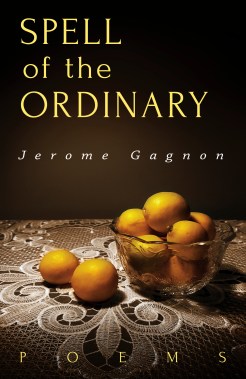
SpelloftheOrdinary_PhotoCovers“In this stunning collection, Jerome Gagnon exalts evidence of the ‘enduring mutable.’ Spell of the Ordinary is a contemplative song that modulates between Gregorian chant and blues hymn.  Here you will find beauty in discord and discard, loveliness in the moment and in the minute…”

– Lana Hechtman Ayers, author of The Dead Boy Sings in Heaven 

News

Happy to announce that my chapbook, “Spell of the Ordinary,” is scheduled to be published by Finishing Line Press and will be available to order.  (Please click here to order.)  Thank you to Tony Sanchez for designing such an eye-catching cover and to everyone who shared their thoughtful comments about my work.  Thanks also to the editors of those journals where several of the poems first appeared — their notes were always encouraging.  Last, my gratitude to Director Leah Maines, Senior Editor Christen Kinkaid, and the dedicated staff at Finishing Line Press for their work in bringing out this volume and so many others.   

Reed Magazine’s 150th issue is out and it’s a beauty.  Over three hundred pages of engaging poetry, fiction, nonfiction, art, and profiles.  Honored that they selected “Some Ways Into Joy” to appear in the Anniversary edition.  A celebration/reading will take place on the evening of September 22 in the Rotunda of San Jose City Hall.

Editor Daniel J. Rice selected “Crow Makes a Scene,” for the new anthology from Riverfeet Press, “Awake in the World.”  Love the cover (image by Creative Pear Graphic) — it reminds me of my old Boy Scout manual.  Chris Dombrowski, author of “Body of Water,” says, “Leave room in your dry-bag, boat box, rucksack, even fishing vest, for this rich collection of voices.”  Among my favorites, poetry by Matt Hohner and Gwen McNeir.

Editor Judy Bolz selected “Pieces, Some Blue” for the latest issue of Poet Lore (“America’s oldest poetry journal”).  Due shortly.


Writing “Spell of the Ordinary”

The poems in this collection are about paying attention to ordinary things and the activities going on around me.  A barometer hanging on a wall, a bowl of lemons, an aphid on my arm.  Looking for the connections they sometimes evoke.  Usually they were prompted by a recognition or memory that I’d seen something in a new way.  Sometimes a line would come to me and I just went with it, not knowing where it would go.  Sometimes I found myself confronting loss (“Cranking the Wheel”), sometimes a sense of gratitude (“Gifts”).  Sometimes, what I would call paradox or mystery (“Spotting Turkeys,” “Crow Makes a Scene”).

Although most of the poems required polishing, they generally came as a single piece, or slice of life.  (Happy day!)  I didn’t add or take away much.  Sometimes I got stuck.  “Crow,” for instance was all about pronoun usage.  Should I refer to the crow as he or she?  Or should I address the whole experience as “You?”  I think I finally got it right and was pleased that editor Daniel Rice of Riverfeet Press selected it for the recent anthology, “Awake in the World.”

Lately, I’ve found myself more invested in the idea of shaping a poem.  I’ve let go of the idea of expecting them to arrive in any sort of finished form.  The process of polishing is a time for making associations, and possibly for finding some kind of personal meaning, as much as it’s an opportunity to experiment with form.  For me, the moments of “Spell of the Ordinary” were openings to go below the surface but also to appreciate that surface, to savor the penumbra around a pear, or the light off frost.  


Writing Poems of Praise

iris-2502898_640

Mary Oliver’s poem, “Prayer,” (from “Thirst,” 2006) speaks volumes about praise-making and poem-making.  Yes, we love the blue iris, though possibly not before it’s sent up its skinny stalks and roused our attention, before the unfurling.  But what about the weeds that grow around it, the wild artichoke, and the skunk grass?  Glittering glass in the alleyway?

Paying attention, she suggests, is the way to go.  Looking closely at what’s there.  The grimy couch somebody set out on the sidewalk.  A fallen gate.  The way fog slips down from Twin Peaks to the city below.

Form arises out of function, and a poem, if it’s going to have any life at all, will shape itself, tell us which way it wants to go.  “Patch a few words together,” Oliver says, and don’t make them grandiose, as if you’re standing on a soapbox.  Consider a whisper as opposed to a shout.


Via Negativa

galaxy-10994_640

It’s not easy to talk about my own poetry because it generally comes from a place of not knowing.  I don’t think I’ve ever started a poem knowing where it would end up.  And although it’s true that poetry can sometimes lead to discovery, it can also lead to uncertainty, and that’s okay, too.  Uncertainty can be a door into wider awareness of the mystery that surrounds us.  Keats dubbed this state “negative capability,” the willingness to be in “uncertainties, mysteries, doubts, without any irritable reaching after fact and reason.”

It’s a condition that reminds me of the theological term, Via Negativa, which suggests that God can  never be fully known or described because the mind is unable to grasp infinitude.  So God is best approached by reflecting on what He is not.  That’s the way the thinking goes.  St. Thomas said that “to know that we do not know Him,” is the ultimate in human knowledge.  And if we look at the poetry of some of the early Christian mystics such as Hildegard of Bingen, we can find some moving examples of the Via Negativa at play.  When she writes, “The mystery of God hugs you in its all-encompassing arms,” uncertainty appears as a loving connection, a hug that can contain our fears and our losses, as well as our joys.

For me, Rilke is one of the most compelling travelers on the Via Negativa, and I think it’s because his poems reveal an intimate relationship with a personal God who encompasses knowing and not-knowing, light and dark.  “You, darkness that I come from,” he writes, “I love you more than any of the fires.”    

Here’s one more example of the Via Negativa by the Sufi poet, Rumi (1207 – 1273):

“God, whose love and joy

are present everywhere

can’t come to visit you

unless you aren’t there.”

     (trans. Stephen Mitchell)

I really like that one.  It’s not so much a description of mystery, really, as it is a reminder of the importance of getting out of our own way.