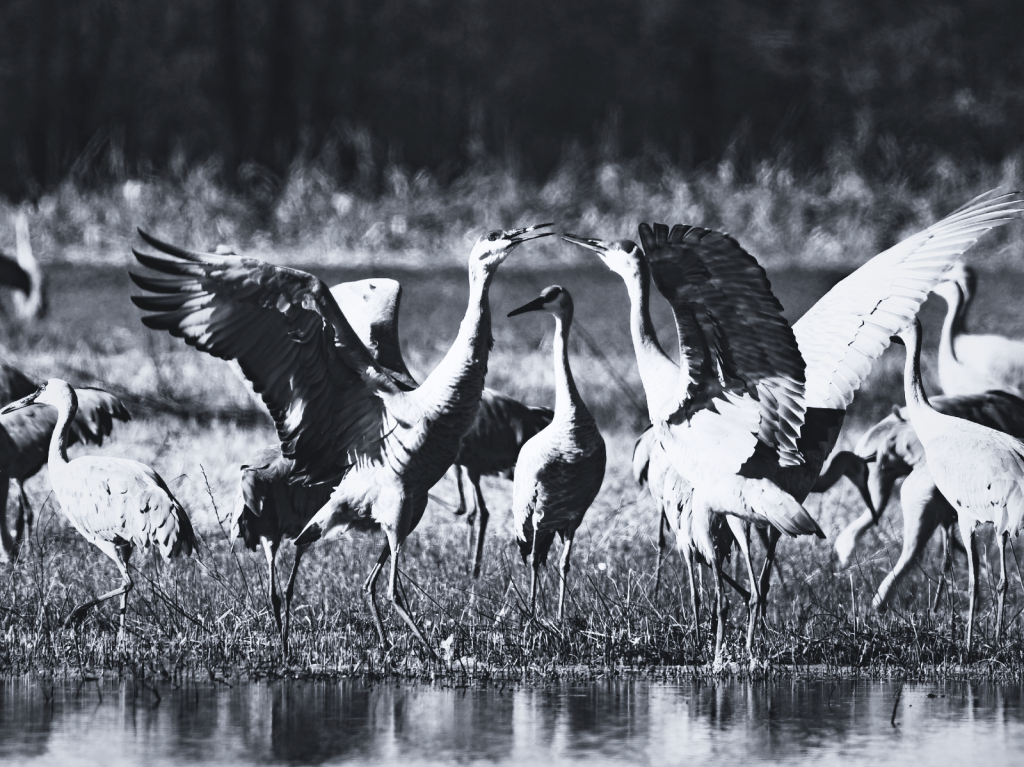
The cover design for Refuge for Cranes is complete and I think it’s a standout. Designed by Melody Stanford Martin of Wildhouse Publications, it features a photograph of Sandhill Cranes in flight by Chris Briggs that evokes the majesty of these amazing birds (pls. see Books section). My thanks to both Melody and Chris for their beautiful work. I’ll post more information about publication when it’s available.
Susan Fenimore Cooper, “America’s First Recognized Female Nature Writer”
When Rural Hours, a natural history diary by Susan Fenimore Cooper, was first published in 1850, it was done so anonymously “by a lady,” the custom for women writers of the Victorian era. Favorably reviewed, it went into nine editions in Cooper’s lifetime, according to Michelle T. Harris, writing in Audubon Magazine (Jan. 8, 2021). One of the first to warn of the dangers of deforestation, Cooper also lamented the loss of wild Passenger Pigeons (extinct by 1900) and the shrinking populations of other birds. The daughter of popular novelist James Fenimore Cooper, she lived in Cooperstown, New York, where she founded an orphanage and wrote for magazines, including The Atlantic Monthly and Harper’s. Rural Hours was reissued in 1998 by University of Georgia Press.
Sandhill Cranes Return to Platte River
This month thousands of Sandhill Cranes will touch down in the Platte River Valley in central Nebraska, feeding primarily on corn kernels and insects, before moving on to their nesting grounds in Canada, Alaska, and Siberia. Visitors often hear the low, chortling sound of the prehistoric birds before they see them, observes columnist Rick Windham of the Platte River Telegraph. Known as a “rally bugle,” that call “is a sound that moves the spirit,” he says. The Iain Nicolson Rowe Audubon Center in Gibbon, Nebraska, offers guided tours of this annual event. Bird lovers can also observe the cranes in their natural habitat in “virtual tours.” For more information, go to https://www.row.audubon.org/events/.
An Ethics of Wild Mind
Author, poet, and translator David Hinton speaks about his latest book in a recent interview in Emergence Magazine. Drawing on Eastern philosophy, Ch’an, and “an ethics tempered by love,” he discusses the need for a deep relationship between humans and earth. https://www.emergengencemagazine.org
Writing Opportunities
The Annual Permafrost Book Prize in Poetry is open to all writers (including non-U.S. citizens) until March 15th. Winner receives $1000, 50 copies, and publication by the University of Alaska Press.
Passager Journal is now accepting poetry entries for their annual contest issue through April 15th. An independent press located in Baltimore, MD, it was founded in 1990 for writers over the age of fifty. https://www.passagerbooks.com
The Robert Phillips Poetry Chapbook Prize is open until March 31st. Winner receives $500 and publication by the Texas Review Press.
An Interview with Gail Entrekin, Editor of Canary Literary Magazine
Interviewed by Jerome Gagnon
The rise of ecopoetry during the last several years can be seen in the many publications devoted to the environment. Some of the newer periodicals are Ecotone, Emergence, Terrain, Flyway: A Journal of Writing, About Place , and Canary Literary Magazine. These publications carry on the tradition of reverence for nature found in world literatures and serve as witness to the effects of ecological devastation. One of the best of the on-line journalsis Canary Literary Magazine (www.https://canarylitmagazine.org. Started in 2007, it aims to “deepen awareness of the environment and enrich the well-being of the individual,” according to their home page.
I interviewed Editor Gail Entrekin (via email) to learn what influenced her to found Canary and what advice she would give to writers planning to submit their work. A poet, hiker, teacher, and quilt-maker, Gail earned an M.A. in English Lit/Creative Writing from Ohio State University. She’s also the poetry editor of Hip Pocket Press. She taught English and Creative Writing at Sierra College in Grass Valley and, for many years, worked with California Poets in the Schools, teaching poetry to children. Her books of poetry include The Art of Healing, with her husband, Charles Entrekin (2016), Rearrangement of the Invisible (2012), and Change (2005), which was nominated for the Northern California Book Award.
Q. I’d like to start by saying how in awe I am with the overall work and aesthetics of the magazine. The combination of text and photographs is always very inviting visually. Can you please share with us what motivated you to found Canary?
A. I don’t know. It was the thing that was on my mind at the time. Our area of the world (Nevada City, CA) had been gold mined back in the day and there was mercury in many areas that was damaging the soil and the water supply. We were fighting the powers that be not to dam the beautiful and scenic Yuba River, and the air quality was heading down due to the pollution rising up to us on our mountain from Sacramento down below. The more I learned, the more upsetting it was. So it seemed to me that what I could do to help was small, but perhaps it would help some people to wake up. And if nothing else, it might serve as a reminder of all the beauty, the connection to the natural world that we were betraying and stood to lose.
Q. Please tell us a little bit more about your background and what you find most satisfying about the editing process.
A. I started a local online publication for women first, to showcase and discuss work in progress (Women’s Writing Salon). It was wildly popular and I expanded it into a local reading series in Nevada City, where I was living at the time, Beyond that, I’ve been employed as an editor in one way or another, on and off, for about 40 years. I also run poetry critiquing workshops, and an important aspect of critiquing is noticing how line breaks, word choices, etc. contribute to the success or failure of a poet’s ability to reach their desired goal for the poem. I love, love, love the opportunity to read work by so many talented and passionate, mostly unknown writers that I would not have read otherwise — people leading their own quiet campaigns in their neighborhoods to save a small piece of the planet on their watch.
Q. What have you learned in your tenure as an editor?
A. At this point, the only things I learn are the new ways the language is changing: new pronoun usage, use of back slashes within lines, etc.
Q. Do you believe that Canary has had a concrete impact on environmental/ ecological issues?
A. No, I fear that we’ve had very little direct impact on the crisis at hand. I think most of our readership is already well aware of the loss of habitat and species that we’re experiencing. We circulate Canary to friends and fellow writers, though, and my hope is that someone becomes more aware of what’s happening and is able to have some small impact in their own world.
Q. What advice would you give to writers who are planning to submit their poetry, and how would you describe your editorial style?
A. I guess I’d give the same advice any editor would give: read the magazine before you submit, so you understand what kind of work we publish. Be sure to read our mission statement on our home page so you understand what we’re trying to accomplish. I never change anything larger than a comma or a spelling error without letting the author know what I’m doing. If I do more than that, I send them my edited version for approval. Poets are especially interested in the formatting of their poems and they don’t take well to unauthorized changes.
Q. Your mission statement says that the theme of the magazine is “the environmental crises and the losses of species and habitat.” Can you give us an example of a poem from one of your issues that addresses that? What is it that you admire, and how do you think your own tastes help or hinder the selection process?
A. The very first poem I selected for Canary was “Birdsong from My Patio”by Ellen Bass, which I solicited (and which considers the effects of pesticide and acid rain on birds and nature – jg). I hoped for more of these and, indeed, there are many. But after a while I branched out into broader stories of events which are contributing to these losses, and too many pieces that simply praise what IS. Some tell of human indifference to other living things, a broader way of considering what’s coming to pass. “Little Fires” by Christina Lovin, for example, in Issue #4 is about the bats we killed. I can think of so many…
As for the last part of your question, I like poems that have something at stake, that are authentic, and reflect both the passion of the poet and the skill and craft to convey that passion. I can’t know, of course, how who I am affects the decisions I make. I try hard to be open to all kinds of styles of poetry that are new to me or that initially fail to move me. Clichés, awkward language, confusion or lack of logical progression, and lack of images and/or metaphors are all serious drawbacks. But I feel very excited when I come across beautiful and well-crafted work that teaches or moves me. I want to share this work with the world. Those are the finest moments in this job.
Q. Thanks very much, Gail. I have just one last question — how do you approach beginning writers?
A. I always give a read to all pieces in a person’s submissions because sometimes a beginning writer stumbles onto one good poem. If I feel someone is almost there, I often say that and ask them to submit again in the future. I sometimes tell a writer who is really pretty good what I like and how I felt the poem fell short.