Writing the Ekphrastic Poem
Probably the best known example of an ekphrastic poem is “Ode on a Grecian Urn,” by John Keats, followed by “Musee de Beaux Arts,” by W.H. Auden, but there are many other examples that add clarity to art: “The Starry Night,” by Anne Sexton; “The Tall Figures of Giacometti,” by May Swenson; “The Dance,” by William Carlos Williams; “The Weary Blues,” by Langston Hughes; and “Waiting on Elvis,” by Joyce Carol Oates can all be found online. An article on The Poetry Lab website, “Ekphrasis Poetry: A Multi-genre Journey You Can See,” by Marilyn Ramirez, offers some good tips on writing in this mode www.thepoetrylab.com.
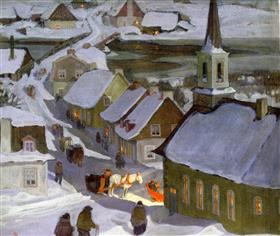
“A Question of Light,” a poem inspired by a winter scene by Canadian painter Clarence Gagnon (no relation) received an honorable mention recently in the annual Catholic Literary Arts Sacred Poetry Contest www.catholicliteraryarts.org. Below is a jpeg, courtesy Wikimedia Commons, of the artist’s 1933 work, “Midnight Mass,” the subject of my entry. Here the artist skillfully depicts the phenomenon of light reflecting off snow on Christmas Eve, evoking a sense of mystery. The perspective, too, is unusual, as if the artist was hovering overhead in a helicopter.
The Ekphrastic Review
An online journal, The Ekphrastic Review was founded “to promote ekphrastic writing, promote art appreciation, and experience how the two strengthen each other,” according to their website. To that end they provide regular contests, a series of online classes and events, and a Zoom reading series. They’ve also published two well received anthologies and several e-books to date

