News

Ways to Help

Following the Russian invasion on February 24th, over two million refugees have fled Ukraine, approximately half of them children. A recent article in the Washington Post (“Here’s How Americans Can Donate to Help People in Ukraine,” February 27) provides links to several helping organizations, including Voices of Children and Save the Children (www.washingtonpost.com). Below are addresses for some other organizations that have dedicated their efforts to helping refugees displaced by this war, including UNICEF:

www.unicefusa.org

www.globalgiving.org

www.internationalrescure.org

www.doctorswithoutborders.org

www.airbng.org

www.unhcr.org

Poem Goes Viral

Ukranian American poet Illya Kaminsky’s poem, “We Lived Happily Through the War,” went semi-viral after the invasion. In an article in the New York Times (March 3), poet Victoria Chang introduces the poem, which originally appeared in Kaminsky’s volume, Deaf Republic (a NYTs Notable Book). The theme is complacency during a time of war. Born in Odessa, the author emigrated to the U.S. with his family in 1993. He speaks at greater length about his work in an interview with Dan Kois (Slate, March 4).

Auden’s 1939 Meditation

W.H. Auden’s poem, “Crisis” first appeared in the Atlantic magazine in 1939, on the same day the German army invaded Poland. It’s been described by the Atlantic as “a meditation on the creeping horror of fascism and the dread of invasion,” and “an unofficial prologue to Auden’s famous poem on the beginning of the war, “September 1, 1939.” He continued to revise the latter work over the years, never content with the final line. Yet that line, “We must love one another or die,” continues to resonate. 

Teach This Poem

The Academy of American Poets offers lesson plans for teaching Kaminsky’s poem, as well as for those by Auden and others. Activities include reading, writing, speaking and listening, with suggestions for remote and blended learning. See “Teach This Poem,” www.poets.org. Biographies and poems of more than 3,000 poets can be found on the website. 

Poetry Peace Award

The annual Barbara Mandigo Kelly Poetry Peace Award contest is accepting entries until July 1, 2022, and is open in three categories: for adults, youth, and youth under twelve. First prize is $1,000 and publication. For more details, see www.peacecontest.org.

News

Sights and Sounds

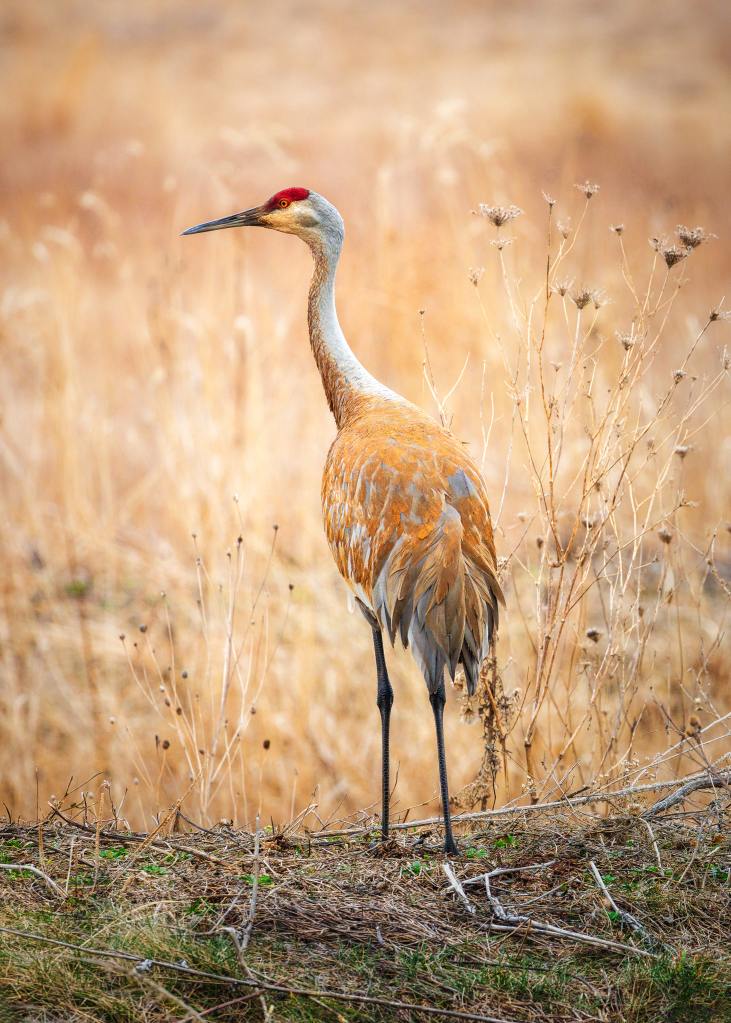
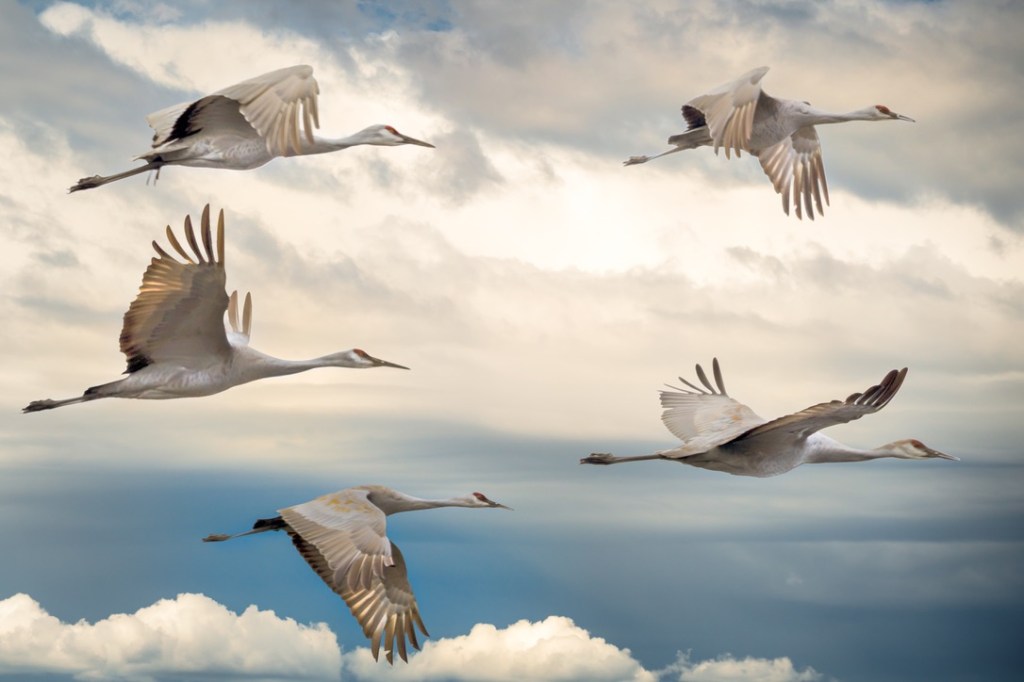
Sandhill cranes have been wintering recently in the Sacramento Delta region, drawn to the marshes and fields where they feed on waste grain from harvested crops. Standing up to four feet tall and with wingspans of up to seven feet, they’re known for their unique courtship dance and trumpet-like calls. The Woodbridge Ecological Preserve and the Cosumnes River Preserve in Lodi offer some of the best designated viewing spots around. A wide range of other birds can also be found there, including whooping cranes, double-crested cormorants, white pelicans, grebes, egrets, and various species of hawks, quail, geese, and ducks.

We received abundant snow and rainfall in California earlier this winter. In Yosemite, the falls are all flowing and accessible (some services may be limited due to COVID; for the latest information visit www.nps.gov.) In Mill Valley, the Cascade Falls are running again, and in Sunol Regional Wilderness, the scenic gorge of the Little Yosemite Area offers hikers the sight and sound of cascades spilling over boulders into swirling pools.

The increased rainfall has been a boon for spawning salmon. In Lagunitas Creek in Samuel P. Taylor State Park, female coho salmon can be seen preparing nests in the shallow waters while males compete for the best spots in the creek. (“A Good Year to See Coho Salmon Make Their Annual Return to Marin,” by Tara Duggin, SF Chronicle, January 4). 

World of Wonders

I don’t know how I managed to miss this book. World of Wonders: In Praise of Fireflies, Whale Sharks, and Other Astonishments,” by Aimee Nezhukumatathil, was on the best seller lists for weeks. A review by James Rebanks in the NYTs (Sept. 11, 2020) offers that the author has written “a timely story about love, identity, and belonging (more accurately often about not belonging, because of racism and her family’s immigrant experience).” A poet with four collections to her credit, Nezhukumatathil, links her personal history with the natural world, focusing on the wonders of the catalpa tree, fireflies, and Narwhals, among other subjects. The result is an engaging and intimate memoir, and a wonder itself. It reminds me of some of the early writing of Gerald Durrell, though without the comic lens. With illustrations by Fumi Mini Nakamura (Milkweed Editions, 2020). 

The Colors of Nature

This breakthrough anthology, edited by Alison Hawthorne Deming and Lauret Savoy, reveals how bias influences attitudes and policies about nature. In The Colors of Nature: Culture, Identity, and the Natural World, thirty writers of various backgrounds examine how conditioning can shape our awareness of the environment and how we write about it, and how important diversity is in our approach to planetary struggles. (Milkweed Editions, 2011).

Open Submissions

Terrain.org is an online journal seeking poetry, nonfiction, fiction, art, multi-media and mixed genre work that inspire “just and joyous relations with the planet and each other.” Since 1997, they’ve published award-winning literature, editorials, and case studies about place. Deadline is April 4, 2022 for the spring issue. Visit www.terrain.org for details.

About Place is an online journal published the Black Earth Institute. Dedicated to finding “pathways to peace” and to “cure what is wrongfully impacted by ecological destruction,” they seek poetry, fiction, essays, creative nonfiction, and audio/visual artwork. Open for submissions until March 10 Visit www.aboutplacejournal.org for details.

News

Books Noted

Kindest Regards, New and Selected Poems, by Ted Kooser (Copper Canyon Press, 2021), contains four decades of poetry in addition to recent work. The Pulitzer Prize winner, who hails from Nebraska and served as Poet Laureate to the Library of Congress from 2004 to 2006, is known for his short, imagistic poems that focus on everyday events and objects. Reflecting the landscape of Midwestern towns and farms (he lives on acreage in Garland, Nebraska), his poetry expresses universal experiences and the need for meaningful connection. He has said of his work that, “I want to show people how interesting the ordinary world can be if you pay attention.”

As the 23rd U.S. Poet Laureate, Joy Harjo gathered the poetry of Native peoples past and present in the 222-page An Anthology of First People’s Words: Living Nations, Living Words (W.W. Norton, 2021). Poets such as Natalie Diaz, Sherwin Bitsui, Ray Young Bear, and Santos Perez address themes of displacement, visibility, struggle, resistance, and other subjects here. The anthology demonstrates “that heritage is a living thing,” Harjo writes in the introduction, “and there can be no heritage without land and the relationships that outline our kinship.” A member of the Muscogee (Creek) Nation, she is the author of several poetry volumes and a memoir, “Crazy Brave.” 

Poet and teacher John Brehm’s The Dharma of Poetry: How Poems Can Deepen Your Spiritual Practice and Open You to Joy (Wisdom Publications, 2021) is geared toward poets and poetry lovers who practice meditation, but it’s a rich resource for readers and writers of any persuasion. Brehm presents poetry as a “powerful way to disrupt the habitual momentum of the mind, its automatic reactions and obsessive self-concerns.” His analysis of poems such as James Wright’s “A Blessing” and Ryokan’s “First Days of Spring” point out how these poems offer the reader an opportunity to pause while “full of imaginative engagement,” and invite us to enter “the timeless experience the poem describes.” The book also contains writing prompts and suggested meditations.

In Memoriam

Three of San Francisco’s former poet laureates died in 2021 — Lawrence Ferlinghetti (at age 101), Janice Mirikitani, and Jack Hirschman. In addition to their innovative literary output, each made a vital contribution to the city’s cultural life — Ferlinghetti as co-founder of City Lights Bookstore and publisher of the Beat poets, Mirikitani as ambassador of love (with her husband the Rev. Cecil Williams) and Hirschman as an outspoken writer who reminded us of the importance of politically relevant poetry. Other outstanding American poets who passed recently are: bell hooks, Stephen Dunn, Thomas Kinsella, Jean Breeze, and Robert Bly. May they all rest in peace.

Open Submissions

Split Rock Review, an independent online publication, is accepting submissions for Issue #18, including poetry, creative nonfiction, fiction, hybrid, photography, and art with an emphasis on place and the environment. Until Jan. 31st. www.rockreiew.org

The Emerson Review, out of Emerson College, is now open for submissions until February 1st for the spring issue, due to be published in April. Seeking poetry, fiction, nonfiction, photography and art. Selected pieces are nominated for a Pushcart Prize. www.emersonreview.submittable.com

Beloit Poetry Journal, a print publication, is open for poetry submissions in various forms and styles. Send up to five unpublished poems or one long poem by January 31st.  www.bpj.org

Haiku Notes

Chiyo-ni

Anybody who’s ever lived around morning glories knows that they often turn up in unexpected places — curled around a shovel or a ladder, growing around a drainpipe, or climbing up a fence post, to name a few. The haiku, below, reflects that trait*:

morning glories 

wrapped around the well bucket —

borrowing water

According to D.T. Suzuki, this haiku by Fukudo Chiyo-ni (1703-1755) conveys the experience of suchness, in which the speaker is “perfectly at one with reality” — so much so that she went to a neighbor to borrow water rather than disturb the scene she described. Chiyo-ni began writing haiku at the age of seven and by seventeen was well known throughout Japan as a follower of Basho’s style. Below is one of many haiku she wrote expressing evanescence*:

clear water

cool to the touch —

fireflies vanishing

Late in life, she became a nun in the Pure Land Buddhist tradition, while continuing to write haiku and renga. Here are a few more examples of her work*:

pampas grass,

made for this life

in the wind

from the heart of this one vine,

countless gourds

flickering

between maple leaves —

twilight

   *trans. jg 

Gratitude

As 2021 draws to a close, I’m reminded of Mary Oliver’s poem, “Gratitude,” from the collection, Thirst. It contains eight questions, any one of which might serve as a prompt for a poem:

– “What did you notice?”

– “What did you hear?”

– “When did you admire?”

– “What astonished you?”

– “What would you like to see again?”

– “What was most tender?”

– “What was most wonderful?”

– “What did you think was happening?”

For me, the question,“What was most tender?”, invites reflection. The tender moments we experience in life are often the ones that are imbued with love — the love of close relationships, the love for pets, for wildlife, or the beauties of nature. Which questions resonate with you? What are you most grateful for? 

Haiku Notes

…The Awakened One, a new anthology of Buddhist-themed haiku, is now available on Amazon and other platforms. Published by Poetry Chaikhana and edited by Adjei Agyei-Baah and Gabriel Rosenstock, the anthology features haikuists from around the world in dialog with Japanese masters such as Basho, Buson, and Issa. 

…The Haiku Apprentice: Memoirs of Writing Poetry in Japan, by Abagail Freidman with an introduction by Michael Dylan Welch (Stone Bridge Press, Berkeley, CA, 2006). Abigail Freidman was living in Japan as an American diplomat when she met haikuist Momoko Kuroda. At that time Kuroda was already a prominent teacher who had been featured in the anthology, Far Beyond the Field: Haiku by Japanese Women, by Makoto Uedo (the title comes from one of Kuroda’s haiku):*

greening the sky

far beyond the field —

lightning flash

Friedman, who was already studying calligraphy, joined Kuroda’s haiku group, Aoi Kaiku Kai, writing her first haiku in Japanese. She traces her learning curve here, offering passages on the significance of kigo and cutting words, and the value of working with a group. This lively account is as revealing for its intimate glimpses into Japanese culture as it is for its many insights into the practice of haiku.       

The Poems of Nakahara Chuya, translated by Paul Mackintosh and Maki Suglyama (Gracewing Publishing, 2017). One of Japan’s early 20th century poets, Nakahara Chuya was influenced by both Dada and French symbolism and has been referred to as the “Japanese Rimbaud.” He is known for his collections Yagi no Uta (Goat Songs, 1934) and Arishi Hi no Uta (Songs of Bygone Days, 1938).

*trans. jg

News

Stories We Tell Ourselves

I don’t know anyone who isn’t concerned about the environment these days. The impact of air pollution and climate change can be seen around the globe. As sea levels rise, currents are expected to shift dramatically. From what I understand, there are approximately 1,000 species becoming extinct every day. In her book, Staying with the Trouble(Duke University Press, 2016), theorist Dr. Donna J. Haraway suggests that “staying with the trouble” brought on by climatic and environmental crises can encourage new ways of thinking and new means to sustain us in the future. At the same time, there needs to be a change in the stories we tell ourselves.      

“Everything is held together with stories, that’s all that’s holding us together, stories and compassion,” essayist and fiction writer Barry Lopez once said. Many of these stories influence our actions. The anthropocentric story that humans are the apex of nature, for instance, underlies the idea that we’re entitled to treat the world as an exploitable resource. Yet there are other stories that support sustainability and the interdependence of life. Some of them are ancient, coming from indigenous cultures. Some are new and science-based. We know that organisms in an ecological system depend on each other for their survival, for instance, reinforcing the importance of conservation and species preservation.     

Dr. Suzanne Simard’s recent book, Finding the Mother Tree: Discovering the Wisdom of the Forest (Knopf Doubleday), reports on her lifelong research with trees in the rainforests of British Columbia, demonstrating that forests are “social, cooperative creatures connected through underground networks by which trees communicate their vitality and vulnerabilities…” Not only are they capable of recognizing other trees around them, they “can remember the past and have agency about the future,” according the publisher’s notes. Simard’s work offers compelling evidence of the interdependence of these noble organisms. More than that, it presents scientific inquiry in a humanistic light, showing that “it is about understanding who we are and our place in the world, and how old growth trees “nurture the forest in the profound ways that families and human societies do, and how these inseparable bonds enable all our survival.” Finding the Mother Tree offers a compassionate model as a way forward, one based on a benevolent relationship with the earth, rather than a commodity to be exploited. As poet Wendell Berry has put it, “The environment is in you. It’s passing through you. You’re breathing it — you and every other creature.” 

Eco News

In February, 2021, a snowy owl was spotted in New York City’s Central Park for the first time in over 130 years. Within days it moved on, possibly disturbed by the crowds that came to admire it, or maybe just wanting to return to the Arctic where the majority of the white raptors with black markings make their home

Plans for a controversial oil pipeline project, slated for construction in Memphis, Tennessee, were cancelled in July during the midst of protests and ongoing lawsuits. The proposed 49-mile long pipeline would have carried thousands of gallons of crude oil daily over a protected zone that supplies drinking water to residents of Southwest Memphis, home to several predominately black communities. Led by Memphis Community Against the Pipeline (MCAP) and Protect Our Acquafier, locals rallied to protest the plan they believe would have put neighborhoods such as Boxwood and surrounding homes and businesses at risk, while the Southern Environmental Law Center opposed litigation against long-time residents whose homes stood in the path of the project. The plan, which drew fire nationally, was condemned by former Vice-President Al Gore and others

In Galveston, Texas, volunteers rescued over 2000 green sea turtles that were “cold-stunned” in late February of this year by unseasonably freezing temperatures. Approximately 200 threatened sea turtles from Matagorda Bay and Padre Island were also rescued and taken to the Galveston Laboratory Sea Turtle Hospital for treatment.   

Contests

The 2021 Porad Award, sponsored by Poetry Northwest, is now open. Submit up to five haiku (www.haikunorthwest.org) by September 20th. Named for Francine Porad, the late founder of Haiku Northwest and a former president of the Haiku Society of America, the contest is free this year and will be judged by Susan Antolin, editor of Acorn and author of The Years that Went Missing. Results will be announced on October 30th… The Miller Williams Poetry Prize: submit a full-length collection by September 30th… The Patricia Dobbler Poetry Award: submit two poems up to 75 lines each (for women over forty who haven’t published a full-length book) by 

Putting a Full-length Collection Together: Part 2

Looking at a variety of poetry collections can be useful when it comes time to assemble your own. Many are thematic like Stag’s Leap, by Sharon Olds, which focuses on the years before and after the poet’s divorce following a thirty-year marriage. Others tell a story, such as Ann Carson’s Autobiography of Red and Illya Kominsky’s Deaf Republic. Less common today are those that concentrate on formal poetic forms, such as Dana Gioia’s 99 Poems: New and Selected. There are countless ways a collection can coalesce, and a strong vision combined with other factors can help to make it shine.

The poetry of Frank O’Hara has a distinctive voice that’s conversational in tone. One of the things that makes his Lunch Poems so effective is that it combines voice with theme. These pieces were written when O’Hara was on lunch break from his job at the Museum of Modern Art in Manhattan and have a spur-of-the-moment quality that evokes the pace of city life. Like the poems themselves, the collection comes across as spontaneous with a lively mix of topics and emotional content.  

A distinguishing facet of Lucille Clifton’s poetry is its visual appeal. Reviewer Peggy Rosenthal wrote of Clifton’s work that, “The first thing that strikes us about Lucille Clifton’s poetry is what is missing: capitalization, punctuation, long and plentiful lines. We see a poetry so pared down that its spaces take on substance, becoming a shaping presence as much as the words themselves.” Visual appeal is closely related to voice, and when these two qualities are combined with strong themes, as they are in Clifton’s Blessing of the Boats, New & Selected Poems, 1988-2000 (winner of the National Book Award), the result can be unforgettable.        

Lyric ordering is another way to enhance cohesion. With this approach, each poem is linked to the previous one in some way, for instance, by imagery or repeated words or phrases. An alternative approach is to place “hinge” poems at the close of each section and the beginning of the next one to guide the reader from one section to the next.

Editing

The conventional wisdom is to begin the editing process after you’ve finished your first draft. But editing a poetry collection is different from editing the draft of a novel, say. I find it to be an ongoing process from start to finish, of writing, revising, and editing. Whatever your method is, when you get to the point that the manuscript feels complete, it’s advisable to let it sit for several days, or even weeks. Then, you’ll be able to give it a final edit with fresh eyes. At that point, it may seem that you’re looking at someone else’s work, a huge advantage because you won’t be blinded by attachment it. 

A final edit can reveal some surprising oversights. It might be a wordy poem that could be tightened up or one that needs to be reformatted, or tweaked. It might be a repeated misspelling or that fact that you used a certain word too many times. (This is where spellcheck and the search function come in handy.) Even if you’ve never been a particularly good judge of your own work, you may find that your editorial eye has become hawk-like, zooming in on a misplaced modifier or a less than effective image. You may also get a sense for what ails the manuscript. Poet and editor April Osserman, who served as Executive Director for Alice James Books, points out that one of the hardest tasks for a poet who’s assembling a collection is to let go of those pieces that aren’t “book strong” or those that “don’t fit the major or minor themes of the book.”  Save those for another project, she recommends in her article, “Thinking Like an Editor: How to Order Your Poetry Manuscript,” March/April 2011 (www.https:pw.org).  

It’s advisable to look closely at your first and last poems, too. Does the first poem set the right tone? Is it one of your stronger poems? Does the last poem in that section foreshadow the next section? If not, is the transition effective as is? Re-examine key poems and those around them; do they expand on your vision or “talk” to each other? Then read through them sequentially. If there’s a narrative line, does it carry the reader in an engaging way from point A to point B?  Does the last poem in the collection reiterate your vision while adding something new?  Last, if you haven’t been doing this all along, you’ll want to read the poems out loud to yourself. How do they sound? What do you notice about reading them out loud versus reading them silently? What would you change?

Selecting a Title

It’s not absolutely necessary to have a working title, but it can help as a kind of stabilizing force around which the poems revolve. As the project moves along, you may come up with alternative titles, some better, some worse, and the right one may not appear until the last moment. You may hear it from a trusted reader or editor who points out that a little noticed phrase in one of your poems might be the one. Or you might compose a new poem that introduces it. One way or another it will show up.

Some questions to ask when deciding on a title:

  • does it reflect your vision?
  • is it memorable?
  • is it original?
  • does it invite the reader in?
  • does it resonate with the style or voice of the poems? 
  • is it intriguing, or even mysterious?

Sometimes a prospective title just needs a twist, a little something extra to make it stand out. Try switching out a lackluster word or adding a verb to give it action. Rearrange the word order, adding other words to the mix if necessary and see what comes up. Consider making a list of your favorite titles, whether or not they’re poetry collections. Here are a few of my favorites: On Earth We’re Briefly GorgeousCatalogue of Unabashed GratitudeBright Dead ThingsHeaven Is All GoodbyesEveryday Mojo Songs of EarthPetals of the Moon. Some titles emphasize verbs or verb forms, such as TrainspottingSleeping It Off in Rapid City, and If We Had a Lemon We’d Throw It and Call That the Sun. At thirteen words, this last one definitely gets my attention.
Putting a Full-length Collection Together: Part 1

Getting Started

There are a lot of articles out there about how to put a full-length collection of poems together and some of them are of the “ten easy steps” variety. But the truth is, it’s more complicated than that. The process calls on intuition, trial and error, and a good deal of rewriting and editing. A full-length collection can take three years or more of reworking and polishing before it’s ready to be published. Teaming with an experienced editor may speed up the process, but the time it takes to turn a manuscript into a book is valuable, even precious, to a poet’s growth. Why rush it?

Like writing a poem, assembling a collection of poetry is a non-linear process that invites deep immersion. Through close observation you begin to recognize the shape and purpose of the work. You note its weak points and its strengths. You go over it multiple times with various lenses, looking for connections and commonalities. You sink into the mystery of it, not looking for answers necessarily, but alert to questions.

In her article, “How Do You Pick and Arrange the Poems for a Poetry Collection?” poet and blogger Christina M. Ward, author of the collection “organic,” stresses the importance of cohesiveness (www.https:medium.com): “When I say plan a theme, I don’t mean that each poem needs to be about one topic, but the book as a whole needs to have a definable “purpose” or “theme” or “feel,” she says, suggesting that poets think of this as the “vision” of the book. It helps if a book is about something but not every collection needs a specific theme to be cohesive.

Selecting, Sectioning, and Sequencing

Once you’ve identified your vision for the book, you’re ready to begin selecting the poems that are most aligned with that vision. In assembling my second collection, I began by separating poems into two stacks, those that worked or had the potential to work, and those that clearly didn’t. At that point I had about thirty-five poems and knew I needed more. Searching what I laughingly call “my files” — a couple of drawers full of loose papers and others in manila folders — I found a few more possibilities, bringing the total to fifty-one, just enough for a full-length collection. I wasn’t exactly off and running, but there was a glimmer of a hope that I might find a book in there someplace. 

One way to jump-start your collection is to divide the manuscript into sections. This will let you zone in on specific areas and can make it feel more manageable. It also offers visual breaks, along with an opportunity to add section titles and related inscriptions that can help to transition the reader from one thematic focus, or mood, to the next. But like everything else in the process, these details are apt to change. For me, those changes are a sign that I’m beginning to hone in on the finer details. At some point, sections and inscriptions may appear superfluous or even interrupt the flow — if so, it’s okay to let them go. They will have served their purpose like scaffolding on a building site. 

One of the most challenging tasks in putting a collection together is sequencing. Phoebe Stuckes, a former Foyle Young Poet and author of Platinum Blonde (www.https:poetryarchive.org), compares the process to stand-up comedy, in which you “tell your second best joke at the start of your stand-up set and your best joke at the end.”  She suggests printing out your manuscript so you can physically try out various sequences until you find the right one. I’d compare this stage to putting an album of songs together; you want some ballads and some up tempo numbers, some highs and lows, some short numbers and some longer ones. These variations will add texture and interest. Avoiding repetition is key. If you have two poems that are both on the same topic and use much the same vocabulary, you’ll need to rework one or drop it. Feel free to experiment. Playing with different formats such as prose poems and concrete poems can reap unexpected benefits, not only in the way the poems look on the page, but in how they “mean,” and can open the work up in unexpected directions. If you decide later that an experimental poem doesn’t make the grade, you can always pull it.   

Having an accurate table of contents early on is an advantage if you decide to submit the manuscript on the spur of the moment or if you want to share it with a trusted reader for their input. Yes, it’s going to change a lot over the course of the project, but the benefit is that you can scan it from time to time to get a sense of how the “narrative line” is evolving (more on this later). It’s also a good place to enter any notes about what you think might be missing. Do you want a title poem? If so, where do you think it ought to go? Scanning the table of contents will help you decide. Granted, it can be tedious to update page numbers as you shift sections or shuffle poems around, but I’ve found that it’s worth it. This is the uninspiring part of the work, the busy work you might call it, that nevertheless helps to bring a sense of structure to the chaos. (Next time: Looking at structural models and selecting a title.)