Garden Notes
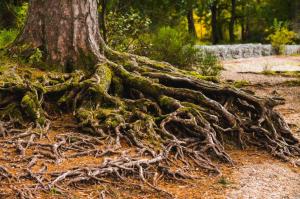
This was the wettest summer on record in San Francisco and the coldest July in over forty years. The fog has returned with a vengeance, but here in the burbs we’ve had a mild summer so far with many days in the mid-seventies — just right for working in the garden. It’s mostly clean-up here to cut back and remove debris. As usual, the bamboo is a mess and the morning glories have sent out their runners all over the place, but there are also layers of dried weeds. I do everything with hand tools, so it’s a quiet practice for the most part, interrupted by the sound of bamboo stalks cracking and branches coming down.
A garden is never finished — an ongoing process full of little surprises. I like coming through the gate in spring to see the nectarine tree in blossom. Or, in summer, finding the first bunch of fruit hidden in the leaves. I can gaze at an empty space, imagining what might grow there, examine an overgrown patch to figure what should be removed. It’s a lot like reviewing a poem and seeing something I didn’t see before, an implied metaphor that could be developed or a few words that should be omitted. A “they” that might to be changed to a “we”.

The Wild Iris
In Louise Gluck’s Pulitzer Prize winning collection, The Wild Iris (1992), the title poem and others are spoken in the voice of a flower reflecting on the mysteries of this world and the “hidden” world beyond. I remember reading this book, or trying to read it, for the first time. At first, the poems were largely opaque — I just wasn’t used to thinking about flowers as having a voice, much less a philosophical one. And then something clicked. Suddenly I suspended my disbelief and the poems came alive, although they weren’t always transparent. Some of them may be deliberately ambiguous, which allows for multiple interpretations. Writing in The New Republic, Helen Vendler observed that The Wild Iris “…wagers everything on the poetic energy remaining in the old troubadour image of the spring, the Biblical lilies of the field, natural resurrection.” Like nature, it revolves as much around winter and oblivion as it does around renewal, and these images evoke trauma. As Gluck writes in her title poem, “…whatever returns from oblivion returns to find a voice.” It’s this voice that appears “like a great fountain” in the closing lines and resonates page after page with a hard-won wisdom.
Opportunities
The Fourth River, a print and online publication of Chatham University’s MFA in Creative Writing, is seeking submissions of poetry, fiction, and nonfiction until September 15th, and then from November 15th to January 15th. They want to see writing that “explores the relationship between humans and their environment, both natural and built, urban, rural, or wild.” The current theme is “innovation.” See www.4thriversubmittable.com for details.
Modern Haiku is open to submissions of haiku, senryu, and haibun year round with cut-off dates on March 15th, July 15th, and November15th. Regarding the content of haiku submissions, their perspective is that “syllable and line count are not vital in English-language haiku” while seasonal references, concrete images, and a lack “views or values” characterize the best examples. Submissions may be made by mail or email, and are free. For details visit www.modernhakiu.org.
Finishing Line Press is now accepting entries for the 2025 New Women’s Voices Chapbook Competition. The competition offers publication and a prize of $1,500 for a writer who “identifies as a woman and has not yet published a full-length collection,” according to their website. Ten finalists will also be selected for the chapbook series. Contest ends October 15, 2025. www.finishinglinepress.submittable.com

 Jerome Gagnon Blog