New Collection Slated for 2023

I’m very happy to report that my new collection, Refuge for Cranes: Praise Poems from the Anthropocene, will be the first volume of a poetry series by Wildhouse Publications. Slated for mid-2023, it explores the intersection between inner and outer landscapes, finding refuge in nature, art, and awareness itself. Poems range in topic from climate fires and the demise of bees, to the “transparency of grace” and “the soul’s deep-down unfathoming.” These poems were a way to address my fears about the environment, even as I continue to find beauty all around. Someone used the term eco-grief to describe the psychological effect of the crisis we’re living through — the sorrow at seeing habitats destroyed and species gone forever, and that was part of my impetus. But as the subtitle indicates, they’re also poems of praise. My thanks to everyone at Wildhouse Publications for welcoming this project and for bringing poetry to the forefront during these challenging times. (I’ll post details about ordering, etc., as soon as they’re available.)
Sandhill Crane Conservation

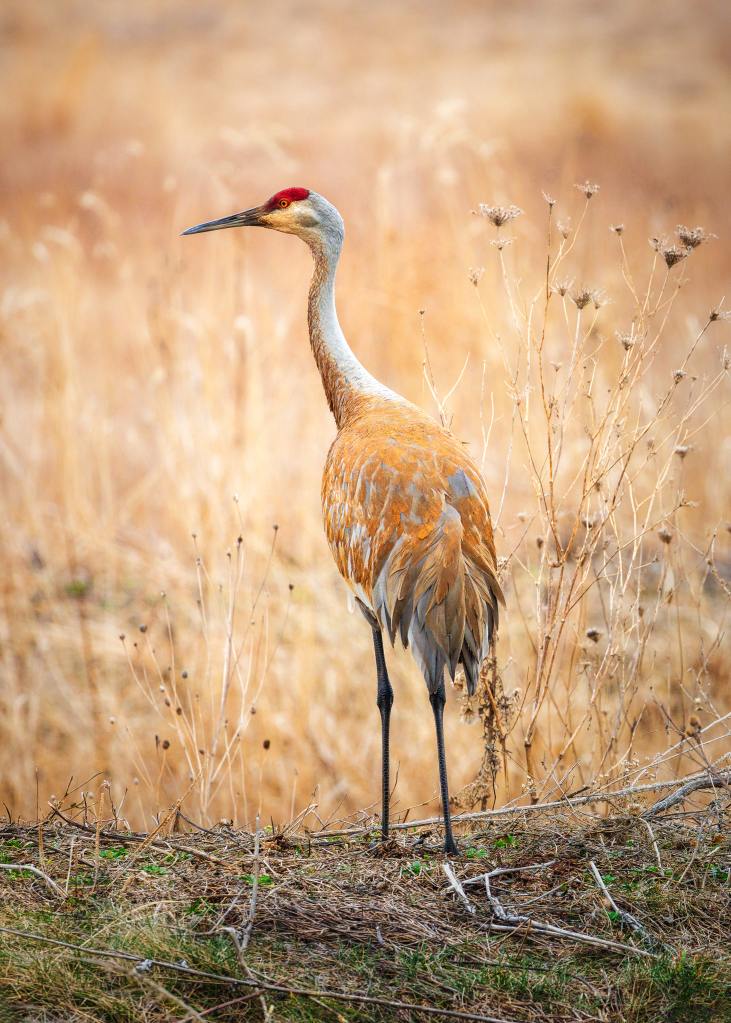
In 1937, conservationist Aldo Leopold warned in his essay, “Marshland Elegy,” that upper Midwest Sandhill Cranes were in danger of extinction. But with the support of farmers, wetland restoration, and changed hunting practices, their  population rose from just 25 breeding pairs in Wisconsin to over 15, 000 today, while the eastern population is around 90,000 (“A Conservation Success Story,” October 26, 2022, www.https://wpr.org). Yet cranes still remain at risk throughout the world, with 10 out of 15 species endangered, including Greater and Lesser Sandhill Cranes of California’s Central Valley. The International Crane Foundation “works worldwide to conserve cranes and the ecosystems, watersheds and flyways on which they depend,” according to their mission statement. To learn more and how you can help visit www.https://savingcranes.org.

Writing Opportunities

Wildhouse Poetry, a new imprint of Wildhouse Publications (WHP), is sponsoring a chapbook contest to launch their new poetry series. Offering publication and $500 to the winner, the contest will be judged by Jane Hirshfield. Based in Boston, Massachusetts, WHP “exists to bring transformative spiritual insights to people for whom traditional resources may not fit,” according to their homepage. The non-profit indie press is also considering full-length poetry, fiction, and non-fiction manuscripts through Submittable (https://www.wildhousepublishing.com/WiPo).

Happy New Year!

(Coming up: Writing the New Year Haiku)

A Place for Joy

The poet Carl Phillips said in an interview recently that, “A place must be made, still, for joy.” That’s probably always been the case but these days the need to cultivate positive feelings and attitudes may seem more critical. May we all find a time and place for joy, now, and in the days to come.

Pushcart Nomination

“Encomium for a Garden” (Spiritus, Fall 2022), was recently nominated for a Pushcart Prize. This is one of those serendipitous poems that practically wrote itself. I may have changed a word or two and then changed it/them back, again. This is my favorite kind of poem to write, one that flows easily from pen to paper. My thanks to the editor, Mark Burrows, for forwarding it.

Winter Workshops

Cassie Premo Steel, author of Earth Joy Writing: Creating Harmony thorough Journaling and Nature, will lead an online writing workshop, Release the Dark, Receive the Light, sponsored by Ashland Creek Press, on January 2, at 11:a.m. www.https://ashlandcreekpress.com

Robin Farr, poet and co-editor of River Heron Review, will lead a four-session online workshop, Poetry Boost: From Title to Publication on Thursday nights from November 10 to December 8. www.https://riverheronreview.com

Writing Opportunities

Emergence Magazine

An online magazine with an annual print edition, Emergence publishes essays, op-eds, films, and audio stories about the “timeless connections between ecology, culture, and spirituality,” according to their homepage. Focusing on “long-form content that is both thought-provoking and evergreen,” they also offer a weekly podcast with interviews, narrated essays, fiction, and more. www.https://emergencemagazine.org

Passager Journal and Books

Dedicated to the work of writers over the age of 50, Passager Journal publishes a twice-yearly print edition and now features a weekly podcast, too. Passager Books focuses on poetry collections, short fiction, and anthologies by writers who’ve been published in the journal and offers the Morgenthau Prize for a first book of poetry by a writer age 70 or older. www.https://passagerbooks.com

The Cincinnati Review is seeking poetry, fiction, nonfiction, and translations through December. (Submissions close once they meet their cap.) A print magazine out of the University of Cincinnati, it pays $30 per page for poetry. www.https://cincinnatireview.com

KAIROS Literary Magazine

Founded in 2016, this online magazine is looking for poetry, creative nonfiction, and op-ed pieces. Published tri-annually, submissions are accepted on a rolling basis. www.https://kairoslit.com
Prairie Schooner is a print quarterly published by the University of Nebraska-Lincoln. They’re seeking essays, interviews, reviews, short stories, and poetry now until May 1st. The Raz-Shumaker Book Prize opens January 15th. www.https://prairieschooner.unl.edu

In Praise of the Natural World

Attention is the beginning of devotion.

– Mary Oliver

Praise seemed to come instinctively to Mary Oliver. One of the most popular late twentieth-century poets, Oliver’s attention was often focused on the woods, ponds, and beaches that she explored in forays around her home in Provincetown, Massachusetts. In Upstream (2016), a collection of essays on nature and literature, she notes that early on she “did not think of language as the means to self-description…” but as a way “to notice, to contemplate, to praise…” One of my favorite poems, from New and Selected Poems Volume One (winner of the National Book Award) is “Little Owl Who Lives in the Orchard.” It captures me from the first line and doesn’t let go until the last line. I could say the same for most of Oliver’s poems, but this one feels as if I’m right there in the orchard listening to a youngish owl “flutter down the little aluminum ladder of his scream.”  

If “attention is the beginning of devotion,” as she wrote, then wonder may be the beginning of praise — for the fox “so quiet — he moves like a red rain,”  for the hawk with “one exquisite foot” attached to a twig, even for “The cracked bones/of the owl’s most recent feast…” For Oliver, attention most often means being in the presence of, whether it’s the owl in the orchard, a hermit crab on the beach, a hummingbird in a trumpet vine, or egrets at the edge of a pond. This attention to wildlife and the environment alerts her to possibility — the possibility of danger, of beauty, of death, of life, or simply of nothing “but the cold creek moving/over the old pebbles…”

Unlike the narrative “I” of Whitman, who she considered a childhood “friend,” Oliver’s “I” enjoys a relative position in the background. From this vantage point, she offers observations rich with detail, color, and music. She’s not afraid to use a well-placed exclamation point occasionally, or just as often, a question mark. “Are you listening, death?” she asks in “The Rabbit.” These kinds of questions don’t always come with answers, of course, but reflect a sense of mystery that permeates her work, a respect for not knowing and for silence.

She had her darker moments, some of them probably attributable to childhood trauma. In “A Visitor,” she struggles to come to grips with her estrangement from her father, a subject she discussed frankly in her later years. In one of her most well-known poems, “Wild Geese,” she writes, “Tell me about despair, yours, and I will tell you mine./Meanwhile the world goes on.” If there’s a secret to her appeal, I think it’s that she comes to the poem with an inclusive love for the world in all its imperfections — that and a willingness to embrace it again and again.

Writing Prompt: Gratitude

For this prompt, make a list of ten things you’re grateful for. They might be ordinary items around you — just-picked tomatoes, a set of salt and pepper shakers, or a glass of water, for instance, or they might be something more personal such as a family member, pet, or a prized possession. After completing your list, select the most promising subject and write continuously about that for at least five minutes, or more. When you’ve run out of steam, take a look at what you’ve come up with. Is there a poem there, or more than one poem? After fine-tuning your work, let it sit for several days. Then go back and have a second look. If it’s redundant, remove the deadwood. If it feels incomplete, you may want to weave in some additional details, or consider posing a question and answering it.

Writing Opportunities

Poetry Northwest is accepting poetry submissions from October 1st to November 30th. https://www.poetrynw.org

The Colorado Prize for Poetry is open for submissions of full-length manuscripts (48-100 pages) from October 1st to January 14th. https://www.coloradoreview.colostate.edu

Haiku as Discovery

Haiku sometimes arrive intact and read just right. But more often than not (at least in my case), they can benefit from revision. This process is the subject of the article, “Haiku as Discovery,” forthcoming in the fall issue of Seashores, #8 (https://www.haikuspirit.org).

Recent Haiku

old pine: Modern Haiku, issue #54.1, Fall 2022

empty swings: Haiku Corner, Japan Society, #34, 2022

walking (under redwoods): Seashores, issue #8, Fall, 2022 

Inquiry as a Poetic Tool

Questions naturally arise in first drafts but they can help during the later stages of composition, too, if we’re stalled, or seeking to develop a theme. The right question can move us from reason to intuition, from the prosaic to the unexpected.The following questions all have one thing in common — they ask “who,” “what,” “when,” “where,” “why,” or “how:”

 “What is the world?”(from Book of a Monastic Life, by Rilke)

“Which side am I supposed to be on?” (from the poem of the same title by W.H. Auden)

“How can you look at the Neva…?” (from White Flock, by Anna Akhmatova)

“Oh, what will I do, what will I say, when…?” (from The Swan, by Mary Oliver)

“What can I say to someone…?” (from The Fire in the Center, by Rumi) 

“Don’t you want God to want you?” (from The Tradition, by Jericho Brown)

 “And what did I do today?” (from Kennedy’s Inauguration, by Robert Bly)

“When did we enter the heartless age?” (from Heartland, by Lisel Mueller)

Writing Opportunities

The Maine Review is open for submissions of fiction, nonfiction, and poetry (including hybrid forms) from September 1st to November 30th. A triannual online journal, MeR “publishes culturally significant writing by writers living in Maine, across the country, and around the world. https://www.mainereview.com

Third Coast Magazine, out of Western Michigan University, will be accepting poetry, fiction, and creative non-fiction from September 15th to October 15th. Work published in Third Coast has gone on to win both O’Henry Prizes and Pushcart Prizes. https://www.thirdcoastmagazine.com

modern haiku is accepting haiku now until November 15th. www.https://modernhaiku.org

Witness in the Poetry ofTed Kooser

Born and raised in Ames, Iowa, Ted Kooser has lived for many years in Garland, Nebraska. A teacher of poetry and nonfiction at the University of Nebraska in nearby Lincoln, the former U.S. Poet Laureate and winner of the Pulitzer Prize also edits a weekly poetry column, “American Life in Poetry” (www.https://americanlifeinpoetry.org). His poetry depicts a fading world as seen in Ektachrome slides — of family, land, pets, antique teacups, old vehicles and tools — and as Brad Leithauser noted in the New York Times Book Review, it “is rare for its sense of being so firmly and enduringly rooted in one locale.” His poems speak of the weather, arbiter of crop futures and human futures — of hoarfrost and blizzards, searing heat and floods. But they also celebrate the small moments of the heart and everyday pleasures. In the poem, “At Nightfall,” the poet describes the flight of a barn swallow bringing back one white feather to her nest in the rafters, and in “A Morning in Early Spring,” he notes, “In the first light I bend to one knee. I fill the old bowl of my hands/with wet leaves and lift them…”

Reaching beyond the boundaries of small town life, his writing reminds us of our common connections. As David Mason observed in Prairie Schooner, this poetry is beyond regionalism — it’s about “perception itself, the signs of human habitation, the uncertainty of human knowledge and accomplishment.” At times, it can seem almost archeological, as in the poem “The Red Wing Church,” which describes a partially deconstructed church, or in “In the Basement of the Goodwill Store,” a place populated by “doll heads, and rust,” and an old man “trying on glasses.,,,” “…through which he looks to see you looking back.” Kooser’a poetry exhibits what, in Hindu philosophy, is called Sakshi, or witness, a neutral perspective of looking at the world. This quality is apparent in several poems from Kindest Regards — in “Old Soldier’s Home,” for instance, and in “A Letter in October,” but there are many other examples. While Sakshi has been described as the witness of the flow of thought and feeling in an ever-changing world, Chitchhaya, is the reflection of the ego or the residue, it might be said, of personality. It resembles “the moon with its bruises,” the “chalk” on the porch post, “the old yellow shell” of a snakeskin, and “a whisper of dust,” to quote Kooser. This quality of witness in his poetry appears as emotion filtered through a frayed screen door, as a face behind a lace curtain, a tenuous separation between inside and out. 

Another aspect of the witness function in poetry concerns the acknowledgment of traumatic events such as those of war or social injustice, and this, too, can be found in his work, although it’s the exception. “Fort Robinson,” for instance, depicts the killing of infant magpies by grounds keepers on the site where the Northern Cheyenne were held captive one “terrible winter,” and “Blackout” describes domestic air raid practices during WWII as seen through the eyes of a six-year old. In “Blizzard Voices” he tells of the devastation of the “Children’s Blizzard” of 1888. Sometimes, the subject involves economic upheaval, as in the poem “Three Steps in the Grass,” which tells how a desperate homeowner bulldozed his house and set it on fire to avoid paying property taxes.

One of his most compelling poems, “Pearl,” describes a visit he paid to a childhood friend of his late mother’s. It evokes not only a sense of loss and the isolation of old age, but a more intimate time when we communicated in person rather than through emails and text messages. It’s this depiction of a fading era that characterizes much of his poetry and has given him a reputation as an elegist. An abandoned tractor, rusty harness bells, a WWI helmet, and “a heap of enameled pans as white as skulls” are a few of the objects from the past that appear in his lines. But, besides a certain wistfulness for days gone by, his work contains a balance of fresh and worn, of young and old, and an abiding wonder at the present moment.

The San Francisco Renaissance

The First Festival of Modern Poetry took place in San Francisco in April, 1947. Organized by Madeleine Gleason, founder of the San Francisco Poetry Guild, the two-night event featured readings by twelve poets including Gleason, William Everson (Brother Antonius), Robert Duncan, Muriel Rukeyser, and Kenneth Rexroth. Together with poets Robert Creeley, Kay Boyle, and other transplants to the Bay Area, they comprised what came to be known as the San Francisco Renaissance. Although her work was overshadowed by the advent of the Beats in the mid-1950s, Gleason continued to publish throughout the 1960s and 70s. Her poetry was featured in Donald Allen’s The New American Poetry:1945-1960 and Collected Poems:1919-1979, with an introduction by Robert Duncan, was published posthumously in 1999. Samples of her work can be found at www.poetryfoundation.com.

Exploring North Beach and Telegraph Hill

Centered around Washington Square, just below Telegraph Hill, San Francisco’s North Beach district is the kind of neighborhood where poets scribble at sidewalk cafes and seniors practice Tai Chi in the park. Although the Beat movement that once flourished there is long gone, you can still get a feel for it at Café Trieste, 601 Vallejo Street. It’s a good spot to sip a cappuccino at a sidewalk table while writing in your journal or catching up on emails. Just up the street from Café Trieste, The Beat Museum, 540 Broadway (near the corner of  Columbus Avenue), features books, manuscripts and ephemera of poet Allen Ginsberg (Howl), novelist Jack Kerouac (On the Road), and other North Beach habitués of the 1950s and 60s.

No tour of North Beach would be complete without a visit to City Lights Bookstore, 261 Columbus Avenue (near Broadway). Co-founded by legendary poet Lawrence Ferlinghetti, who served as San Francisco’s first poet laureate, it carries a wide range of literature, counter culture magazines, and poetry broadsides. You’re likely to find a copy of Diane Di Prima’s Recollections of My Life as a Woman on the shelves, along with Ferlinghetti’s classic, A Coney Island of the Mind, not to mentionan array of current releases.

Vesuvio Cafe, 255 Columbus Avenue (across Jack Kerouac Alley from City Lights), has been a bohemian watering hole since the 1940’s. Enjoy a glass of wine and people watch from a window seat, or jot down some random free verse on your napkin.

On and Off the Streets

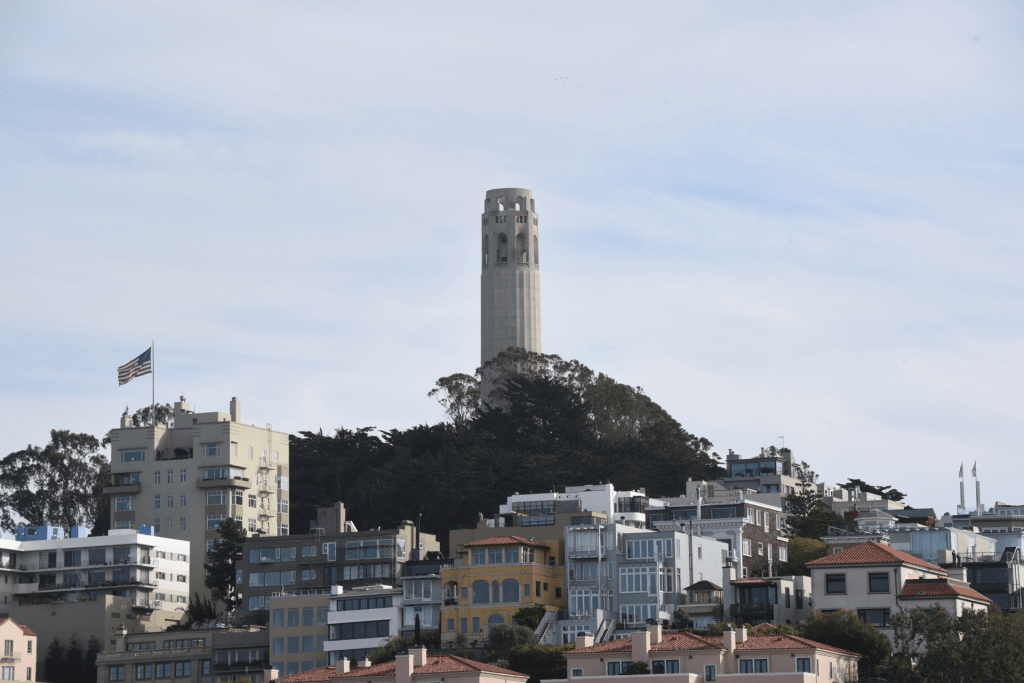
San Francisco has changed dramatically over the years but it’s still a place of surprising beauty. Although much of the downtown and South of Market areas have acquired a bland, corporate look, North Beach has managed to maintain its quirky charm. Part of the fun of exploring the area is leaving your car behind. Narrow side streets are lined with bay-windowed flats while sidewalks merge into stairways that practically beg to be investigated. If you’ve got your walking shoes on, head up Telegraph Hill Boulevard to Coit Tower and Pioneer Park for the 360-degree bay and city views. Funded by Lillian Hitchcock Coit, the tower was designed in a pared down classical style by Arthur Brown, who also designed City Hall, and was completed in 1933. After checking out the tower’s WPA murals by artists such as Clifford Wright, consider trekking down the Filbert Steps on the eastern side of the hill where a colorful flock of green parrots can sometimes be seen. At the bottom of the steps you’ll find Levi-Strauss Plaza with its “participatory” fountain, just across from the palm tree-lined Embarcadero.

Summer Reading

Did you know that you can borrow digital and audio books for free on your library card? Just download the Hoopla and Libby Apps on your device, set up your account, and you can borrow up to six books for a month at a time. (An added advantage of Libby is that it works with Kindle.)

Opportunities

Salt Hill Journal is now accepting poetry submissions to September 5th, along with nonfiction, fiction, and art year round. https://salthilljournal.net

Parenthesis Journal is now accepting poetry submissions to September 1st, along with art and photographs. https://parenthesisjournal.com

Orison Books is now accepting entries in multiple genres for a chapbook contest to July 1st. Manuscripts should be between 25-45 pages.  https://orisonbooks.com

News

April is Poetry Month

National Poetry Month began in April, 1996, spearheaded by the Academy of American Poets. Visit their website to sign up for Poem-a-Day, to order a free poster, and find out the many ways you can celebrate poetry at home and in the classroom. www.poets.org

The Beauty of Passing Things

Traditional Japanese haiku often show an appreciation for the aesthetic of transience, known as mono no aware (the beauty of passing things). The following two haiku by Basho, below, include seasonal references, evoking transience with images from the natural world:*     

spring fades —

birds cry out, and tears

blur the eyes of carp

In these lines, Basho depicts nature as sentient. Birds and fish seem to be aware of spring’s passing, possibly even lamenting it. There’s an intimacy that suggests the poet shares a connection with the creatures and cycles of nature.

This next one, written at the site of a famous battle, reminds me of Shelley’s poem Ozymandias. Both deal with the folly of dreams of conquest, yet Basho’s lines suggest the element of rebirth in nature and, by extension, in human nature:*   

dried grasses —

all that remains of the dreams

of lost warriors

*versions by jg

Recent Publications

Humana Obscura is a print and online journal that focuses on work “where the human element is concealed but not entirely absent, aiming to revive the nature genre,” according to their website. Founded in 2020, they seek poetry, short prose, and artwork in a variety of mediums. “Notes from Snow Mountain” (Spring 2022, issue #4) is a brief account of a hiking trip on Mt. Lassen, known originally by the name Snow Mountain (or Kohm Yah-mah-nee in Maidu). www.humanaobscura.com

Canary is an online journal “that explores one’s engagement with the natural world.” They seek poetry, essays, and fiction “that address the environmental crisis with its heartbreaking loss of habitat and species.” “Sleeping Deer in the Afternoon” (Spring 2022, issue #56) depicts an encounter with a group of deer sleeping in an orchard. www.canarylitmagazine.org

cattails is an online journal that publishes “new and unpublished English haiku, senryu , tanka, and haibun with translations in the poets’ own language. “baby squirrel” (April 2022) was written several years ago, but the use of the adverb “this” suggests otherwise. www.cattailsjournal.com

News

Sights and Sounds

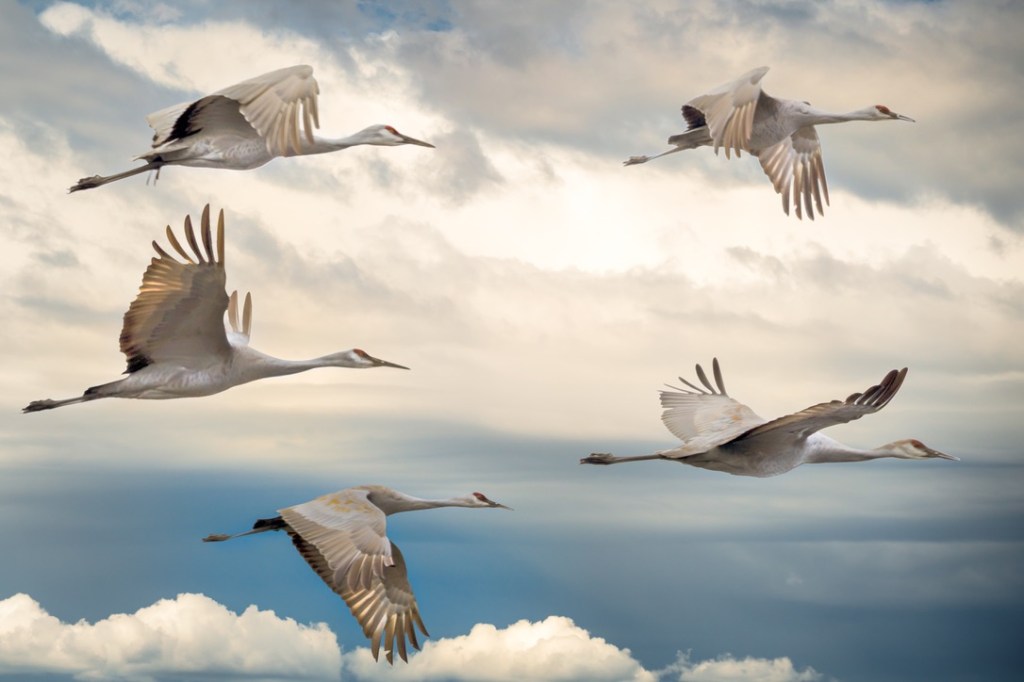
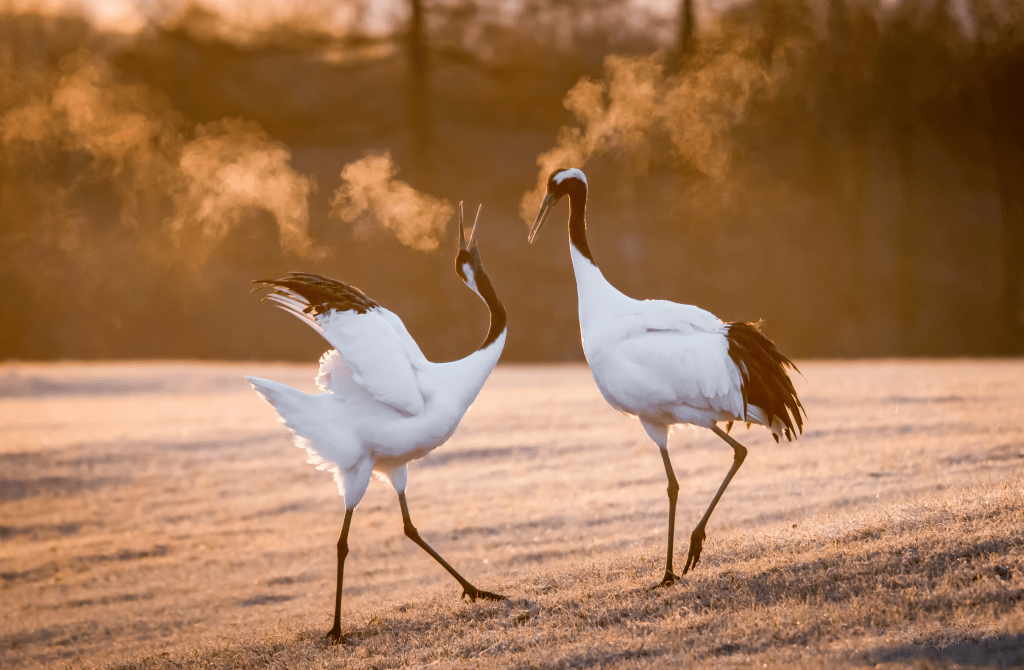
Sandhill cranes have been wintering recently in the Sacramento Delta region, drawn to the marshes and fields where they feed on waste grain from harvested crops. Standing up to four feet tall and with wingspans of up to seven feet, they’re known for their unique courtship dance and trumpet-like calls. The Woodbridge Ecological Preserve and the Cosumnes River Preserve in Lodi offer some of the best designated viewing spots around. A wide range of other birds can also be found there, including whooping cranes, double-crested cormorants, white pelicans, grebes, egrets, and various species of hawks, quail, geese, and ducks.

We received abundant snow and rainfall in California earlier this winter. In Yosemite, the falls are all flowing and accessible (some services may be limited due to COVID; for the latest information visit www.nps.gov.) In Mill Valley, the Cascade Falls are running again, and in Sunol Regional Wilderness, the scenic gorge of the Little Yosemite Area offers hikers the sight and sound of cascades spilling over boulders into swirling pools.

The increased rainfall has been a boon for spawning salmon. In Lagunitas Creek in Samuel P. Taylor State Park, female coho salmon can be seen preparing nests in the shallow waters while males compete for the best spots in the creek. (“A Good Year to See Coho Salmon Make Their Annual Return to Marin,” by Tara Duggin, SF Chronicle, January 4). 

World of Wonders

I don’t know how I managed to miss this book. World of Wonders: In Praise of Fireflies, Whale Sharks, and Other Astonishments,” by Aimee Nezhukumatathil, was on the best seller lists for weeks. A review by James Rebanks in the NYTs (Sept. 11, 2020) offers that the author has written “a timely story about love, identity, and belonging (more accurately often about not belonging, because of racism and her family’s immigrant experience).” A poet with four collections to her credit, Nezhukumatathil, links her personal history with the natural world, focusing on the wonders of the catalpa tree, fireflies, and Narwhals, among other subjects. The result is an engaging and intimate memoir, and a wonder itself. It reminds me of some of the early writing of Gerald Durrell, though without the comic lens. With illustrations by Fumi Mini Nakamura (Milkweed Editions, 2020). 

The Colors of Nature

This breakthrough anthology, edited by Alison Hawthorne Deming and Lauret Savoy, reveals how bias influences attitudes and policies about nature. In The Colors of Nature: Culture, Identity, and the Natural World, thirty writers of various backgrounds examine how conditioning can shape our awareness of the environment and how we write about it, and how important diversity is in our approach to planetary struggles. (Milkweed Editions, 2011).

Open Submissions

Terrain.org is an online journal seeking poetry, nonfiction, fiction, art, multi-media and mixed genre work that inspire “just and joyous relations with the planet and each other.” Since 1997, they’ve published award-winning literature, editorials, and case studies about place. Deadline is April 4, 2022 for the spring issue. Visit www.terrain.org for details.

About Place is an online journal published the Black Earth Institute. Dedicated to finding “pathways to peace” and to “cure what is wrongfully impacted by ecological destruction,” they seek poetry, fiction, essays, creative nonfiction, and audio/visual artwork. Open for submissions until March 10 Visit www.aboutplacejournal.org for details.

News

Books Noted

Kindest Regards, New and Selected Poems, by Ted Kooser (Copper Canyon Press, 2021), contains four decades of poetry in addition to recent work. The Pulitzer Prize winner, who hails from Nebraska and served as Poet Laureate to the Library of Congress from 2004 to 2006, is known for his short, imagistic poems that focus on everyday events and objects. Reflecting the landscape of Midwestern towns and farms (he lives on acreage in Garland, Nebraska), his poetry expresses universal experiences and the need for meaningful connection. He has said of his work that, “I want to show people how interesting the ordinary world can be if you pay attention.”

As the 23rd U.S. Poet Laureate, Joy Harjo gathered the poetry of Native peoples past and present in the 222-page An Anthology of First People’s Words: Living Nations, Living Words (W.W. Norton, 2021). Poets such as Natalie Diaz, Sherwin Bitsui, Ray Young Bear, and Santos Perez address themes of displacement, visibility, struggle, resistance, and other subjects here. The anthology demonstrates “that heritage is a living thing,” Harjo writes in the introduction, “and there can be no heritage without land and the relationships that outline our kinship.” A member of the Muscogee (Creek) Nation, she is the author of several poetry volumes and a memoir, “Crazy Brave.” 

Poet and teacher John Brehm’s The Dharma of Poetry: How Poems Can Deepen Your Spiritual Practice and Open You to Joy (Wisdom Publications, 2021) is geared toward poets and poetry lovers who practice meditation, but it’s a rich resource for readers and writers of any persuasion. Brehm presents poetry as a “powerful way to disrupt the habitual momentum of the mind, its automatic reactions and obsessive self-concerns.” His analysis of poems such as James Wright’s “A Blessing” and Ryokan’s “First Days of Spring” point out how these poems offer the reader an opportunity to pause while “full of imaginative engagement,” and invite us to enter “the timeless experience the poem describes.” The book also contains writing prompts and suggested meditations.

In Memoriam

Three of San Francisco’s former poet laureates died in 2021 — Lawrence Ferlinghetti (at age 101), Janice Mirikitani, and Jack Hirschman. In addition to their innovative literary output, each made a vital contribution to the city’s cultural life — Ferlinghetti as co-founder of City Lights Bookstore and publisher of the Beat poets, Mirikitani as ambassador of love (with her husband the Rev. Cecil Williams) and Hirschman as an outspoken writer who reminded us of the importance of politically relevant poetry. Other outstanding American poets who passed recently are: bell hooks, Stephen Dunn, Thomas Kinsella, Jean Breeze, and Robert Bly. May they all rest in peace.

Open Submissions

Split Rock Review, an independent online publication, is accepting submissions for Issue #18, including poetry, creative nonfiction, fiction, hybrid, photography, and art with an emphasis on place and the environment. Until Jan. 31st. www.rockreiew.org

The Emerson Review, out of Emerson College, is now open for submissions until February 1st for the spring issue, due to be published in April. Seeking poetry, fiction, nonfiction, photography and art. Selected pieces are nominated for a Pushcart Prize. www.emersonreview.submittable.com

Beloit Poetry Journal, a print publication, is open for poetry submissions in various forms and styles. Send up to five unpublished poems or one long poem by January 31st.  www.bpj.org