News

The Ordinary in Haiku

To practice haiku is to be attentive to the ordinary, as Basho pointed out.  “If you describe a green willow in the spring rain it will be excellent as a renga verse.  Haikai, however, needs more homely images, such as a crow picking mud snails in a rice paddy,” he wrote.  (The Essential Haiku, Versions of Basho, Buson, and Issa, edited by Robert Hass).  Here’s a classic haiku by Basho that depicts the ordinary in nature (translated by Burton Watson):

     “Day by day

the barley ripens,

     the skylarks sing.”

In good times the crops ripen and birds sing, yet sometimes we forget how important these seemingly mundane events are.  Haiku such as these invite us to return our attention to everyday  subjects — the changing of the seasons, the music of tree frogs in the branches, mist enveloping the moon, just-washed leeks in a bucket.

The ordinary isn’t without its surprises, as in this observation by Buson:

a shaft of sunlight

on the sleeve of a paper robe

turns it to brocade *

What could be more unassuming than a paper robe?  Yet, in these lines, Buson reveals the ordinary and the extraordinary as one, related by a trick of light, a matter of perception.

Here’s another by Buson:

at year’s end, walking

along Cherry-Flower river —

garbage floating past *

This haiku might have been written today about any number of our polluted rivers.  While the sight of floating garbage may have been a sorry one for Buson, it nevertheless conveys an eye that isn’t attached to romanticized notions of beauty.

This focus on the ordinary in Japanese haiku can be found in Zen, too, as exemplified by the maxim byojo shin, kore michinari (ordinary mind is the way), attributed  to Zen master Mazu Daoyi.  But not all early haiku poets studied Zen, as Stephen Addiss points out in The Art of Haiku.  Many were followers of other sects such as Taoism, Confucianism, or Shintoism.

In this haiku from 1813, Issa evokes a still-popular form of Buddhism through an ordinary, everyday image, suggesting that the The Pure Land may be with us in this very moment, if we would only recognize it.

The Pure Land —

isn’t it here and now

in the morning dew?

*versions by jg


News

Special Feature

Working in Multiple Genres: an Interview with Aline Soules

Interviewed by Jerome Gagnon

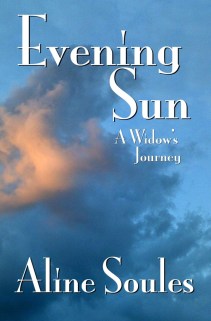
It’s a privilege to have poet and historical fiction writer Aline Soules as my guest today.  Author of Meditation on Woman (bit.ly/meditationonwoman) and Evening Sun: A Widow’s Journey (bit.ly/evening-sun), her poetry has appeared in such publications as Kenyon Review, Houston Literary Review, Poetry Midwest, and the Galway Review.  I thought it would be interesting to see what she’s up to these days and, in particular, to ask about her experience working in multiple genres.

Q. I know you’re a fairly voracious reader.  What are you reading these days? Do you read more for information, amusement, or some other thing?

A. Answer to your last question first:  Yes, yes, and yes—information, amusement, fun, the cereal box, I don’t care.  I read all the time and have several books going at once, depending on where I’m reading—my comfy chair, my outdoor chaise longue, in bed.  Right now, I’m reading the following: The Secret History of SOE, by William Mackenzie and Code Name: Lise: the true story of the woman who became WWII’s most highly decorated spy, by Larry Loftis, both as research for my novel; Lovers and Dancers, by Heather Ingman, for fun; some of the Collected poems of Louis Macneice (always read poetry); conversations with W. S. Merwin, by Michael Wutz and Hal Crimmel (so sad—no more poems from him).  As you can see, anything goes.

Q. Can you share with us some of your favorite poets and novelists?   What’s the appeal for you?  

A. So many poets.  I’ll start with Seamus Heaney, not just for his famous poems, like “The Field,” but also for Beowulf.  I’ve noticed that, in “English” classes, students are often presented with the Iliad or the Odyssey. That’s fine, but why not our English classic, Beowulf?  Heaney’s version is accessible and wonderful.  Gerard Manley Hopkins—I go back to him all the time.  The language, the imagery stun me. Many women poets, like Adrienne Rich, Carolyn Forché, May Sarton, Linda Gregerson, Rita Dove, Lucille Clifton, Elizabeth Bishop, Wislawa Szymborska—I could go on.  But I also like “dead white males,” which isn’t the popular choice these days. I remember the controversy over Robert Bly’s Iron John: a Book about Men, yet it’s proved to be one of his most enduring works, an international best seller and a start to the Mythopoetic men’s movement in the U.S.  There’s a danger in deciding that one’s ethnicity or gender has made one biased, thereby missing out on great language and thought, whether I agree with it all or not.  Today, we have new writers—Ocean Vuong, Sherman Alexie, Amber Tamblyn, Kei Miller, Morgan Parker. I’m trying to understand the appeal of Rupi Kaur, the “Instapoet,” but I admit to struggling with her work.  

Q. You’ve written poetry in the past and now you’re working on an historical novel.  Do you find that any of the skills for writing poetry apply to fiction, or are they very different?

A. Great question.  I use my poetry skills (if “skills” is the right word) in everything I write.  Poetic language is key anywhere—the ability to come up with the right words, the right image, the best phrase to convey a feeling or a thought in a way that resonates with readers and makes what you write memorable.  Writing is an endless struggle (why do we do this, again?), but, somehow, a struggle that’s worthwhile to me. In my current novel, I’m still not at the point of going through my work to struggle with the final language and phrasing, but, when I do (soon), it will be one of the more pleasurable parts of novel writing.  I should add that poetry has also helped in all my writing. During my academic career, I wrote many articles and book chapters, all of which were improved by my poetry practice. In fact, I start all my writing days with poetry, unless I have a pressing deadline.

Q. In an interview, I think Ocean Vuong said that his new novel (On Earth, We’re Briefly Gorgeous) was written, in part, as a letter to his mother.  How do you go about finding the right form (or forms) for a novel, or does it find you?

A. Forms are organic, I think, particularly in poetry, but also in other writing forms.  
front_cover_140503

Even academic writing, with its introduction, method, results, and discussion/conclusion sections enables organic form within the structure.  My novel is historical fiction and I’ve discovered that it’s like a jigsaw puzzle in some ways. I’ve written a full draft (more than once) and I still find myself cutting up the summary of each chapter and moving the pieces around on my table to decide the best order for the story.  I may have a linear approach in my first draft (what happens? what happens next? etc.), but I won’t end up with that.

Q. Are you continuing to write poetry even as you work on a prose project?  If so, do you have any advice for writers on how to balance these two disciplines?

A. I do write poetry—all the time.  As mentioned above, I start with poetry when I sit down to write.  It might be ten minutes or two hours, depending on how the work develops. Then I turn to my novel.  I have no advice for writers on balancing multiple disciplines, other than to suggest that each writer must find his/her/eir path through the process.  When I also wrote academic articles and book chapters, I interspersed those with poetry, too. I’m sure that some writers practice one or the other at any

given time, rather than engaging with more than one at the same time, but starting with poetry gets me in my writing frame.  I’ve also noticed that when I’m “on a roll” with poetry, everything else is “on a roll,” too. The converse is also true.

Q. A sense of Time with a capital “T” seems to be all important in novels.  Even if they’re written conventionally in the past tense, they’re generally supposed to represent the present — or, in the case of historical novels, the “distant” present.  Where is your narrator located in terms of time? Have you encountered any challenges and/or benefits in exploring the notion of time in fiction? 

A. My novel is written in close third, past tense.  I’ve tried other points of view and other tenses, but have decided on this approach.  The idea of “representing the present” is really the idea of engaging the reader so that he/she/ey feels “present” with the main character.  I say character (singular) because I’m working in close third and the story unfolds from her point of view. I’ve never tried omniscient point of view, although the greats in the past used it all the time (Dickens, Thackeray, Trollope).  As for the notion of time in fiction, I’ve never explored this directly, but Alan Lightman has. I particularly love Einstein’s Dream, which I re-read periodically, but any of his books are fabulous.  He engages with physics principles, such as time. After all, who better?  As a physicist and a writer, he’s worked at Harvard and MIT, where he’s currently professor of the practice of the humanities.  

Q. Some writers advise that, once you have an outline, you should write straight through your first draft and not stop for anything, no editing or rewriting at all.  How do you feel about this, and what’s your approach?  

A. Ah, the pantser vs. plotter theme.  The pantser, e.g., Ellen Sussman, goes for what happens?  what happens next? and next? and next? (no outline). After that, she spends a year or two revising. The plotter, e.g., John Grisham, goes for plot everything out before he writes a single word.  After that, he writes. I like a combination. I start with a form of the pantser method, where I write scenes about what comes to me but, not too far into what happens, I make a rough outline. After that, I move back and forth. If I wake up with an idea that excites me, I write the scene while it’s “hot,” whether it’s next in line or not.  Otherwise, I follow and develop my outline and my scenes together.

In the end, what’s important about any method is that your reader makes “discoveries” along with you; otherwise, the reader won’t be engaged.  The action may be too predictable. Of course, some readers like predictability (e.g., romance novels), but, I want surprises. The pantser method leads me to discoveries that surprise me and those are key for my novel because the reader will be surprised, too.  I’m also endlessly amazed at how my characters tell me what to do. They go off on tangents I don’t expect — surprises. And that’s the joy of the written word, isn’t it? To be surprised, expanded, given an emotional journey as well as intellectual stimulation. Reading and writing and the book itself — what a great trio.  What a wonderful world.

 

aline_black_sweater_2017Find Aline Soules online at http://allinesoules.com,@aline elisabeth, https://www.facebook/com/alinesoulesauthor, and https://www.linkedin.com/in/alinesoules/

For Aline’s Q & A with me, Writing Contemplative Poetry, please visit her blog or the Interview section on this site (see main menu).  


(Note: I’ll be on hiatus from the blog through August, resuming in mid-September.  I hope you’ll join me then.)
News

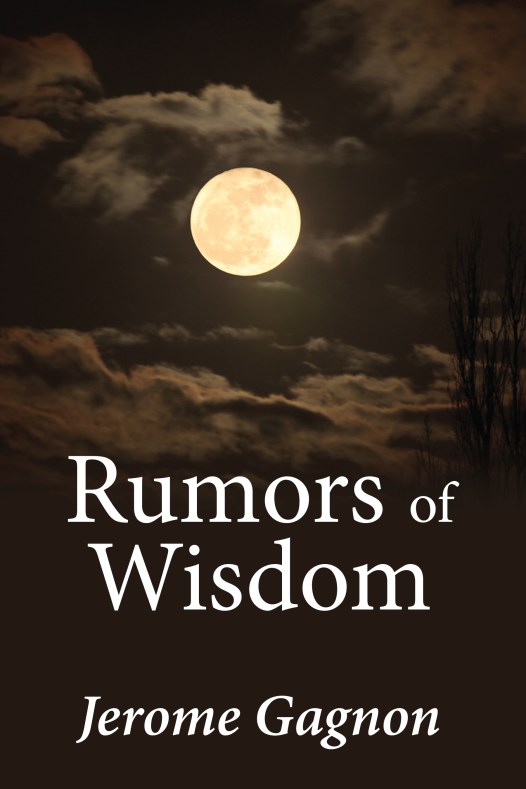
Rumors New Cover

Rumors of Wisdom impressed me throughout with poems about very specific things, or memories, or details; specifics that often metaphorically stand for bigger things.  This collection stands out for its breadth of scope.”

– Timons Esaias, Louis Book Award Judge

author of Why Elephants No Longer Communicate in Greek

“Luminous, lyric, sparkling with wit and the kind of subtle wisdom that comes from a

long, slow, generous looking at life… these poems are simply irresistible in their appeal.”

– Mark S. Burrows, Ph.D

Poetry Editor of Spiritus, author of Meister Eckhart’s Book of the Heart:

Meditations for the Restless Soul, with Jon M. Sweeney

Book Release

I’m happy to report that Rumors of Wisdom has just been released.  This full-length, perfect bound collection consists of fifty-eight poems and received the 2018 Louis Book Award from Concrete Wolf Press.  My sincere gratitude to Editor/Publisher, Lana Hechtman Ayers, for her commitment to this ongoing series, to the judge, Timons Esaias, and to Tonya Namura for her handsome cover design.   Rumors can be ordered from selected retailers via the publisher’s website at Concrete Wolf Press or click on the photo, above.

Contest Announcements

Hidden River Arts will award $1,000 plus publication by Sowilo Press to a woman fiction writer over the age of forty for a collection of stories, a novella, or a novel.  Submit by March 15th……Bellingham Review will award three prizes of $1,000 each for poetry, fiction, and nonfiction (including CNF).  Submit by March 31st……River Styx is offering a $1,500 prize in the River Styx International Poetry Contest.  Oliver de la Paz will judge.  By May 31st…..The Crab Creek Review Poetry Prize offers $500 plus publication for the best poem.  “All entries are considered for submission.”  By May 15th.

Writing Prompt:

Expressing Another Person’s Struggle

“Write a poem about someone you know in a way that helps you to become more keenly aware of their struggle or difficulty.  Find sounds, rhythms, details and images to describe what this person is going through.  What does this person’s experience tell you about yourself?”  (from Poetic Medicine, The Healing Art of Poem Making, by John Fox, Jeremy P. Tarcher/Putnam)

News

Haibunwater-1246669_1920

These days, haiku is a relatively familiar poetic form to readers and writers around the world.  Less well known is haibun, which pairs haiku with prose.  In its more traditional style, haibun often serves as a kind of travel diary, with commentary about the journey leading up to, and/or following, a haiku.  Some contemporary approaches more closely resemble prose poetry, while others may use haibun as a means for contemplation.  Patricia Donegan, author of haiku mind, describes the practice of combining hai (haiku) with bun (sentences) as “a springboard for the contemplation of a specific theme, be it adversity, nowness, or compassion.”  It addresses “the story or reflection behind the poem,” she writes.  Here’s a haiku by poet Elizabeth Searle Lamb, one of the founders of the Haiku Society of America and a former editor of their journal, frogpond:

pausing

half-way up the stair —

white chrysanthemums

Haiku such as this invite us “to slow down and tune in to this fleeting moment, to appreciate what’s right in front of us,” Donegan observes.  They offer a pause in our routines, and an opportunity to foster deeper awareness.  While some readers may be struck by the transience of the moment described here, some may focus on the beauty of the image of white chrysanthemums, or their sheer presence.  Still others may be drawn to explore the position of the subject “half-way up the stair,” poised in mid-life, or the symbolism of white chrysanthemums which, in Japan, are often used at funerals.  In this way, a particularly rich haiku may prompt exploration of issues in our own lives; at the same time, it can point to the commonality of our stories through the writing of haibun.  (haiku mind, 108 Poems to Cultivate Awareness & Open Your Heart, Patricia Donegan, Shambala, 2008).

Workshop

Bottle Rockets Press is planning a day-long Haibun Workshop on May 4th, 2019, in Hartford, Connecticut, to be conducted by Stanford S. Forrester, editor of the press.  Participants are “encouraged to bring their own work,” although it should be noted that the traditional 5-7-5 formula won’t be used “when discussing the haiku component of haibun.”  The fee is $75.  If you can’t attend the workshop, check out the video featuring six of Forrester’s haiku at www.bottlerocketspress.com 

New Poems 

Spring Breeze, a haiku, will appear in hedgerow: a journal of small poems, #126.   I remember “experiencing” this haiku back in the late 1990s, so it’s not really new.  Sometimes, haiku write themselves, and this was one of those happy accidents.

Blue Jay Way is slated to appear in in the spring issue of Pinyon, out of Colorado Mesa State University.

Haibun Writing Prompt

Select a haiku from one of the many anthologies, collections, or journals that are available, or one you’ve written yourself.  Jot down some observations about your choice, line by line.  These can be in the form of sentences or simply word associations at this point.  You should have at least one sentence or three or four word associations for each line.  Now, which of these responses to the haiku suggest further development?  Which of them is “magnetized,” in other words, which of them calls to you?  Select the first sentence or word that comes to mind and write about that, exploring both the said and the unsaid elements of your chosen haiku.  Repeat this process for each line.  Consider writing your work in longhand, in a dedicated journal, with haiku on one side and haibun on the opposite side.

News

In the Marketplace

img_0182-2.jpgI remember running into poet Michael Palmer in San Francisco’s Civic Center Plaza one afternoon, back in the day when people weren’t glued to their cell phones and walking around the city like zombies. He was offering hand-written poems for a penny each. I wish I still had that poem, but like so many things, it disappeared into the biosphere from which it came. What remains for me, though, is the memory of a friendly street encounter, and the notion that poetry can be much more than a solitary pursuit.

Writing in the Atlantic, Bhavna Patel looks at street poetry around the country, noting that it can sometimes serve a therapeutic purpose (“A Verse to Go, Please: Poets and the Lives They Touch”). Patel tells the story of Neal Ewald, who asked poet Jacqueline Suskin for a poem at the Arcata Farmer’s Market in Northern California where she’d set up a folding chair and was balancing “a manual typewriter on her knees…. A small sign next to her read, ‘Poem Store — Your Subject, Your Price.’” What Ewald wanted was “a five-dollar poem about being underwater,” Suskin said. Rereading the impromptu poem while sitting in his car, memories of his late wife, Wendy, came “flooding” back to him, Patel writes. Eventually, he commissioned Suskin to write a longer poem to honor his wife’s memory.

San Francisco resident Mc Allen dedicates one day a month to “free-range poetry,” writes Caillie Millner in the San Francisco Chronicle (“Taking Time for a Line of Rhyme”). Standing at a favorite spot on Cole Street in front of the Reverie Café, Allen can be heard calling to passersby, “Would you like to hear a poem? It’s completely free.” One afternoon he read Tom Wayman’s, “Did I Miss Anything?” to a bicyclist and Mary Oliver’s “Humpbacks” to a group of “tech bros,” Millner notes. “I’d say that one in every dozen or so people will stop,” said Allen, who brings a trove of poetry books along with him in a toolbox and recites from a variety of poets. “You never know who needs a poem in their life at that moment.”

“Entangle”

“Sometimes I prefer not to untangle it,

I prefer it to remain disorganized,

because it’s richer that way,

like a certain shrubbery I pass each day…”

– Tony Hoagland

(1953 – 2018)

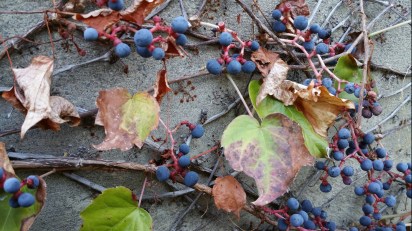
Plumbago, grape ivy, and morning glory vines have taken over a largely untended corner of the yard. At sundown, the blue flowers of the plumbago take on an electric glow against the faded violets and purples of the morning glories. When I consider this rampant mix, I think of the late Tony Hoagland’s poem, “Entangle,” which first appeared in the Paris Review. It’s a beautiful, wrenching work. It’s not just about the confluence of branches and flowers, of course, but memory and mortality, and our deep connections to each other. In his poem, “Lucky,” Hoagland” tells us… “If you are lucky in this life,/ you will get to help your enemy/the way I got to help my mother…you will get to raise the spoon /of pristine, frosty ice cream/ to the trusting mouth of your old enemy/because the taste buds at least are not broken/because there is a bond between you/and sweet is sweet in any language.” These are poems that draw you back for a closer look, to savor their details and the way they convey our foibles and frailty.

Calls for Poetry and More

Nowhere Magazine is sponsoring a travel writing contest for a poem, short story, or essay “that possesses a powerful sense of place.” The prize is $1,000 and publication. Submit online by December 31. http://www.nowheremag.com/contests

Quercus Review Press out of Modesto Junior College has announced their annual Poetry Book Award. The prize is $1,000, publication, and fifteen author copies. Deadline, December 28th. For details, visit http://www.quercusreviewpress.com

Willow Books is offering two prizes of $1,000 and publication for “a book of poetry and a book of fiction or creative nonfiction by writers of color.” Submit by December 15th. http://www.willowlit.net/willowbooks-literature-awards

Bayou Literary Magazine will award two prizes of $1,000 each for a poem and a short story. Submit by January 1st. http://www.bayoumagazine.org

Applications for the James Merrill House Writer-in-Residence Program in Stonington, Connecticut will be accepted until January 8th, 2019. Writers of all genres, including translators, are eligible for the four to six week residencies that come with a stipend. For more information, visit http://jamesmerrillhouse.org/residency/writer-in-reseidenceprogram

News

The Curlew, out of Wales, is a non-profit journal that supports conservation projects and offers “art, photographs, essays, poems, and short stories with a connection to the natural world.”  My thanks to the editor, Dr. Lynn Parr, for selecting “Pulling Weeds” for the latest issue. www.the-curelew.com

In celebration of National Poetry Month, the Academy for American Poets is sponsoring a poster contest for grades 9 through 12.  Opening September 1st, the contest will be judged by award-winning poet Naomi Shihab Nye and designer Debbie Millman.  The winner will receive $500, and the winning poster will be distributed to approximately 100,000 schools, bookstores, and libraries across the U.S.  www.academyforamericanpoets.org

I’ll be taking a hiatus from the blog for the rest of the year, returning in early 2019 with a new direction.  This should give me time to finish up a couple of projects. I hope you’ll rejoin me then. Meanwhile, let me leave you with the last stanza from Martin Espada’s wonderful poem, “The Republic of Poetry”:

“In the republic of poetry,

the guard at the airport

will not allow you to leave the country

until you declaim a poem for her

and she says, Ah! Beautiful.”


News

I’m happy to announce that Rumors of Wisdom was selected for the Concrete Wolf Louis Book Award and is slated to be published early in 2019.  My gratitude to the judge, Timons Esaias, and to Lana Hechtman Ayers, Managing Editor of Concrete Wolf Press, for their belief in this project (www.concretewolf.com).  Named in honor of Ayers’ grandfather, who inspired her love of poetry, “the award is for a first full-length book by a poet age fifty or over.”  Rumors was approximately three years in the making, although a few of the poems go back farther than that.  It went through several versions and various titles, as I continued to revise and add new poems. In the process, I learned a lot about what makes a cohesive collection.  Like Spell of the Ordinary, Rumors is essentially about mindfulness.  It suggests that deep attention to the moment offers a portal into the “enduring mutable,” that nature and the human spirit are salvageable.

Just received my copy of Arts, jointly published by the United Theological Seminary of the Twin Cities and the University of St. Thomas.  The visual arts are represented here by photographs, drawings, and paintings, along with in-depth articles that explore the work of Frida Kahlo, the making of mandalas, and art as ministry in an immigrant detention center.  An article on The Mount Tabor Ecumenical Center for Art and Spirituality (Villa Via Sacra) in Barga, Italy, traces the Center’s origins and the connection between creativity and religious faith, while poetry and reviews round out the selections.  This is an inspiring and visually inviting issue. www.societyarts.org

Standing at the Edge: Finding Freedom Where Fear and Courage Meet, by Joan Halifax (Flatiron Books, 2018), offers insight into the “bivalent qualities” of what she terms Edge States, including altruism, empathy, and engagement.  Citing experiences from the Civil Rights and Antiwar movements, as well as from her work as a medical anthropologist and Buddhist leader, Halifax describes what can happen when good intentions lead to despair and burnout, and what we can do about it.  Standing at the Edge is a wise and practical guide for navigating challenging times, and a valuable resource for teachers, caregivers, and those in the helping professions.

The Summer Writing Program at the Truro Center for the Arts on Cape Cod, Massachusetts, offers workshops in a variety of genres, including poetry, memoir, travel writing, and playwriting.  Some of the poets scheduled to participate this year are Robert Pinksy, Lorna Blake, Rebecca Fost, and Peter Campion. Be sure to bring your sunscreen. www.info@castlehill.org

Hannah Aizenman, poetry coordinator for the New Yorker, addresses the questions: “From a craft standpoint, what causes you to accept a poem?” “What advice do you have for new poets who are submitting work?” and “How many rejections have you faced and how do you deal with them?”  www.frontierpoetry.com

The Edith Wharton Writer-in-Residence Program offers residencies in March, 2019, to three women writers at Wharton’s former estate in Massachusetts, the Mount.  Included are a stipend of $1,000, lodging, and work space. www.edithwharton.org/visit/the-edith-wharton-writer-in-residence-program

News

Poets Illya Kaminsky, Bruce Beasley, and Alexandra Teague are among the faculty of the Centrum Port Townsend Writers’ Conference, which will take place July 15 – 23 at Fort Worden State Park in Washington.  Scholarships are available. For more information, visit www.centrum.org/theport-townsend-writers-conference.

It was fun returning to SFSU to attend the Creative Writing Student Awards Reading and Reception, and to share my memories of Kay Boyle.  The campus never looked better, just the way a bustling urban campus should look: the expanded library sparkles in its glass skin and the new humanities building adds a note of verticality.  My thanks to Paul Hoover and Maxine Chernoff of the Poetry Center for making me feel so welcome, and congratulations to all of this year’s graduates and honorees. I thought that all of the students who read were amazing, and everyone showed the kind of originality and attention to detail that can make a writing life.       

The Southern Humanities Review is sponsoring the Auburn Witness Poetry Prize, open through June, to honor the late Jake Adam York…WaterWood Press is sponsoring the Carolyn Forche’ Prize for Humanitarian Poetry, open through mid-August…The Spokane Prize for Short Fiction offers an award of $2,000 and publication, open until June 15th…Information on hundreds of writing grants and awards can be found at www.pw.org.

Reading Reynolds Price’s preface to his Collected Poems (1997), I came across a reference to Poetry as a Means of Grace, by C.G. Osgood.  “Conceived in the 1940s as lectures to young Princeton theologians, Osgood’s still keenly provocative chapters propose that, in a hectic and book-filled world, a thoughtful person might well choose a single inexhaustible poet and fix upon that poet’s work as a lifelong spring of refreshment in the driest times.”  Price’s choice, early on, was Milton, but he also had a special kinship with Dickenson. When I met him, Price was fresh from his first literary success and teaching a class in fiction writing. At the time, I had no idea he wrote poetry, that you could do both, but it’s clear that poetry remained for him a saving grace through youth and old age, health and disability.  In “Pears,” he depicts the ephemerality of experience and memory with quick brushstrokes, and in “Neighbors,” inhabits his dilemma in the form of inquiry:

“My name is Edward Reynolds Price,

So here on the ward, I’m Edward Price.


Last night I looked at my new neighbor’s door.

He’s Edward Reynolds, plain as ink.


Which one is the other’s doppelganger?

Scapegoat?  Porter of an alternate fate?”

News

the-golden-gate-bridge-1956459_1920“The Beat Goes On: Celebrating the Bay Poetry Collection” is the title of an exhibit at California State University East Bay (Hayward, CA), featuring publications from the library’s special collections.  Highlighting the work of “Beat” luminaries such as Lawrence Ferlinghetti, Allen Ginsberg, and Gary Snyder, it traces the development of contemporary poetry in San Francisco and the Bay Area. While Ferlinghetti’s City Lights Publishing has played a pivotal role on the local literary scene since the early 1950’s, contributions by others such as Panjandrum Press and Sixteen Rivers Press are also featured.  (Runs through December.)

“Cherries, After,” a sense-memory poem that pulls together images from my visit to a small farm near Dartmouth, Massachusetts, was selected for the 2018 Robert Frost Poetry Prize, sponsored by the Frost Foundation.  Many thanks to the judges for this honor, and my gratitude to Executive Director Jessica Sanchez and President Jim Knowles for their efforts in promoting this annual contest in celebration of Frost’s poetry. Like a lot of people, the first time I encountered his work was in a high school English class.  We were studying “The Road Not Taken” and “Stopping by Woods on a Snowy Evening.” Although I admired both poems, it was “Snowy” that held me with its imagery, the resonance of its rhyme scheme, and the tinkle of harness bells.

Poet, translator, and founder of Copper Canyon Press, Sam Hamill, “died on April 14th at his home in Anacortes, Washington,” according to an obituary by Daniel E. Slotnik of the New York Times.  He was seventy-four years old. As a teenager in Utah, Hamill ran away from an abusive environment and made his way to San Francisco where he met poet Kenneth Rexroth who “helped him give up drugs and taught him about poetry — kindnesses that Hamill said changed his life,” Slotnik wrote.  Known for his sensitive translations of poets such as Wang Wei and Matsuo Basho, Hamill went on to publish several collections of his own poetry and initiated a national protest by poets and others against the Iraq war. In his poem, “True Peace,” he wrote, “Not for me, Nirvana./ This suffering world is mine,/ mine to suffer in it’s grief.”  Recipient of PEN’s Freedom to Write First Amendment Award, among other honors, his most recent collection, After Morning Rain, will be published later this year by Tiger Bark Press, according to the Times.    

“Longing has its own quiet place

in the human heart, but love

is sometimes rapturous, noisy,

almost uncivilized, and knows

no boundaries, no borders.”

from After Morning Rain,

          by Sam Hamill

Headlands Center for the Arts is now accepting applications through June for residencies in 2019.  Poets, fiction and creative nonfiction writers, and other artists are eligible. Located on the scenic coast of Marin County, CA, just outside of San Francisco, “Headlands” offers airfare for qualified applicants, a private room in a shared house, studio space, five meals per week, and a monthly stipend of $500.  Residencies are for periods of from four to ten weeks. For details, visit www.headlands.org.

News

natural-880069_1280

Sent off the final galleys of “Spell of the Ordinary” to Finishing Line Press on January 11th.  It looks good and I’m glad to have it under wraps.  Well, almost.  Word is that it’s being sent directly to the printer but will be delayed a few weeks.  My guess is that it will be out sometime in February.  I’m told that any questions or concerns about orders can be addressed to missingbookorders@finishinglinepress.com (please include the title, author name, purchase date, and your name and shipping address).  My apologies to those of you who were kind enough to order.   I’ll keep you posted on progress as I hear more.

My thanks to David Dragone, Editor of Crosswinds, for selecting “White Poppies” for their spring issue, to Richard Smyth, Editor of Albatross, for selecting “Looking out at the Stream” for an upcoming issue, and to Lynn Parr, Editor of Curlew (Wales, U.K.) for selecting “Pulling Weeds” for their June issue.

Appreciated Editor Jonathan Heinenen’s introductory note to the Fall 2017 issue of Crazyhorse (out of the College of Charleston in South Carolina).  Commenting on the “fevered tempo” of bad news recently, he asks, “…how much making art matters when so much seems so grim.”  His conclusion bears repeating:  “Art isn’t some frivolous reflection or aimless escape.  It’s a way for us to understand each other, to imagine experiences we would never have first hand, and empathize with someone other than ourselves.  It’s something we need.  It’s the light that shines so brilliantly and helps us make sense of the world we inhabit.  It’s truth.”  This is a remarkable issue with standout work by Gary Soto, Wendy Chen, Wesley Rothman, Emily Skaja, and others.  I look forward to reading more.