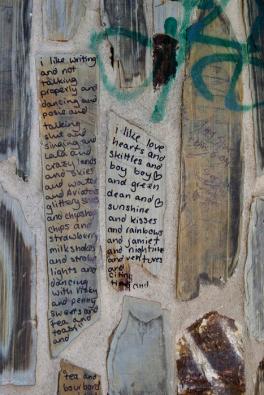
I’m not sure exactly what sacred poetry is, but I know it isn’t always about drama, Moses on the Mountain and all that. It’s just as often about small things — a plastic bag drifting across a parking lot or a bee caught in a spider web. Do you remember these lines by Emily Dickinson?
“There’s a Certain slant of light
Winter Afternoons —
That oppresses, like the Heft
Of Cathedral Tunes —”
It’s the opening of one of her most effective poems, and shines a light on her inner life. It’s about despair, a feeling she wrote about from time to time, and she doesn’t shy away from it. Even though, for Dickinson, that slant of light brought a recognition of oppression, I suspect her poem provided a more tangible, manageable shape to it.
Besides serving as a touchstone of our inner lives, sacred poetry makes a point of gratitude, of celebration or thanksgiving. Mary Oliver has a remarkable poem called “Gratitude” that asks eight questions. “What did you notice?” “What did you hear” “What did you admire?” “What astonished you?” What would you like to see again?” “What was most tender?” “What was most wonderful?” and “What did you think was happening?” Any one of those questions is an invitation to widen our horizons and lead us to an enhanced sense of gratitude. Used as writing prompts, they might even lead to a poem.
Here are a few lines from Oliver’s “Messenger” that identify the poet as lover, as praiser:
“My work is loving the world.
Here the sunflowers, there the hummingbird —
equal seekers of sweetness.
Here the quickening yeast; there the blue plums.
Here the clam deep in the speckled sand.”
I like this stanza by Yeats, too, from his well-known poem, “Gratitude”:
“Whatever gifts and mercies in my lot may fall
I would not measure
As worth a certain price in praise or great or small;
But take and use theme all with simple pleasure.
Western sacred poetry offers a vast resource for inspiration, with psalms and hymns, the poetry of St. Ambrose, Prudentius, St. John, Hildegard of Bingen, the two St. Theresa’s, and many more. But there’s also a wealth of inspirational poetry in secular literature by Milton, Donne, Blake, Smart, Merton, and others. Here are the closing lines of John Donne’s “A Hymn to God the Father”:
“I have a sin of fear, that when I have spun
My last thread, I shall perish on the shore:
But swear by thyself, that at my death thy Son
Shall shine as he shines now, and heretofore;
And having done that, thou hast done;
I fear no more.”
A common hallmark of poetry of faith is that, even while it’s focused on details, it tends to evoke the big picture. It gives solace and can inspire us to be more fully present in the divine drama. In “God’s Grandeur” Gerard Manly Hopkins chants:
“…all is seared with trade; bleared, smeared with toil;
And wears man’s smudge and shares man’s smell;
The soil is bare now, nor can foot feel, being shod.
And for all this nature is never spent;
There lives the dearest freshness deep down things.”
Those words were written in 1877. A hundred and forty years later, people are still mining for that “dearest freshness.” Who knows how long it can survive, given the toxicity that’s polluting the planet.
Sometimes poetry feels like a wise friend, like Donne, and sometimes like a mysterious stranger. I’m thinking now of Theodore Roethke’s poem, “The Waking.” These are the closing lines:
“…I should know,
what falls away is always. And is near.
I wake to sleep, and take my waking slow.
I learn by going where I have to go.”
While Donne gives us the image of the full sun of day, Roethke attends here to shadows and uncertainty. Putting one foot in front of the other, we make our way.
These opening lines from African-American poet Paul Lawrence Dunbar’s poem “Mystery” describe an existential dilemma, but there may also be a subtext about power and race, about inequality that can’t be ignored:
“I was not; now I am — a few days hence
I shall not be; I fain would look before
And after, but can neither do; some Power
Or lack of power says “no” to all I would.”
Haiku — three line exclamations that originated in Japan — flourish on bare attention and happenstance. They can open into a sense of wonder and sometimes awe. Here’s an example by Buson:
“A bat flits
in moonlight
above the plum blossoms.”
Another word for wonder is surprise. Here’s an unorthodox haiku by the French poet Paul Eluard:
“The wind
undecided
rolls a cigarette in the air.”
Who ever thought of that image before? Probably no one until Eluard. Is it good? I’ll leave that for you to decide. Is it surprising? I think so.
Attention to small things, mindfulness, gratitude, mystery, faith, and wonder. And music. I’m still not sure exactly what sacred poetry is, but it’s probably something that’s better left without explicit boundaries, something to be discovered — like the yellow bird that appeared a few days ago in the yard and hasn’t been seen since.


 Jerome Gagnon Blog