The San Francisco Renaissance

The First Festival of Modern Poetry took place in San Francisco in April, 1947. Organized by Madeleine Gleason, founder of the San Francisco Poetry Guild, the two-night event featured readings by twelve poets including Gleason, William Everson (Brother Antonius), Robert Duncan, Muriel Rukeyser, and Kenneth Rexroth. Together with poets Robert Creeley, Kay Boyle, and other transplants to the Bay Area, they comprised what came to be known as the San Francisco Renaissance. Although her work was overshadowed by the advent of the Beats in the mid-1950s, Gleason continued to publish throughout the 1960s and 70s. Her poetry was featured in Donald Allen’s The New American Poetry:1945-1960 and Collected Poems:1919-1979, with an introduction by Robert Duncan, was published posthumously in 1999. Samples of her work can be found at www.poetryfoundation.com.

Exploring North Beach and Telegraph Hill

Centered around Washington Square, just below Telegraph Hill, San Francisco’s North Beach district is the kind of neighborhood where poets scribble at sidewalk cafes and seniors practice Tai Chi in the park. Although the Beat movement that once flourished there is long gone, you can still get a feel for it at Café Trieste, 601 Vallejo Street. It’s a good spot to sip a cappuccino at a sidewalk table while writing in your journal or catching up on emails. Just up the street from Café Trieste, The Beat Museum, 540 Broadway (near the corner of  Columbus Avenue), features books, manuscripts and ephemera of poet Allen Ginsberg (Howl), novelist Jack Kerouac (On the Road), and other North Beach habitués of the 1950s and 60s.

No tour of North Beach would be complete without a visit to City Lights Bookstore, 261 Columbus Avenue (near Broadway). Co-founded by legendary poet Lawrence Ferlinghetti, who served as San Francisco’s first poet laureate, it carries a wide range of literature, counter culture magazines, and poetry broadsides. You’re likely to find a copy of Diane Di Prima’s Recollections of My Life as a Woman on the shelves, along with Ferlinghetti’s classic, A Coney Island of the Mind, not to mentionan array of current releases.

Vesuvio Cafe, 255 Columbus Avenue (across Jack Kerouac Alley from City Lights), has been a bohemian watering hole since the 1940’s. Enjoy a glass of wine and people watch from a window seat, or jot down some random free verse on your napkin.

On and Off the Streets

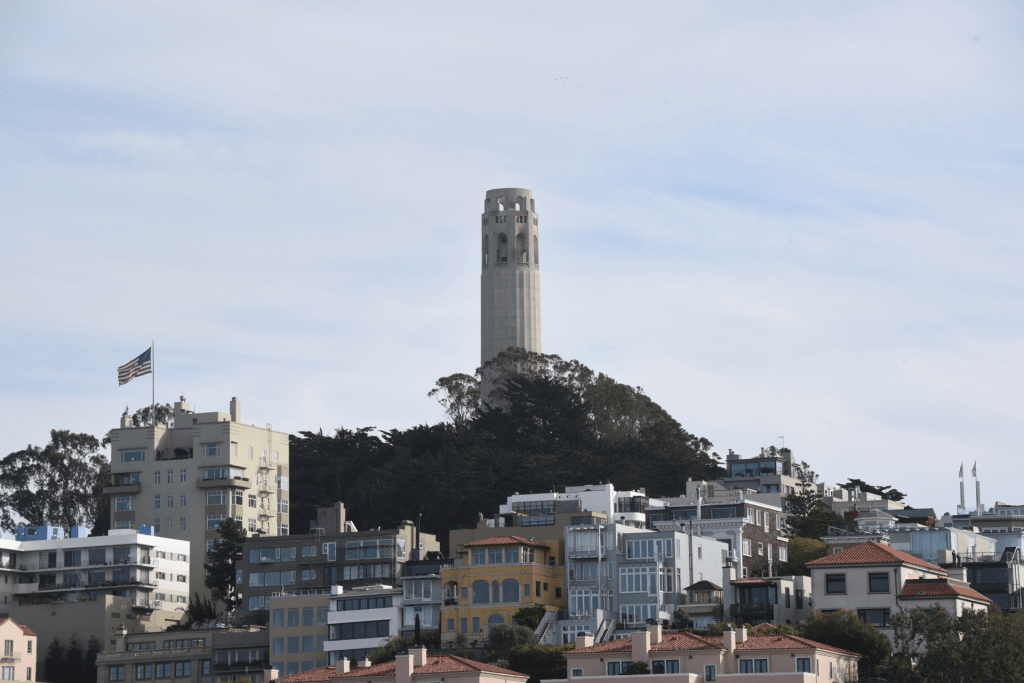
San Francisco has changed dramatically over the years but it’s still a place of surprising beauty. Although much of the downtown and South of Market areas have acquired a bland, corporate look, North Beach has managed to maintain its quirky charm. Part of the fun of exploring the area is leaving your car behind. Narrow side streets are lined with bay-windowed flats while sidewalks merge into stairways that practically beg to be investigated. If you’ve got your walking shoes on, head up Telegraph Hill Boulevard to Coit Tower and Pioneer Park for the 360-degree bay and city views. Funded by Lillian Hitchcock Coit, the tower was designed in a pared down classical style by Arthur Brown, who also designed City Hall, and was completed in 1933. After checking out the tower’s WPA murals by artists such as Clifford Wright, consider trekking down the Filbert Steps on the eastern side of the hill where a colorful flock of green parrots can sometimes be seen. At the bottom of the steps you’ll find Levi-Strauss Plaza with its “participatory” fountain, just across from the palm tree-lined Embarcadero.

Summer Reading

Did you know that you can borrow digital and audio books for free on your library card? Just download the Hoopla and Libby Apps on your device, set up your account, and you can borrow up to six books for a month at a time. (An added advantage of Libby is that it works with Kindle.)

Opportunities

Salt Hill Journal is now accepting poetry submissions to September 5th, along with nonfiction, fiction, and art year round. https://salthilljournal.net

Parenthesis Journal is now accepting poetry submissions to September 1st, along with art and photographs. https://parenthesisjournal.com

Orison Books is now accepting entries in multiple genres for a chapbook contest to July 1st. Manuscripts should be between 25-45 pages.  https://orisonbooks.com
News

the-golden-gate-bridge-1956459_1920“The Beat Goes On: Celebrating the Bay Poetry Collection” is the title of an exhibit at California State University East Bay (Hayward, CA), featuring publications from the library’s special collections.  Highlighting the work of “Beat” luminaries such as Lawrence Ferlinghetti, Allen Ginsberg, and Gary Snyder, it traces the development of contemporary poetry in San Francisco and the Bay Area. While Ferlinghetti’s City Lights Publishing has played a pivotal role on the local literary scene since the early 1950’s, contributions by others such as Panjandrum Press and Sixteen Rivers Press are also featured.  (Runs through December.)

“Cherries, After,” a sense-memory poem that pulls together images from my visit to a small farm near Dartmouth, Massachusetts, was selected for the 2018 Robert Frost Poetry Prize, sponsored by the Frost Foundation.  Many thanks to the judges for this honor, and my gratitude to Executive Director Jessica Sanchez and President Jim Knowles for their efforts in promoting this annual contest in celebration of Frost’s poetry. Like a lot of people, the first time I encountered his work was in a high school English class.  We were studying “The Road Not Taken” and “Stopping by Woods on a Snowy Evening.” Although I admired both poems, it was “Snowy” that held me with its imagery, the resonance of its rhyme scheme, and the tinkle of harness bells.

Poet, translator, and founder of Copper Canyon Press, Sam Hamill, “died on April 14th at his home in Anacortes, Washington,” according to an obituary by Daniel E. Slotnik of the New York Times.  He was seventy-four years old. As a teenager in Utah, Hamill ran away from an abusive environment and made his way to San Francisco where he met poet Kenneth Rexroth who “helped him give up drugs and taught him about poetry — kindnesses that Hamill said changed his life,” Slotnik wrote.  Known for his sensitive translations of poets such as Wang Wei and Matsuo Basho, Hamill went on to publish several collections of his own poetry and initiated a national protest by poets and others against the Iraq war. In his poem, “True Peace,” he wrote, “Not for me, Nirvana./ This suffering world is mine,/ mine to suffer in it’s grief.”  Recipient of PEN’s Freedom to Write First Amendment Award, among other honors, his most recent collection, After Morning Rain, will be published later this year by Tiger Bark Press, according to the Times.    

“Longing has its own quiet place

in the human heart, but love

is sometimes rapturous, noisy,

almost uncivilized, and knows

no boundaries, no borders.”

from After Morning Rain,

          by Sam Hamill

Headlands Center for the Arts is now accepting applications through June for residencies in 2019.  Poets, fiction and creative nonfiction writers, and other artists are eligible. Located on the scenic coast of Marin County, CA, just outside of San Francisco, “Headlands” offers airfare for qualified applicants, a private room in a shared house, studio space, five meals per week, and a monthly stipend of $500.  Residencies are for periods of from four to ten weeks. For details, visit www.headlands.org.

News

old-rustic-shed-1636419_1920

The latest issue from Poet Lore arrived and it was well worth the wait. Have been dipping in and out of “The Poetics of Liquid,” by Terrance Hayes, “Mysterious Me, a Brief Meditation on Personae,” by Leah Souffrant, and “Making it Real in the Time of Trump,” by Annie Kantar. These thoughtful essays explore the personal and public aspects of writing poetry, of living in an uncertain world. Not to be missed, Robert Schreur’s “Leaving Baltimore” and Barb Reynolds’ “March 10, 2016.” Grateful that my poem, “Pieces, Some Blue,” was included here.

Dodging the Rain is an innovative “blogazine” out of Galway, Ireland with quality writing and some amazing visuals. If you haven’t seen it yet, visit https://dodgingtherain.wordpress.com. “November Turning” appeared November 1st.

The Creative Writing Department at San Francisco State University recently established the Kay Boyle Poetry of Witness Award. A longtime writing professor at SFSU (and two-time O. Henry Award winner), Boyle was active for many years in Amnesty, while much of her fiction and poetry focused on the need for political awareness. Available to students of SFSU, the award offers a prize of $500. For writing contests open to the general public, see https://pw.org.

Each of the twenty-two poems in Ted Kooser’s final volume, “At Home” (The Comstock Writers Group, 2017), demonstrates his finely-honed powers of observation. “That Kooser often sees things we do not would be delight enough, but more amazing is exactly what he sees. Nothing escapes him; everything is illuminated,” says the Library Journal. Selections reflect the Nebraska farm life he knew and loved — a squirrel’s nest, a meteor shower, a barn door, a bat, a croquet ball, an owl, a milk jug — and each reveals the universal in the particular. Describing the cracks around an aged croquet ball as “rings on a planet,” he suggests, “…perhaps it is a planet, and not even one of the lesser ones, but something worth our full attention…”  Kooser’s poetry offers nothing less.