As a friend of mine sometimes says, “The good news is that there is good news.” May we find it all around us in the beauty of nature, in the wonder of ordinary things and everyday activities. May peace prevail in the coming year and may love light our way forward.
Recent Poems
Gathering poems together recently for a “new and selected” volume gave me an opportunity to discover some recurring themes, as well as to reconsider work I’d forgotten about. Spanning over forty years, the new collection is underscored by a belief that we share with nature a “wise fecundity” for growth and healing. Two recent poems, Light of Day and Winter Pine, will appear in the next issue of EcoTheo Review (www.ecotheo.org > review).
Poem of the Day
You can receive a poem every day in your in-box just by signing up with the Poetry Foundation. Poems are selected by their editors from a 47,000-plus poetry archive and represent a diverse array of voices. (www.poetryfoundation.org)
A Selection from Refuge for Cranes
Eye of the Heart
1
Say you draw a circle around yourself
and walk freely there, surrounded by love.
Say you expand this circle,
farther than you’ve ever been.
2
The way a seed fulfills itself and fallen things
replenish the world — here now,
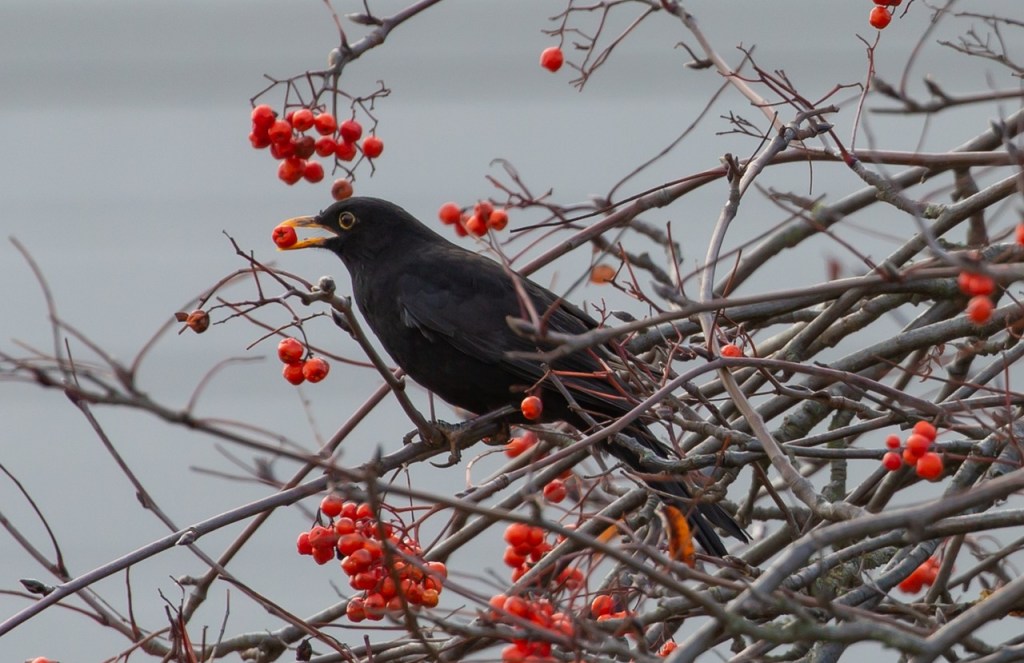
the ends of branches are bright with berries
and ripe for the feasting of blackbirds.
3
May you find yourself in a clearing after a light rain.
Refuge for Cranes, the title poem from the 2023 Wildhouse publication, appeared in the fall issue of Avocet, a Journal of Nature Poetry.
One Bright Pearl appeared in Braided Way (online) September 6, 2024.
darting ahead (haiku) appeared in Under the Basho, Fall/Winter, 2024
Deep Imagery
In the poem “A Blessing,” by James Wright, the language suggests a kind of magic is afoot as “Twilight bounds softly forth on the grass…” and two Indian ponies “come gladly out of the willows…” I don’t often reread this poem, but when I do, it’s always with a certain amount of anticipation. The music is low-keyed, the rhyme subtle, and by the time the last line arrives I’m completely under its spell. Critic James Seay, writing in the Georgia Review, commented on Wright’s work that, “I cannot recall experiencing anything like that keen sense of discovery which I felt in reading The Branch Will Not Break…” and…“what makes Wright’s poetry special…” is that “he has the gift of using language in a way that the human spirit is awakened and alerted to its own possibilities.”
The opening of another one of his celebrated poems, “The Jewel,” is also memorable: “There is this cave/ In the air behind my body/ That nobody is going to touch:/ A cloister, a silence/ Closing around a blossom of fire.” Known for the striking “deep images” of his work, this “blossom of fire” was no doubt hard won. “Poetry can keep life itself alive,” he has written. “You can endure almost anything as long as you can sing about it.” Winner of the Yale Younger Poet’s Prize, the Ohio- born poet (1927-1980) attended Kenyon College and the University of Washington where he studied with Theodore Roethke. Above the River: The Complete Poems was published posthumously in 1990 and won the Pulitzer Prize.
Connecting With Mystery
Poet Ada Limon observed in an interview recently that, “The connection between poetry and nature is that they both give us a moment to recognize what we’re going through. They give us space. They give us breath. They return us to ourselves” (Outsider, August 1, 2024). As part of her signature project as U.S. Poet Laureate, Limon has conceived of a coast-to-coast exhibit of poems engraved on picnic tables in seven national parks, including Mount Rainer in Washington State where visitors can ponder A.R. Ammons’ poem, “Uppermost.” On the east coast, Mary Oliver’s poem “Can You Imagine?” is engraved on a table located in Beech Forest, near Provincetown, Massachusetts. Limon invites everyone, poet or not, to share their responses to the poems and the landscape around them with the hashtag #youareherepoetry. “Poetry is a place that holds so much mystery…” “So often we stand in a forest and think, Oh there are no words, and that’s enough,” she said.
Opening of the River
An historic project to remove four outdated hydroelectric dams along the Klamath River was completed late this summer, allowing it to flow freely in its original channel for the first time in over a century. It’s hoped that restoration of the river, which runs for 257 miles from Central Oregon to Northern California’s Lost Coast, will enable endangered chinook and coho salmon to return to their original spawning grounds. According to water rights specialist Brad Parrish, it’s vital to reconnect “the features on the landscape that allow water throughout the basin to function naturally…” (“A Geography of Hope,” Earth Island Journal, August 8, 2024).
In Case You Missed It
In the article “Building Another Kind of Peace: How Poetry Can Help Calm Our Tumultuous Spirits” LitHub, September 4, 2024), teacher and writer Megan Pinto describes poetry as both a mindful and literary practice.
Contests
The Steve Kowit Poetry Prize offers $1,000 and publication in the San Diego Poetry Annual for a single poem. Judged by Ellen Bass, the deadline is October 15th.
The North American Review will award $1,000 and publication for a single poem. All entries will be considered for publication. Deadline is November 1st.
Mad Creek Books, of Ohio State University Press, will award $2,500 and publication for a poetry collection of at least 48 pages. Judged by Marcus Jackson, the deadline is October 9th.
“Wild” Exhibit
A year-long exhibit entitled “Wild” opened in June, 2024, at the U.K.’s Manchester Museum showcasing projects from around the world that have revived natural landscapes and saved wildlife from extinction. Curated by David Gelsthorpe, it includes films, photographs, text, and objects that tell the story of “some of the ways people are rewilding landscapes…” and “gives glimpses of how nature can thrive when given the opportunity,” Gelsthorpe has written in The Conversation (www.theconversation.com, June 4, 2024).
About Craft
I was up early looking at a poem I’d written the day before, instant coffee beside me at the laptop. I knew it wasn’t right and I wondered if I could fix it with a bit of cutting, some revising. Maybe get a whole new poem out of it. No such luck. This was one of those poems that needed more than revising and a few quick fixes. I saved what was left of it and moved it to another file, with some regret. But also with an appreciation for the process. I confess I love poems that write themselves, but most of them require attention, and really, that’s the whole point of poetry, isn’t it? Looking closely at our view of the world and self through the lens of language. This is how poetry saves us, I think. It teaches us to look deeply and with patience, and in doing so we open to uncertainty, to the messiness of the process, to disappointment, to loss. Here, I find a hint of the objectivity I could use more of, an appreciation for poetry and life as creative movement, as change.
Spotting the Redstart
As birder Dominik Mosur wandered around Pine Lake Park in San Francisco one day recently, he heard what sounded like the tick of a warbler. Peering through the foliage, he caught a glimpse of the red belly and black feathers of a slate-throated redstart. Commonly found in the southern hemisphere, from Mexico to Bolivia, this was the first such sighting in California, according to an article in SF Gate (“Mysterious bird never seen in California draws crowds to San Francisco park,” Amanda Bartlett, Aug. 6, 2024). Birders and biologists have offered various reasons the redstart might have ventured so far north, including global warming, monsoons in Northern Mexico that may have disoriented it, and the instinct to seek out new territory.
Into the Clear Blue Sky
July 22, 2024 was the hottest day on record on earth, according to NASA, caused in part by human activity and the proliferation of greenhouse gasses. Climate Scientist Rob Jackson’s new book, Into the Clear Blue Sky: The Path to Restoring Our Atmosphere (Scribner, 2024) presents an attainable vision for the future, pointing out that while cutting harmful emissions is essential, we also need to reduce carbon dioxide and methane to pre-industrial levels by such means as “direct-air capture” and “enhanced weathering.” Chair of the Global Carbon Project and a Senior Fellow at Stanford’s Woods Institute for the Environment, Jackson believes that this goal can be accomplished in a lifetime with the help of nature and technology, and it’s our moral duty to attempt to do so. Publisher’s Weekly calls Into the Clear Blue Sky “an exceptional inquiry into the fight against global warming.” Kirkus sees it as “A useful handbook for reducing one’s carbon footprint and encouraging neighbors and communities to do the same.” (Jackson is also a well-published poet, with poems in the Atlanta Review, Cold Mountain Review, LitHub, and elsewhere.)
For many people, one of the primary functions of the poem is to reaffirm a sense of wholeness, to restore. It’s a way of seeing the bigger picture, or at least to gain some semblance of objectivity about our experience. Is this why I write poetry? To say that I do it as a form of self-care seems true enough, but that would be to isolate it from its other parts. Poet and essayist Reginald Shepard cited a variety of reasons for his writing habit from the observation that, “I write because I would like to live forever” to the call to “never forget beauty, however strange or difficult.” (Orpheus in the Bronx, by Reginald Shepard, University of Michigan Press, 2007). In her poem, “Why I Write Poetry,” Leah Kindler offers that one of her reasons is “Because I could say my friend’s exes live in a swamp in my heart/ and no one would ask what it means” (from Respect the Mic: Celebrating 20 Years of Poetry from a Chicagoland High School, Penguin, 2022). In the coming weeks I’ll be looking at some of the reasons we read and write poetry and how it can serve as what Robert Duncan called an x-ray of the psyche.
One Bright Pearl
A new poem, “One Bright Pearl,” will appear in an upcoming issue of Braided Way Magazine. It was inspired by an observation of 9th century Zen master Xuansha Shibei, “In all the ten directions, the whole world is one bright pearl.” A publication of the non-profit Spiritual Quest Foundation, Braided Way aims “to cultivate and nurture people to become open and accepting of different spiritual perspectives and practices…” www.braidedway.org
Exploring Suisun Marsh
and Grizzly Island
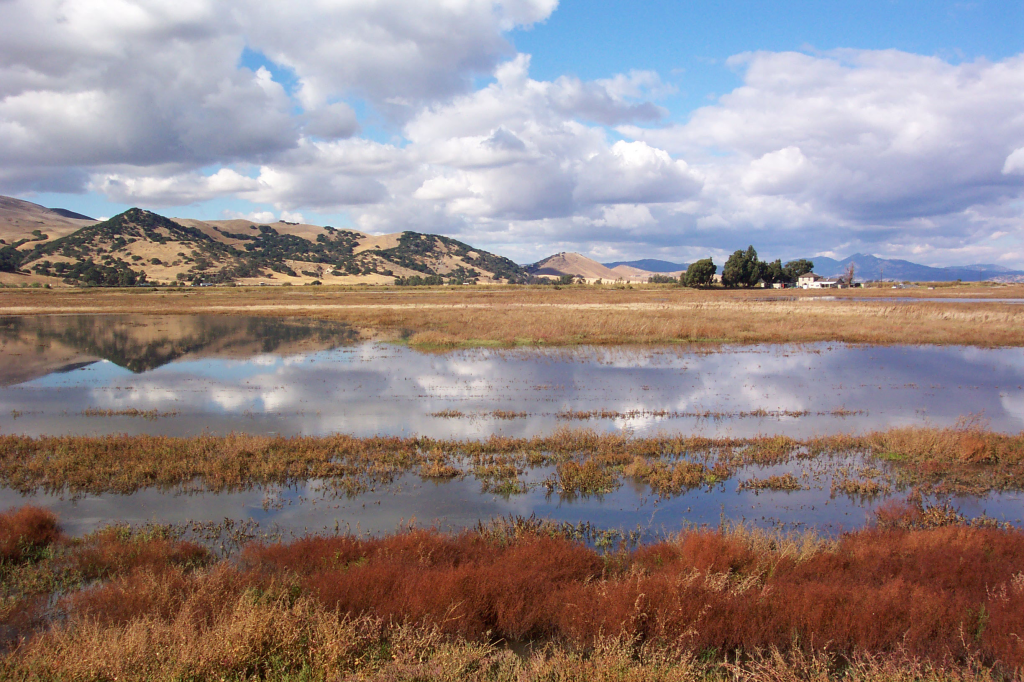
Ground broke last June, 2023, on the new Pacific Flyway Center located on Suisun Marsh, about 6 miles from the City of Fairfield in Northern California. Originally home to the Suisunes, the site is a sanctuary for over 200 species of birds including snowy egrets, quail, pelicans, and hawks, and serves a stopover for thousands of waterfowl as they migrate annually from Alaska to Patagonia. Phase One of the project, scheduled to open in 2027, was funded by a $5 million donation and consists of restoration work and a “marsh walk” that will meander through 15 new habitat ponds. Phase Two will see the construction of an interpretive center consisting of three buildings. Meanwhile, visitors can take advantage of 75 miles of existing roads and paths while the nearby Grizzly Island Trail offers educational signage, benches, and an overlook area. Summer temperatures often hover in the 90’s here but can reach the triple digits. Late fall days are generally cool, with foggy mornings and breezy afternoons.
“A wonderful bird is the pelican.
His bill will hold more than his bellican.”
– Dixon Lanier Merritt, 1910
Nature and Health
In the new book All in Her Head: How Gender Bias Harms Women’s Mental Health (Greystone Books, 2024), author Misty Pratt writes that quality time spent in nature is vital for health. Dr. Melissa Lem, a family physician based in Vancouver agrees. Lem studied evidence showing the benefits of nature-time on mental health and physical conditions such as diabetes, blood pressure, and stress hormone levels, and began making changes in her own busy schedule. Now, she’s part of a growing movement by doctors and health care professionals who recommend time in nature to their patients. “I think it’s important for nature to become routine advice during a health care visit — diet, exercise, sleep, and nature time,” Lem says. She calls these the “four central pillars of health.” See The Fourth Pillar of Health: Nature Time – YES Magazine Solutions Journalism (yesmagazine.org).
It was early April, one of the first warm days in the San Francisco Bay Area when it really felt like spring, and I was out on one of my morning rambles. As I veered off the sidewalk and onto the narrow greenbelt that runs along the main road, I felt a sense of relaxation as the view ahead of me shifted from houses and lawns to a mix of wild grasses, orange poppies, and the first of the mantilijas — those white, saucer-sized poppies with the bright yellow center that looks like the yolk of a fried egg. The greenbelt was designed to attract pollinators, especially butterflies, and I could see why the varieties that were once so common here — monarchs, mourning cloaks, and swallowtails — might flourish in this setting. It wasn’t long before a young monarch drifted by, as if to say, “I’m here!” “I’m here!” I suddenly felt about twenty pounds lighter. Now on the “red list” of endangered species, the migrating monarch faces multiple threats, including the loss of native milkweed and winter habitats, pesticide use, and climate change. (See “How You Can Save the Monarch Butterflies,” by Peter Cowan, at https:// www.openspacetrust.org.)
New Books
Leaning Toward the Light
Poet Tess Taylor is the editor of a new anthology, Leaning Toward the Light: Poems for Gardens and the Hands that Tend Them, that captures the wonder and healing power of gardens. In a recent article (April 22, 2024, CNN), she observes that we’re “desperately in need of oases of pollinators” to nourish our “neural pathways” and “regulate stress,” as well as to provide support for struggling species. A diverse range of voices is gathered in this collection, including Ross Gay, Jericho Brown, Ada Limon, Garrett Hongo, Mark Doty, and Naomi Shihab Nye. Illustrations by Melissa Castrillon, a forward by Aimmee Nezhukumatathil, and recipes by some of the contributors add to the appeal of this well-curated anthology. (See the poets reading from their work at www.thepoetscorner.org.
You Are Here: Poetry in the Natural World
In this anthology, United States Poet Laureate Ada Limon sought “to bring us back to earth and back to ourselves,” she says in an interview with Maria Santa Poggi (www.electricliterature.com.). Rather than assemble a collection of nature poems from the past, she invited contemporary poets to create work that spoke “not only to their wonder and joy and love of the planet, but also to some of the anxiety and fear” about today’s climate crisis. Here you’ll find fifty previously unpublished poems including Joy Harjo’s “Eat,” Dorianne Laux’s “Redwoods,” Jose Olivarez’s “You Must be Present,” Victoria Chang’s “A Woman With a Bird” and Patricia Smith’s “To Little Black Girls Risking Flower.” The Los Angeles Times calls it, “A lovely book to take with you to read at the end of your next hike” but it’s more than that. You are Here succeeds both in showing nature as an intimate part of our daily lives and in mirroring the anxiety around environmental devastation, a kind of dread that some are calling “eco-grief.”
Writer’s Conferences
This year’s Summer Poetry Workshop of the Community of Writers will take place June 17-23 in the High Sierras and will include workshops, individual conferences, readings, lectures, and discussions. Now in it’s 50th year, the program is founded on the idea that “when poets gather in a community to write new poems, each poet may well break through old habits and write something stronger and truer than before.” Featured poets this year include Blas Falconer, Major Jackson, Brenda Hillman, and Sharon Olds. For more information visit www.https//:communityofwriters.org.
The five-day Sonoma County Writer’s Camp will feature “Meditative Dream Writing,” a “BIPOC Fellowship,” “Generative Exercises and Guidance,” and ample opportunities for socializing. Hosted by published novelists Ellen Sussman and Elizabeth Stark, the event will take place July 24 – 28 in Occidental, CA, and includes both food and lodging. For more information and testimonials, visit www.sonomacountywriterscamp.com.
Poetry Contests
Palette Poetry is now accepting entries for The Sappho Prize for Women Poets. Judge Megan Fernandes will select three winners. “I’m interested in the scenes of real and imagined reunion…” she says. The winner will receive $3,000 and publication in Palette Poetry while second and third place winners will receive $300 and $200, as well as publication. Send up to three unpublished poems by June 16th (www.palettepoetry.com.)
Poet Dorsey Craft will serve as the judge for this year’s May Sarton Poetry Contest, sponsored by Bauhan Publishing. Poetry manuscripts should be between 50 to 80 pages. Winner receives $1,000, publication, and 50 copies; closes June 30th. (www.bauhanpublishing.com)
Omnidawn Publishing is now accepting entries for a chapbook contest to be judged by T.J.Anderson III. The prize is $1,000, publication, and 20 copies. Submit a collection of from 25 to 45 pages by June 14th. (www.omnidawn.com/contests-omnidawn)
I’ll be reading selections from Refuge for Cranes in tandem with guitarist Jos van der Wilk on Saturday, April 20th from 2 to 3 p.m. at “Books on B,” 1014 B Street, Hayward, CA. Please join us for this impromptu event in celebration of Earth Day and Poetry Month. (You can place an order or sign up for updates at http://www.booksonb.com/)
On Spiritual Verse: A Seminar with Kaveh Akbar. This online Zoom event will take place on two Wednesdays, April 17 and May 1 from 7 to 9pm, Eastern Time. Registration is required. Akbar is an award-winning poet and editor of the anthology, The Penguin Books of Spiritual Verse: 110 Poets on the Divine. https://www.poetrysociety.org
Goddess Art and Poetry, a program dedicated to “poetry lovers who appreciate the goddess archetype, as well as the gifts and stories that women bring,” will take place Saturday, May 18 from 4 to 6pm, Pacific Time. To apply to be a reader or for more information about this online event contact author and organizer Georgia Reash at https://www.georgiareash.wixsite.com
Haiku Notes
A new haiku (first line: “night jasmine,”) will appear in the spring/summer edition of Frogpond, the journal of the Haiku Society of America https://www.hsa-haiku.org.
A haiku on the theme of “transforming paths” was recently selected by the 2024 Golden Haiku annual competition (https://www.goldentriangledc.com). It will be displayed along with others on signage in a 44 block area of the Golden Triangle neighborhood of Washington, D.C. through April and on the website (first line: “lifting a stone,” haiku #73/142).
Books
The Poetry Home Repair Manual
The Poetry Home Repair Manual: Practical Advice for Beginning Poets, by Ted Kooser (University of Nebraska)uses examples from the former U.S. Poet Laureate’s own work and that of others to demystify the process of writing and revising. There’s also some helpful life advice here and a dose of good humor. My only quibble is with the title; this book isn’t just for beginners, but seasoned poets and readers, as well.
Writer’s Conferences
The 42nd annual Napa Valley Writer’s Conference will take place July 21 – 26, featuring poets Jane Hirshfield, Jan Beatty, C. Dale Young, and more. The application deadline is April 22nd. https://www.napawritersconference.org
The Las Vegas Writer’s Conference, from April 1 – 13, is notable for being all virtual and features writing sessions, Q & A opportunities, agent and editor sessions, and tips from industry experts. For more information visit https://www.vegaswritersconference.com.
This month, Mark S. Burrows continues his exploration of poetry and the wisdom of the heart, Richard Blanco reads selections from his latest collection, and Gloria Heffernan offers a free poetry workshop on the power of place.
Homeland of My Body: New & Selected Poems. Join Richard Blanco and friends of The Poet’s Corner as he reads from his latest book, Sunday, February 11, 2024, 4 – 5:30 pm ET. Visit www.https://thepoetscornermaine@gmail.com to register for this free Zoom event.
Sacred Journeys: An Evening Reading And Writing About Place with poet Gloria Heffernan. February 12, 7 -8:30 pm ET. Visit the Raft at www.https://phylliscoledai.substack.com to register for this free event.
Heartwork: Exploring Rilke’s Poetry. Poet, scholar, and translator Mark S. Burrows facilitates this online workshop that explores “how our own heart-work might guide us into greater resilience and authenticity.” Thursday, February 15, 2024, 2 – 3:30pm ET. Cost: $25. Visit www.https://thepoetcorner.org to register.
Aubades: Morning Online Poetry Discussion, Mulberry Street Library, Thursday, February 22, 2024, 10 – 11am ET. Visit the New York Public Library site at www.https://nypl.org to register for this free online event.
A Different Slant
In her review of Refuge for Cranes (Tupelo Quarterly, December 14, 2023), author and poet Aline Soules has written: “On the surface, it would be easy to read these poems as accessible descriptions of the world of ordinary things, to enjoy the beauty the poet highlights from the garden or the woods or the land and creatures around him. But let each poem linger in the mind and their subtle complexity emerges…” www.tupeloquarterly.com
Seven Poems from Refuge for Cranes
Morning Song
I started writing “Morning Song” early one morning and finished the draft within an hour or so. I’d recently seen a yellow grosbeak, unusual for this part of California, and that entered into the stream of things, as did a reference to a “camel inside a camel,” which I think comes from Rumi. The last line was a surprise. I don’t remember giving much thought to loving the unloving before, and these words felt like an opening to begin to see everyone as equally deserving of love. Another way of looking at the last line is as an invitation to love all parts of oneself, so the poem might serve as a prompt for self-care.
Walking Under Redwoods
This poem was brewing on some level even as I was walking through a redwood grove with a friend one crisp December day. As I remember, it was the day after Christmas. Everything was so still and quiet, I almost felt like an intruder. For some reason, our walk prompted my friend to talk about some of her regrets I guess you could call them, and I began to see my own experience through a similar lens. The redwoods seemed to take it all in. Nature, after all, is the best listener. Writing this poem reminded me of the value of silence in our lives, and that includes the silence between words and sentences, the silence of the trees, and the silence of our footfalls on the soft ground. Even the dim rush of the nearby creek was enhanced by that silence around us.
Sites of the Shutdown
I suppose we naturally look for something positive to come out of the negative, and that was true for me about the pandemic and subsequent shut-down of so many things I took for granted. This poem came out of that sensibility, and it reminded me that what I seek isn’t outside myself, that whatever satisfaction I may find isn’t strictly in the outcome of things but in my response to it. It’s true that the pandemic did acquaint me more with solitude, and it’s not over yet as of this writing. But it also taught me to value even the smallest interactions — at the checkout counter, on the bus, or ordering a meal, for instance. None of these would be possible without our mutual participation.
Earthbytes
This poem was a conscious attempt to put into words the need for an active involvement in the environmental crisis, without being “preachy.” I really wanted to write a poem that encourages commitment to conservation and mindful living. This isn’t necessarily that poem, but it’s a start. It began with a fragment of a line from several years ago, “like the bulb that from darkness emits the bloom,” and evolved from there. Yes, the current crisis is dire but I believe we can make a difference. It won’t be easy, but what’s the alternative?
Enquiry
As I get older, the list of things and people I’m grateful for continues to grow. Sometimes, spontaneous memories of the kindness of friends come back to me. (I lived rent-free in the attics of two different friends for over a year.) It’s a wonderful feeling to thank those special friends once again and to feel reconnected on a deep level, one that transcends time and place. But there’s also the spontaneous feeling of gratitude that arises in everyday activities — gratitude for the cup for holding the coffee, and for the bowl for containing my cereal in the morning. Occasionally, we come across beauty in nature in the least expected of places, as this poem recounts, and these moments are worthy of celebration.
Eye of the Heart
This title came to me long before the poem did and wouldn’t let go. I liked it but wondered if it wasn’t a cliché. But in my initial research, I didn’t find any titles exactly like it. I wonder if the subject might have stemmed from some of my childhood art projects in which I took a black crayon and made curvy lines that crossed and re-crossed each other, creating irregular spaces that I filled in with various colors, finally drawing eyeballs in some of the spaces. It was my version of modern art. The surprise of this poem was the last section. I didn’t see it coming. There’s a tangible joy in the practice of wishing others well that benefits both the sender and the recipient.
It reminds me of the metta meditation from Tibetan Buddhism that begins, “May all beings be well, may all beings be happy, may all beings be free.”
We, Cranes
What I like to call the “happy we” is introduced as the narrator here. The voice includes both poet and cranes, blurring the distinction between observer and observed, subject and object. Although brief, this poem is probably my favorite in the collection. There’s something magical about these creatures, and they seem to invite us into an almost mythical world in which language feels unnecessary.
Choosing to be Simple: Collected Poems of Tao Yuanming is an engaging translation of the work of this reclusive poet. Born in Jiujiang, China, Tao Yuanming (365-427 AD) was a civil servant and farmer whose poems reflect a life devoted to the Way. This bilingual edition contains over 160 verses that range in subject from passion and political intrigue to the ups and downs of farming and the joys of wine. Written in a direct and unadorned style, the poems are both wise and heartfelt without being sentimental, as in these passages:
“I built my hut beside a path/but hear no cart or horse/you ask how can this be/where the mind goes I go too…”
“Fall days are cold and harsh/the plants have all withered/it’s that time of year when we walk on frost/and climb the heights to honor friends going home…”
They also depict what the late Jack Gilbert referred to as “the immaculate pain of the Chinese poets” — long separations between friends, the rigors of poverty, and the recognition of what some have called an “immemorial wound.” Included here is the twenty-part poem, “Drinking Wine,” that contains some of the poet’s most memorable lines, such as this one from part IX: “meanwhile, let’s share a drink/I can’t turn this horse around now.” Red Pine (aka Bill Porter) contributes his own insights throughout the book to clarify some of the more obscure references and symbolism (chrysanthemums were often used in medicines, purple mushrooms were “one of the favorite foods of Daoist recluses and immortals”). Like his translation and commentary on the Heart Sutra, one of the essential Buddhist texts, Choosing to be Simple offers an invaluable glimpse into early Eastern culture, as well as a look into the heart/mind of one of the period’s finest poets.
Heart of Zen
“Six Persimmons,” an 800-year old ink and brush painting said to convey the wisdom of Zen Buddhism, will be on display at the San Francisco Asian Art Museum from November 17th to December 10th. Painted by the 13th-century monk Mu Qi Fa Chang, it’s on loan from the Daitokuji Ryoko-in Temple in Kyoto, Japan, and is part of an exhibit, “The Heart of Zen,” that includes a companion piece, “Chestnuts,” on display through December 31st.” Long associated with tea ceremonies held at the temple, “Six Persimmons” has been described by scholar Arthur Waley as “passion congealed into a stupendous calm” and by others as the “Western Mona Lisa.” Gary Snyder has written a poem that references Mu Qi’s work, also titled “Six Persimmons” (Axe Handles, Counterpoint Press, 1983). Inspired by the painting, a copy of which hangs in his home, the poem ends with Snyder standing over the kitchen sink, biting into a persimmon.
New Year’s Note
Dear Friends,
This will be my last regular post for a while as I continue to work on new projects in 2024. I hope you’ll stay tuned for announcements about upcoming publications and special events from time to time. I’ll leave off with two quotations from Julian of Norwich, English anchoress from the Middle Ages, from her Revelations of Divine Love: “All shall be well, and all shall be well, and all manner of thing shall be well,” she wrote in what is believed to be the oldest surviving book written in English by a woman. Her vision was one of all-embracing love and she encouraged others to “Remain in this (love) and you will know more of the same.”
Wishing you happiness and peace now and in the new year!
Haiku have a way of appearing out of the blue, but you may want to try a “haiku walk” in your neighborhood or in a local park as a kind of experiential writing prompt, or just to refresh your senses to what’s going on around you — to nature as it is, minus the usual preoccupations. In Japan, these walks are known as ginkoo (goo – singing, praising, poem-making; koo – walking). You may want to take a notebook and pen along so that you can jot down a few key words about your experiences. These may serve as the basis of one or more haiku later. If that’s not possible, list some of the memorable sites you’ve visited in nature. What was the outstanding thing, experience, or feeling about your visit to each of them? (Think in terms of sensory experiences, such as sights, sounds, or scents.) Compose a haiku using your notes as a jumping off point. Although the traditional format of haiku calls for a pattern of five syllables in the first line, seven in the second, and five in the third, you may want to vary that pattern somewhat. Do incorporate a seasonal reference and leave off the pronoun “I” if possible.
Restoring Chinook Salmon
Northern California Chinook salmon, which once numbered in the millions, are threatened with extinction due to the construction of dams and the subsequent loss of spawning grounds. Although the situation is dire, there’s some good news to report. A new agreement between the Winnemem Wintu Tribe, the State Department of Fish and Wildlife, and the National Oceanic and Atmospheric Administration aims to restore endangered Chinook Salmon to the McCloud River near Redding, just below Shasta Dam. Plans call for developing a “swimway” to allow fish to swim around the dam, and for using eggs from New Zealand Chinook that were introduced to that country in the last century. There are no guarantees, of course, but this could make a big difference in years to come.
Refuge for Cranes: Praise Poems from the Anthropocene will be available from Wildhouse Publications early September. The poems range in topic from climate fires and the demise of bees to the “transparency of grace” and the “soul’s deep-down unfathoming.” There’s praise here for beauty “glinting among the detritus,” but there’s also a call to action, to restore a damaged world. Poet and author Angela Alaimo O’Donnell has written of the collection that “Refuge for Cranes plunges us wholly into the natural world through a series of poems that are equal parts celebratory, revelatory, and prophetic…Like the cranes that give the book its title, birds rumored to be immortal and wise, the poet bravely writes the truth he sees, “scratching our message to this passing world.”
Selections from Refuge for Cranes: “Earthbytes”
This poem was a conscious attempt to express the need for active involvement in the environmental crisis, without being “preachy.” I really wanted to write a poem that encourages commitment to conservation and mindful living. This isn’t necessarily that poem, but it’s a start. It began with a fragment of a line from several years ago, “like the bulb that from darkness emits the bloom,” and evolved from there. Yes, the current crisis is dire but I believe we can make a difference. It won’t be easy, but what’s the alternative?
The Mendocino Coast Writers’ Conference in Mendocino, California offers “craft seminars, panels, one-on-one-consultations, and open mics.” Registration is now open for the 2023 conference to be held from August 3 – 5. It features keynote speaker Ariel Gore, founding editor of Hip Mama and author of the memoir, Atlas of the Human Heart. www.https://mcwc.org
The Santa Barbara Writers’ Conference in Southern California will be held this year from June 18 – 23 at the beachside Mar Monte Hotel. Celebrating its 50th year, the conference features 30-plus speakers, agents, panels, seminars, and workshops. It can accommodate full or partial week attendees. www.https://sbwriters.com
The Jackson Hole Writers’ Conference in Jackson Hole, Wyoming, will be held from June 22 -24 at the Jackson Hole Center for the Arts. Featuring a wide range of speakers and craft classes, including a fiction class by Dave Eggers, it offers both day and evening events, as well as individual manuscript critiques. www.https://jhwriters.org
Books Noted
A Field Guide to Nature Meditation
In A Field Guide to Nature Meditation: 52 Mindfulness Practices for Joy, Wisdom, and Wonder, author Mark Coleman describes how to develop a “nature-based meditation practice (Awake in the Wild, 2022) A psychotherapist and senior teacher of mindfulness meditation at Spirit Rock in Marin County, California, he also conducts wilderness retreats around the world. “Nature teaches us simplicity and contentment,” he says, “because in its presence we realize we need very little to be happy.” For all seasons and landscapes, for sitting still or for moving, these 52 meditations are designed to deepen awareness and support a sense of well-being. https://www.markcoleman.org
Climate Champions
Journalist and author of Girl Warriors, Rachel Sarah showcases the lives and work of influential women “on the frontlines of science” in Climate Champions: 15 Women Fighting for Your Future (Chicago Review Press, 2023, 12 years and up). Aiming to create a sustainable future for planet earth, the subjects profiled here “do not shy away from showing how racial and social injustices lie at the root of so many climate-related issues.”
Environmental News
Bats at Risk
White nose syndrome has killed millions of bats in North America since it was first discovered in a cave in upstate New York in 2006, according to a recent article by Wilson Ring (www.https://physorg.com). Of the 154 species found across the United States, Mexico, and Canada, 81 of them are “at risk for white nose infection, climate change, and habitat loss,” the North American Bat Alliance reported last month. The fungus is identifiable by white spots on their noses, which can disturb their hibernation and prompt them to leave shelter in search of food in frigid, deadly temperatures. Yet studies suggest that certain bat populations have evolved “an efficient DNA repair mechanism,” according to virologist Dr. Arinjay Banerjee of McMaster University (PBS News Hour, December 2020), and these bats can “provide hints for possible future medical treatment strategies.”
Bats in Poetry
“…And bats with baby faces in the violet light/Whistled and beat their wings/And crawled head downward down a blackened wall…”
– from The Waste Land, by T.S. Eliot
Many poets have written about bats, including D.H. Lawrence, Emily Dickinson, T. S. Eliot, Alfred Lord Tennyson, and Anne Sexton. My favorite is by D. H. Lawrence. Known mainly as a novelist (Sons and Lovers, Women in Love), he had a keen eye for observation that served him well as a poet, too. Titled, simply, “Bat” (from Birds, Beasts, and Flowers, 1923), it’s full of unexpected rhyme and images, alarm and, finally, humor. https://www.poetryfoundation.org




 Jerome Gagnon Blog