Garden Notes

This was the wettest summer on record in San Francisco and the coldest July in over forty years. The fog has returned with a vengeance, but here in the burbs we’ve had a mild summer so far with many days in the mid-seventies — just right for working in the garden. It’s mostly clean-up here to cut back and remove debris. As usual, the bamboo is a mess and the morning glories have sent out their runners all over the place, but there are also layers of dried weeds. I do everything with hand tools, so it’s a quiet practice for the most part, interrupted by the sound of bamboo stalks cracking and branches coming down.

A garden is never finished — an ongoing process full of little surprises. I like coming through the gate in spring to see the nectarine tree in blossom. Or, in summer, finding the first bunch of fruit hidden in the leaves. I can gaze at an empty space, imagining what might grow there, examine an overgrown patch to figure what should be removed. It’s a lot like reviewing a poem and seeing something I didn’t see before, an implied metaphor that could be developed or a few words that should be omitted. A “they” that might to be changed to a “we”.

The Wild Iris

In Louise Gluck’s Pulitzer Prize winning collection, The Wild Iris (1992), the title poem and others are spoken in the voice of a flower reflecting on the mysteries of this world and the “hidden” world beyond. I remember reading this book, or trying to read it, for the first time. At first, the poems were largely opaque — I just wasn’t used to thinking about flowers as having a voice, much less a philosophical one. And then something clicked. Suddenly I suspended my disbelief and the poems came alive, although they weren’t always transparent. Some of them may be deliberately ambiguous, which allows for multiple interpretations. Writing in The New Republic, Helen Vendler observed that The Wild Iris “…wagers everything on the poetic energy remaining in the old troubadour image of the spring, the Biblical lilies of the field, natural resurrection.” Like nature, it revolves as much around winter and oblivion as it does around renewal, and these images evoke trauma. As Gluck writes in her title poem, “…whatever returns from oblivion returns to find a voice.” It’s this voice that appears “like a great fountain” in the closing lines and resonates page after page with a hard-won wisdom.

Opportunities

The Fourth River, a print and online publication of Chatham University’s MFA in Creative Writing, is seeking submissions of poetry, fiction, and nonfiction until September 15th, and then from November 15th to January 15th. They want to see writing that “explores the relationship between humans and their environment, both natural and built, urban, rural, or wild.” The current theme is “innovation.” See www.4thriversubmittable.com for details.

Modern Haiku is open to submissions of haiku, senryu, and haibun year round with cut-off dates on March 15th, July 15th, and November15th. Regarding the content of haiku submissions, their perspective is that “syllable and line count are not vital in English-language haiku” while seasonal references, concrete images, and a lack “views or values” characterize the best examples. Submissions may be made by mail or email, and are free. For details visit www.modernhakiu.org.

Finishing Line Press is now accepting entries for the 2025 New Women’s Voices Chapbook Competition. The competition offers publication and a prize of $1,500 for a writer who “identifies as a woman and has not yet published a full-length collection,” according to their website. Ten finalists will also be selected for the chapbook series. Contest ends October 15, 2025. www.finishinglinepress.submittable.com

Stanley Kunitz: The Collected Poems

Born in 1905, Pulitzer Prize winning poet Stanley Kunitz lived to be 100 years old. His later poems, beginning with The Testing Tree in 1971, were less philosophical and more personal than his early efforts. Some of my favorites from this period include “My Mother’s Pears,” “Halley’s Comet,” “Snakes of September,” and “Days of Foreboding,” but there are many more; in “The Unquiet Ones” he addresses the deaths of his parents and in “The Round,” expresses his love of gardening, poetry, and life. Kunitz wasn’t averse to confronting the shadow side of the personality or the dark side of history — his father committed suicide before he was born and he commented that the Holocaust was “the basic subtext of much of his work.” Twenty-five years after its publication, The Collected Poems remains relevant in today’s polycrisis for its penetrating gaze at beauty, love, and loss. “What do we know beyond the rapture and the dread?” he asked. (The Collected Poems, Stanley Kunitz, W.W. Norton & Co., 2000)

Rewilding the River Basin

Thousands of native wildflower seeds, hand collected and planted by Yurok tribe members and volunteers, are thriving along the Klamath River after a spectacular show of color this spring. Over 2,200 acres, submerged for decades by four recently removed dams, are part of an ongoing restoration project along the river basin. Some of the flowers that can be found there are California poppies, lupine, buttercups, tiger lilies, asters, larkspur, and orchids. www.oregonstater.org, www.oregonstate.edu

Opportunities

Blessing the Boats Selections, sponsored by BOA Editions, is offering a $1500 prize and publication for a full-length collection of poetry by a woman of color who lives in the US. Named after Lucille Clifton’s award-winning collection, the series will be judged this year by Evie Shockley. Manuscripts must be at least 65 pages in length. (There’s no entry fee.) www.boaeditions.org

Stony Brook Southhampton is sponsoring a short fiction prize for undergraduates. The winner will receive a prize of $1,000, a scholarship to the Southampton Writer’s conference, and possible publication in the Southhampton Review. The contest is open to undergrads in the US and Canada. (There’s no entry fee.) www.stonybrook.edu

Palette Poetry, an online journal, is open for submissions year round for its Featured Poet category. Payment is $50-150 per poem. Aiming for diversity, they welcome “new and emerging” poets. (There’s no fee for this category.) www.palettepoetry.com

Assembling a Poetry Collection

For tips on assembling a poetry collection, see “Putting a Full-Length Collection Together,” June 6, 2021 and July 26, 2021, on this blog.

Why We Write

For many people, one of the primary functions of the poem is to reaffirm a sense of wholeness, to restore. It’s a way of seeing the bigger picture, or at least to gain some semblance of objectivity about our experience. Is this why I write poetry? To say that I do it as a form of self-care seems true enough, but that would be to isolate it from its other parts. Poet and essayist Reginald Shepard cited a variety of reasons for his writing habit from the observation that, “I write because I would like to live forever” to the call to “never forget beauty, however strange or difficult.” (Orpheus in the Bronx, by Reginald Shepard, University of Michigan Press, 2007). In her poem, “Why I Write Poetry,” Leah Kindler offers that one of her reasons is “Because I could say my friend’s exes live in a swamp in my heart/ and no one would ask what it means” (from Respect the Mic: Celebrating 20 Years of Poetry from a Chicagoland High School, Penguin, 2022). In the coming weeks I’ll be looking at some of the reasons we read and write poetry and how it can serve as what Robert Duncan called an x-ray of the psyche.

One Bright Pearl

A new poem, “One Bright Pearl,” will appear in an upcoming issue of Braided Way Magazine. It was inspired by an observation of 9th century Zen master Xuansha Shibei, “In all the ten directions, the whole world is one bright pearl.” A publication of the non-profit Spiritual Quest Foundation, Braided Way aims “to cultivate and nurture people to become open and accepting of different spiritual perspectives and practices…”  www.braidedway.org

Exploring Suisun Marsh

and Grizzly Island

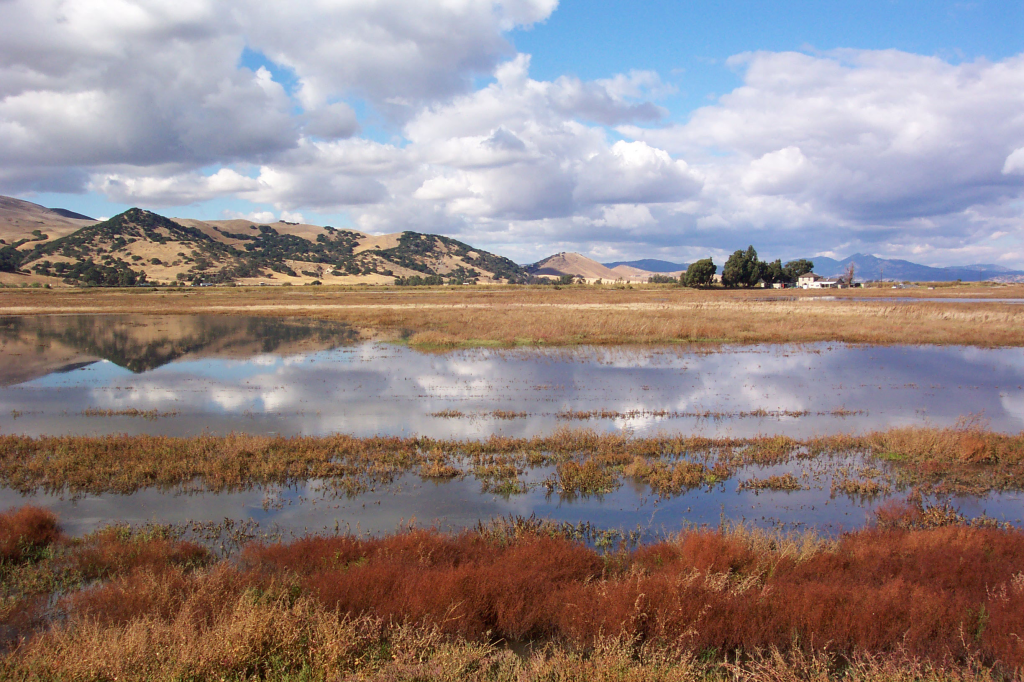
Ground broke last June, 2023, on the new Pacific Flyway Center located on Suisun Marsh, about 6 miles from the City of Fairfield in Northern California. Originally home to the Suisunes, the site is a sanctuary for over 200 species of birds including snowy egrets, quail, pelicans, and hawks, and serves a stopover for thousands of waterfowl as they migrate annually from Alaska to Patagonia. Phase One of the project, scheduled to open in 2027, was funded by a $5 million donation and consists of restoration work and a “marsh walk” that will meander through 15 new habitat ponds. Phase Two will see the construction of an interpretive center consisting of three buildings. Meanwhile, visitors can take advantage of 75 miles of existing roads and paths while the nearby Grizzly Island Trail offers educational signage, benches, and an overlook area. Summer temperatures often hover in the 90’s here but can reach the triple digits. Late fall days are generally cool, with foggy mornings and breezy afternoons.

“A wonderful bird is the pelican.

His bill will hold more than his bellican.”

         – Dixon Lanier Merritt, 1910

Nature and Health

In the new book All in Her Head: How Gender Bias Harms Women’s Mental Health (Greystone Books, 2024), author Misty Pratt writes that quality time spent in nature is vital for health. Dr. Melissa Lem, a family physician based in Vancouver agrees. Lem studied evidence showing the benefits of nature-time on mental health and physical conditions such as diabetes, blood pressure, and stress hormone levels, and began making changes in her own busy schedule. Now, she’s part of a growing movement by doctors and health care professionals who recommend time in nature to their patients. “I think it’s important for nature to become routine advice during a health care visit — diet, exercise, sleep, and nature time,” Lem says. She calls these the “four central pillars of health.” See The Fourth Pillar of Health: Nature Time – YES Magazine Solutions Journalism (yesmagazine.org).

Being Together

It was early April, one of the first warm days in the San Francisco Bay Area when it really felt like spring, and I was out on one of my morning rambles. As I veered off the sidewalk and onto the narrow greenbelt that runs along the main road, I felt a sense of relaxation as the view ahead of me shifted from houses and lawns to a mix of wild grasses, orange poppies, and the first of the mantilijas — those white, saucer-sized poppies with the bright yellow center that looks like the yolk of a fried egg. The greenbelt was designed to attract pollinators, especially butterflies, and I could see why the varieties that were once so common here — monarchs, mourning cloaks, and swallowtails — might flourish in this setting. It wasn’t long before a young monarch drifted by, as if to say, “I’m here!” “I’m here!” I suddenly felt about twenty pounds lighter. Now on the “red list” of endangered species, the migrating monarch faces multiple threats, including the loss of native milkweed and winter habitats, pesticide use, and climate change. (See “How You Can Save the Monarch Butterflies,” by Peter Cowan, at https:// www.openspacetrust.org.)

New Books

Leaning Toward the Light

Poet Tess Taylor is the editor of a new anthology, Leaning Toward the Light: Poems for Gardens and the Hands that Tend Them, that captures the wonder and healing power of gardens. In a recent article (April 22, 2024, CNN), she observes that we’re “desperately in need of oases of pollinators” to nourish our “neural pathways” and “regulate stress,” as well as to provide support for struggling species. A diverse range of voices is gathered in this collection, including Ross Gay, Jericho Brown, Ada Limon, Garrett Hongo, Mark Doty, and Naomi Shihab Nye. Illustrations by Melissa Castrillon, a forward by Aimmee Nezhukumatathil, and recipes by some of the contributors add to the appeal of this well-curated anthology. (See the poets reading from their work at www.thepoetscorner.org.

You Are Here: Poetry in the Natural World

In this anthology, United States Poet Laureate Ada Limon sought “to bring us back to earth and back to ourselves,” she says in an interview with Maria Santa Poggi (www.electricliterature.com.). Rather than assemble a collection of nature poems from the past, she invited contemporary poets to create work that spoke “not only to their wonder and joy and love of the planet, but also to some of the anxiety and fear” about today’s climate crisis. Here you’ll find fifty previously unpublished poems including Joy Harjo’s “Eat,” Dorianne Laux’s “Redwoods,” Jose Olivarez’s “You Must be Present,” Victoria Chang’s “A Woman With a Bird” and Patricia Smith’s “To Little Black Girls Risking Flower.” The Los Angeles Times calls it, “A lovely book to take with you to read at the end of your next hike” but it’s more than that. You are Here succeeds both in showing nature as an intimate part of our daily lives and in mirroring the anxiety around environmental devastation, a kind of dread that some are calling “eco-grief.”      

Writer’s Conferences

This year’s Summer Poetry Workshop of the Community of Writers will take place June 17-23 in the High Sierras and will include workshops, individual conferences, readings, lectures, and discussions. Now in it’s 50th year, the program is founded on the idea that “when poets gather in a community to write new poems, each poet may well break through old habits and write something stronger and truer than before.” Featured poets this year include Blas Falconer, Major Jackson, Brenda Hillman, and Sharon Olds. For more information visit www.https//:communityofwriters.org.

The five-day Sonoma County Writer’s Camp will feature “Meditative Dream Writing,” a “BIPOC Fellowship,” “Generative Exercises and Guidance,” and ample opportunities for socializing. Hosted by published novelists Ellen Sussman and Elizabeth Stark, the event will take place July 24 – 28 in Occidental, CA, and includes both food and lodging. For more information and testimonials, visit www.sonomacountywriterscamp.com.

Poetry Contests                                                                                                        

Palette Poetry is now accepting entries for The Sappho Prize for Women Poets. Judge Megan Fernandes will select three winners. “I’m interested in the scenes of real and imagined reunion…” she says. The winner will receive $3,000 and publication in Palette Poetry while second and third place winners will receive $300 and $200, as well as publication. Send up to three unpublished poems by June 16th (www.palettepoetry.com.)

Poet Dorsey Craft will serve as the judge for this year’s May Sarton Poetry Contest, sponsored by Bauhan Publishing. Poetry manuscripts should be between 50 to 80 pages. Winner receives $1,000, publication, and 50 copies; closes June 30th. (www.bauhanpublishing.com)

Omnidawn Publishing is now accepting entries for a chapbook contest to be judged by T.J.Anderson III. The prize is $1,000, publication, and 20 copies. Submit a collection of from 25 to 45 pages by June 14th. (www.omnidawn.com/contests-omnidawn)

Poetry Events

I’ll be reading selections from Refuge for Cranes in tandem with guitarist Jos van der Wilk on Saturday, April 20th from 2 to 3 p.m. at “Books on B,” 1014 B Street, Hayward, CA. Please join us for this impromptu event in celebration of Earth Day and Poetry Month. (You can place an order or sign up for updates at http://www.booksonb.com/)

On Spiritual Verse: A Seminar with Kaveh Akbar. This online Zoom event will take place on two Wednesdays, April 17 and May 1 from 7 to 9pm, Eastern Time. Registration is required. Akbar is an award-winning poet and editor of the anthology, The Penguin Books of Spiritual Verse: 110 Poets on the Divine. https://www.poetrysociety.org

Goddess Art and Poetry, a program dedicated to “poetry lovers who appreciate the goddess archetype, as well as the gifts and stories that women bring,” will take place Saturday, May 18 from 4 to 6pm, Pacific Time. To apply to be a reader or for more information about this online event contact author and organizer Georgia Reash at https://www.georgiareash.wixsite.com

Haiku Notes

A new haiku (first line: “night jasmine,”) will appear in the spring/summer edition of Frogpond, the journal of the Haiku Society of America https://www.hsa-haiku.org.

A haiku on the theme of “transforming paths” was recently selected by the 2024 Golden Haiku annual competition (https://www.goldentriangledc.com). It will be displayed along with others on signage in a 44 block area of the Golden Triangle neighborhood of Washington, D.C. through April and on the website (first line: “lifting a stone,” haiku #73/142).

Books

The Poetry Home Repair Manual

The Poetry Home Repair Manual: Practical Advice for Beginning Poets, by Ted Kooser (University of Nebraska)uses examples from the former U.S. Poet Laureate’s own work and that of others to demystify the process of writing and revising. There’s also some helpful life advice here and a dose of good humor. My only quibble is with the title; this book isn’t just for beginners, but seasoned poets and readers, as well.

Writer’s Conferences

The 42nd annual Napa Valley Writer’s Conference will take place July 21 – 26, featuring poets Jane Hirshfield, Jan Beatty, C. Dale Young, and more. The application deadline is April 22nd. https://www.napawritersconference.org

The Las Vegas Writer’s Conference, from April 1 – 13, is notable for being all virtual and features writing sessions, Q & A opportunities, agent and editor sessions, and tips from industry experts. For more information visit https://www.vegaswritersconference.com.

Choosing to be Simple

by Red Pine

Copper Canyon Press (2023)

Choosing to be Simple: Collected Poems of Tao Yuanming is an engaging translation of the work of this reclusive poet. Born in Jiujiang, China, Tao Yuanming (365-427 AD) was a civil servant and farmer whose poems reflect a life devoted to the Way. This bilingual edition contains over 160 verses that range in subject from passion and political intrigue to the ups and downs of farming and the joys of wine. Written in a direct and unadorned style, the poems are both wise and heartfelt without being sentimental, as in these passages:    

“I built my hut beside a path/but hear no cart or horse/you ask how can this be/where the mind goes I go too…”

“Fall days are cold and harsh/the plants have all withered/it’s that time of year when we walk on frost/and climb the heights to honor friends going home…” 

They also depict what the late Jack Gilbert referred to as “the immaculate pain of the Chinese poets” — long separations between friends, the rigors of poverty, and the recognition of what some have called an “immemorial wound.” Included here is the twenty-part poem, “Drinking Wine,” that contains some of the poet’s most memorable lines, such as this one from part IX: “meanwhile, let’s share a drink/I can’t turn this horse around now.” Red Pine (aka Bill Porter) contributes his own insights throughout the book to clarify some of the more obscure references and symbolism (chrysanthemums were often used in medicines, purple mushrooms were “one of the favorite foods of Daoist recluses and immortals”). Like his translation and commentary on the Heart Sutra, one of the essential Buddhist texts, Choosing to be Simple offers an invaluable glimpse into early Eastern culture, as well as a look into the heart/mind of one of the period’s finest poets.   

Heart of Zen

“Six Persimmons,” an 800-year old ink and brush painting said to convey the wisdom of Zen Buddhism, will be on display at the San Francisco Asian Art Museum from November 17th to December 10th. Painted by the 13th-century monk Mu Qi Fa Chang, it’s on loan from the Daitokuji Ryoko-in Temple in Kyoto, Japan, and is part of an exhibit, “The Heart of Zen,” that includes a companion piece, “Chestnuts,” on display through December 31st.” Long associated with tea ceremonies held at the temple, “Six Persimmons” has been described by scholar Arthur Waley as “passion congealed into a stupendous calm” and by others as the “Western Mona Lisa.” Gary Snyder has written a poem that references Mu Qi’s work, also titled “Six Persimmons” (Axe Handles, Counterpoint Press, 1983). Inspired by the painting, a copy of which hangs in his home, the poem ends with Snyder standing over the kitchen sink, biting into a persimmon. 

New Year’s Note

Dear Friends,

This will be my last regular post for a while as I continue to work on new projects in 2024. I hope you’ll stay tuned for announcements about upcoming publications and special events from time to time. I’ll leave off with two quotations from Julian of Norwich, English anchoress from the Middle Ages, from her Revelations of Divine Love: “All shall be well, and all shall be well, and all manner of thing shall be well,” she wrote in what is believed to be the oldest surviving book written in English by a woman. Her vision was one of all-embracing love and she encouraged others to “Remain in this (love) and you will know more of the same.”

Wishing you happiness and peace now and in the new year!

Cheers, J

Sandhill Cranes Return to Lodi

Each year in the fall, Sandhill Cranes begin their migration from the northern to southern hemisphere in search of warmer temperatures, food supplies, and nesting sites. West of the Rockies, they journey from western Siberia and Alaska to the Central Valley of California and farther south to Mexico. East of the Rockies, they make their way from Canada, pausing in the Great Lakes region, and down to Arizona, the Gulf, and along the Rio Grande.

Here in California, they can now be found near Lodi where they feed in harvested rice and corn fields, roosting in flooded fields. From late September to February, they can be seen at the Consumnes River Preserve, the Rancho Seco Recreational Area, and the Woodbridge Ecological Reserve, which hosts guided tours. Believed to date to 2.5 million years ago, Greater Sandhill Cranes have a wingspan of up to eight feet and stand approximately four feet tall. Known for their impressive courtship rituals and loud, trumpet-like calls, their populations declined dramatically by the 1940s due to hunting and loss of habitat, but since then breeding pairs in California have increased to over four hundred and fifty.

Climate Action Poem Prize

The 2024 Treehouse Climate Action Poem Prize, sponsored by the American Academy of Poets, is now accepting submissions through November 15th for previously unpublished work. Established in 2019, the contest aims to increase awareness of climate change and the vulnerability of the environment. For more information, visit https://www.poets.org. The first place winner will receive $1,000, second place will receive $750, and third place will receive $500. This year’s judges are poet Elizabeth Bradfield and climate scientist Kate Marvel, Ph.D.

Click here to order.

“Refuge for Cranes plunges us wholly into the natural world through a series of poems that are equal parts celebratory, revelatory, and prophetic…” “Like the cranes that give the book its title, birds rumored to be immortal and wise, the poet bravely writes the truth he sees, “scratching our message into this passing world.” – Angela Alaimo O’Donnell, author of Andalusian  Hours and Holy Land

 “These touching poems remind us of the beauty and value of nature now threatened worldwide by our carelessness. Cranes are appropriate carriers of that message as conveyed in Jerome’s work…” – George Archibald, co-founder International Crane Foundation

“The poet’s “Love of Earthly Things” expressed in this rich collection, is a refuge for the reader. If you enter these pages, be prepared to open yourself wider to the world, like a flower to the sun.” – Phyllis Cole-Dai, author and co-editor of Poetry of Presence, I & II

New Poem

A new poem, “Pear Tree with Sparrows,” appears in the fall issue of The Banyan Review (www.thebanyanreview.org).

Reconnecting to Nature with Haiku

“The wisdom of the ancestors is shining

 on the hundred tips of the grasses.”

                           – Ling Shao

Haiku have a way of appearing out of the blue, but you may want to try a “haiku walk” in your neighborhood or in a local park as a kind of experiential writing prompt, or just to refresh your senses to what’s going on around you — to nature as it is, minus the usual preoccupations. In Japan, these walks are known as ginkoo (goo – singing, praising, poem-making; koo – walking). You may want to take a notebook and pen along so that you can jot down a few key words about your experiences. These may serve as the basis of one or more haiku later. If that’s not possible, list some of the memorable sites you’ve visited in nature. What was the outstanding thing, experience, or feeling about your visit to each of them? (Think in terms of sensory experiences, such as sights, sounds, or scents.) Compose a haiku using your notes as a jumping off point. Although the traditional format of haiku calls for a pattern of five syllables in the first line, seven in the second, and five in the third, you may want to vary that pattern somewhat. Do incorporate a seasonal reference and leave off the pronoun “I” if possible.

Restoring Chinook Salmon

Northern California Chinook salmon, which once numbered in the millions, are threatened with extinction due to the construction of dams and the subsequent loss of spawning grounds. Although the situation is dire, there’s some good news to report. A new agreement between the Winnemem Wintu Tribe, the State Department of Fish and Wildlife, and the National Oceanic and Atmospheric Administration aims to restore endangered Chinook Salmon to the McCloud River near Redding, just below Shasta Dam. Plans call for developing a “swimway” to allow fish to swim around the dam, and for using eggs from New Zealand Chinook that were introduced to that country in the last century. There are no guarantees, of course, but this could make a big difference in years to come.

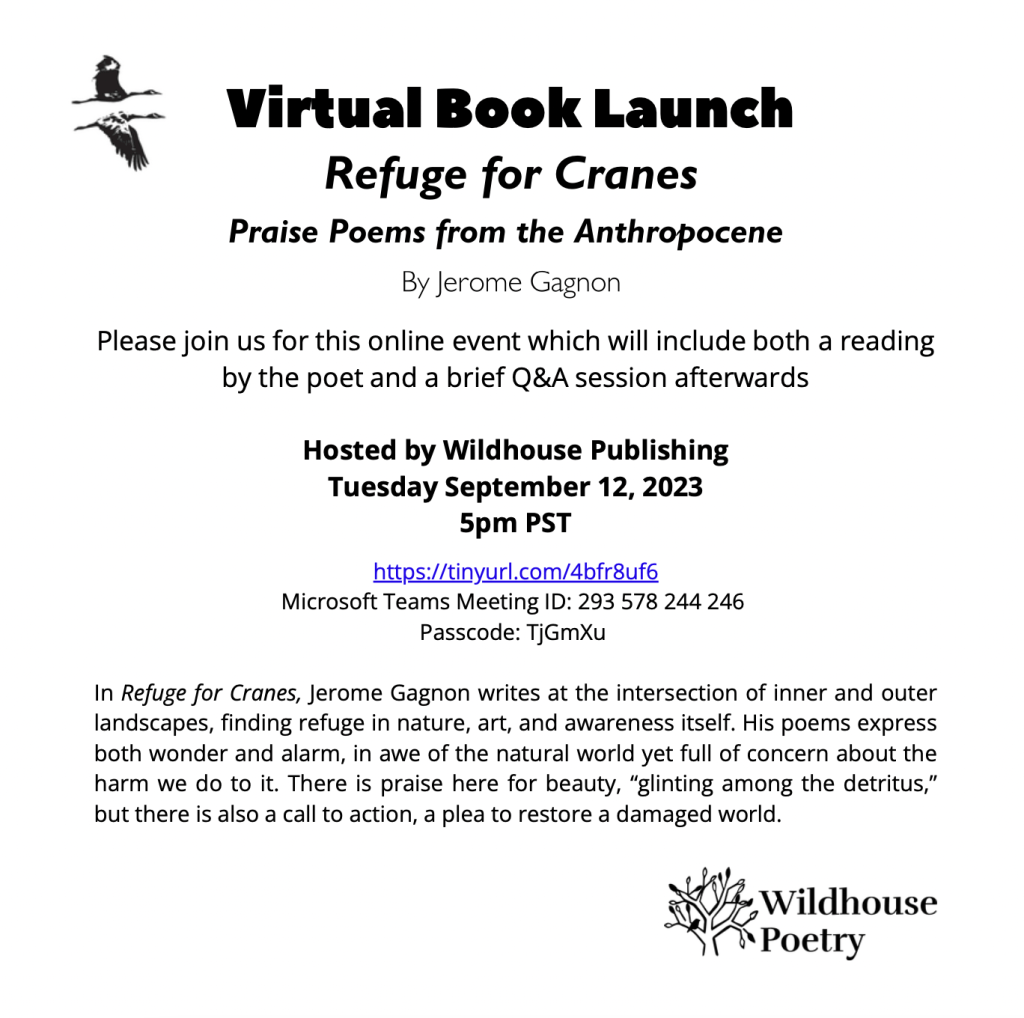
Book Launch September 12th

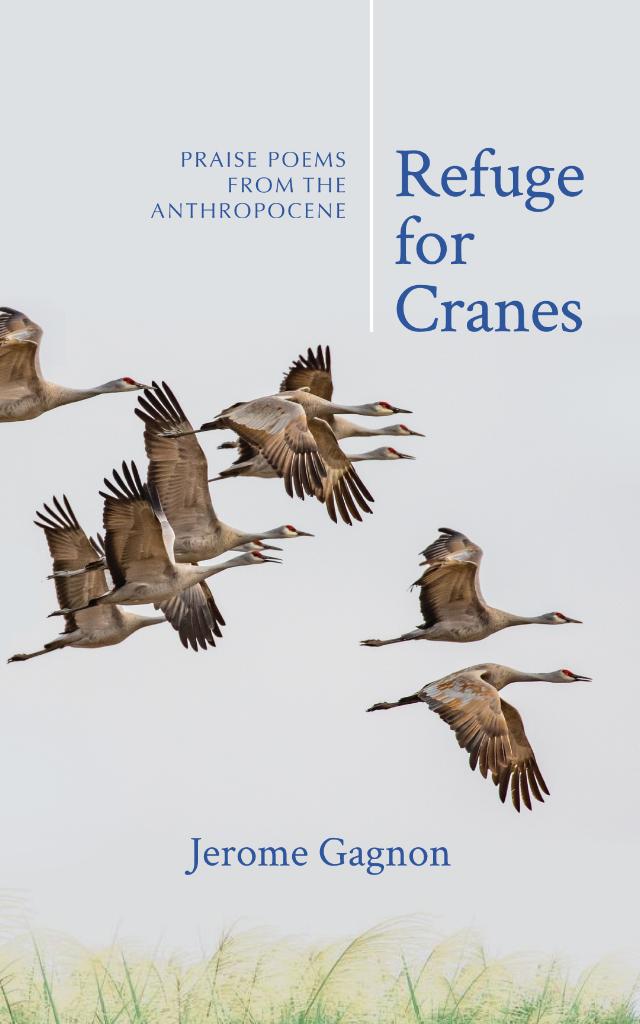
Refuge for Cranes will be available to order soon and looks wonderful (okay I may be biased). Thanks to Editor Mark S. Burrows for sheparding it through the editorial process, and to everyone at Wildhouse Publishing who helped to make this collection a reality. Thanks, also, to Design and Production Editor Melody Stanford Martin, who designed the beautiful cover with a photo of Sandhill Cranes in flight, and to Publicity Manager Molly Silverstein, who produced an awesome book trailer.

A virtual launch will take place via Zoom on September 12th at 8pm EST and at 5pm, PST. I’ll be reading a selection of poems from the book and answering questions afterward. I hope you can join me for this live online event but, if not, you can find a recording of it on the Wildhouse website shortly afterwards. Here’s the link to the Zoom launch:

Out of the Fog Podcast

An interview with podcaster Karen Hager will be released on September 12th (www.https://karenhager.com). I’ll be reading a few selections from Refuge for Cranes and we’ll talk about how the collection came together, how poetry can serve as an X-ray of the psyche, and ways to re-enchant ourselves with nature. Karen lived for many years in San Francisco where she began her popular series “Out of the Fog” while studying at Church Divinity School of the Pacific. She now makes her home in southeastern Michigan where she serves as an intuitive guide and teacher.

Contests

The Philip Levine Prize for Poetry, sponsored by California State University Fresno, is now open for submissions. The winner receives publication of a full-length manuscript (48-80 pages), an award of $1,000, and twenty-five author copies. Until September 30th. http://fresnostate.edu/levineprize

The New Women’s Voices Chapbook Contest, sponsored by Finishing Line Press, is open for submissions until September 15th. Winner receives a $1500 prize plus publication. http://finishinglinepress.com

One Page Poetry will award a prize of $2,000 and publication for a single poem. Until September 30th. http://onepagepoetry.com

Dzanc books will award a prize of $2,500 and publication for short story collection (minimum 40,000 words). By September 30th. http://dzancbooks.org

Refuge for Cranes due in early September

Refuge for Cranes: Praise Poems from the Anthropocene will be available from Wildhouse Publications early September. The poems range in topic from climate fires and the demise of bees to the “transparency of grace” and the “soul’s deep-down unfathoming.” There’s praise here for beauty “glinting among the detritus,” but there’s also a call to action, to restore a damaged world. Poet and author Angela Alaimo O’Donnell has written of the collection that “Refuge for Cranes plunges us wholly into the natural world through a series of poems that are equal parts celebratory, revelatory, and prophetic…Like the cranes that give the book its title, birds rumored to be immortal and wise, the poet bravely writes the truth he sees, “scratching our message to this passing world.”  

Selections from Refuge for Cranes: “Earthbytes”

This poem was a conscious attempt to express the need for active involvement in the environmental crisis, without being “preachy.” I really wanted to write a poem that encourages commitment to conservation and mindful living. This isn’t necessarily that poem, but it’s a start. It began with a fragment of a line from several years ago, “like the bulb that from darkness emits the bloom,” and evolved from there. Yes, the current crisis is dire but I believe we can make a difference. It won’t be easy, but what’s the alternative?

Earthbytes

Perform your natural magic

like the bulb that emits the bloom.

Be in harmony with the brown bear,

the moon, and the music of reeds.

Restore the oceans and rivers,

the kelp forests, marshes and bays.

Repair the hives of bees

and the resting places of monarchs.

Embrace the other, brother and sister.

See no one and nothing as the enemy.

Notice this place as if for the first time

as if it was your own skin, your own bones —

draw strength here, and return it.

                  –  jg